

swing door
Professional science popularization of swing doors | Full analysis of structure classification, profile parameters, sealing hardware, installation acceptance, and purchase of pit avoidance
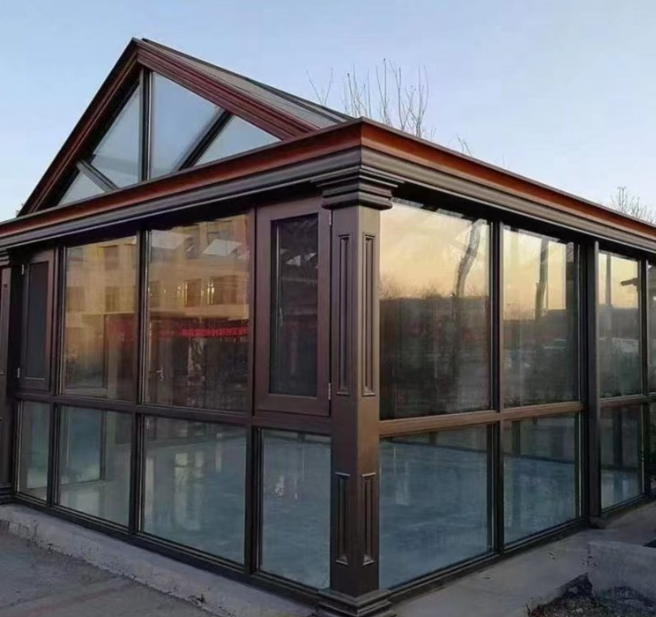
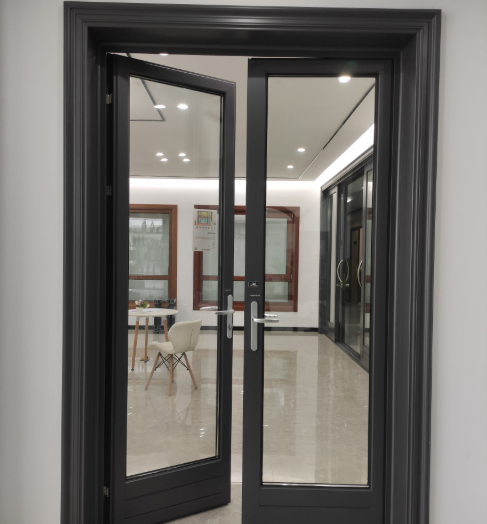
[Real picture of home improvement broken bridge aluminum swing door, balcony swing door, bathroom swing door, kitchen minimalist swing door combination real shot, simple and transparent lines]
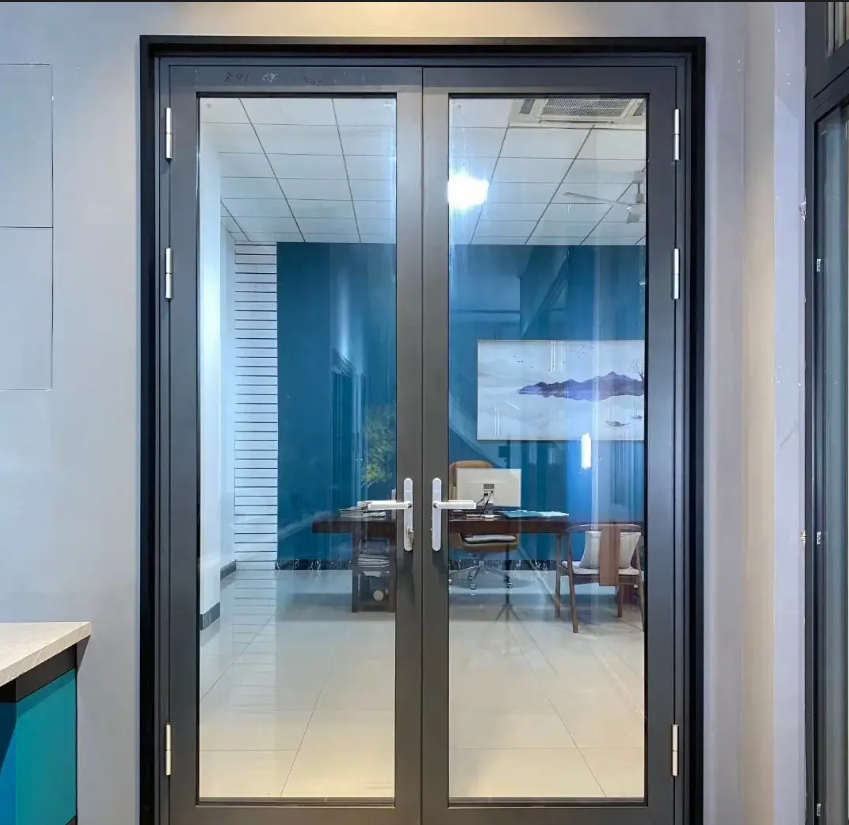
In home decoration, villa decoration and engineering projects, swing doors are the most widely used category of products, covering balcony swing doors, kitchen swing doors, bathroom swing doors, room partition swing doors, entrance swing doors, etc. Many consumers only pay attention to appearance, color and price when purchasing swing doors, and rarely have a deep understanding of the structural principle of swing doors, profile standards, sealing system, hardware load-bearing, opening direction, waterproof structure and other core professional indicators. After the installation is completed, a series of problems such as abnormal switch noises, sagging door fans, air leakage and water leakage in gaps, lax sealing, broken hardware, push-pull cards, etc., and maintenance and replacement costs remain high.
Swing doors are different from sliding doors, folding doors, and lifting doors. They rely on hinges to realize the rotation and opening of the door leaf. They have the inherent advantages of good sealing, strong sound insulation effect, and tight closure. However, they are also products that require extremely high standards for hardware, profiles, processing accuracy, and installation level. This article systematically explains the classification of swing doors, profile materials, structural parameters, sealing systems, hardware accessories, glass configuration, surface technology, installation specifications, acceptance standards, and key points for purchasing and avoiding pits. It takes into account professional depth and popular readability. It is suitable for decoration owners, decoration companies, door and window dealers, and engineering procurement. Read reference.
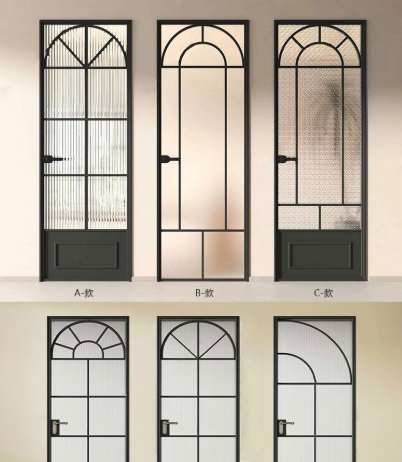
[Style classification chart | Single swing door, folio swing door, child and mother swing door, narrow-sided minimalist swing door, bathroom Changhong glass swing door displayed side by side]
First, the basic definition and mainstream classification of swing doors, different styles of applicable scenarios
Swing door refers to the door leaf connected to the side of the door frame through hinges (hinges), and the door body structure rotates inward or outward with the hinge as the axis. According to the opening direction, it can be divided into inner opening swing door and outer opening swing door. According to the combination form of door leaf, it can be divided into single door, opposite door, and mother and child door, which are also the three most mainstream structures in the market.
Single swing door: Single door fan with unilateral hinge, flexible opening, door opening width is generally between 600mm - 900mm, mostly used in bathrooms, kitchens, small balconies, indoor compartments. Single door occupies indoor opening space. When purchasing, you need to pay attention in advance to whether the direction of opening the door will collide with cabinets, sanitary ware, and furniture.
Folio casement door: The two doors are symmetrically arranged, open in both directions or in the same direction, with a large width of the door opening, with a conventional width of 1200mm-2400mm. It is mostly used for large balconies, large hole partitions, shop entrances, and villa entry positions. The atmosphere is transparent and the passage space is sufficient.
Swing doors for children and mothers: a combination of large and small doors, only small doors can be opened for daily traffic, large and small doors can be opened at the same time when handling large pieces of furniture and equipment, taking into account the needs of daily use and large handling. The width of the hole is mostly 1000mm-1500mm, and it is used more in balconies and entry areas.
If divided according to the material, the current market mainstream is divided into broken bridge aluminum casement doors, aluminum alloy narrow side casement doors, and aluminum-wood composite casement doors. Broken bridge aluminum casement doors have a thermal insulation structure and strong thermal insulation and sound insulation performance, suitable for balconies and outdoor casement doors; narrow-sided aluminum alloy casement doors have no broken bridge structure, focusing on minimalist appearance, and are mostly used for indoor kitchen and bathroom partitions; aluminum-wood composite casement doors are made of wood on the inside and aluminum on the outside, taking into account the wood feel and outdoor weather resistance, and are mostly used in high-end villas.
Here is an important normative knowledge point: external casement doors are preferred for high-rise residences, but they must comply with property regulations; external doors of high-rise buildings cannot be opened outward to impact the fire escape, and many community fire codes prohibit external doors. It is necessary to check the property and fire protection requirements of the community in the early stage of purchase to avoid customization and installation.
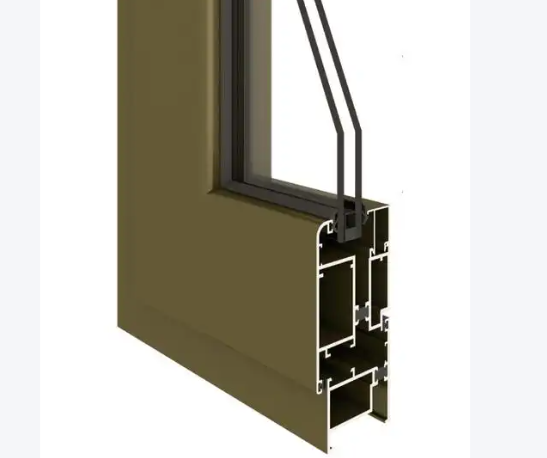
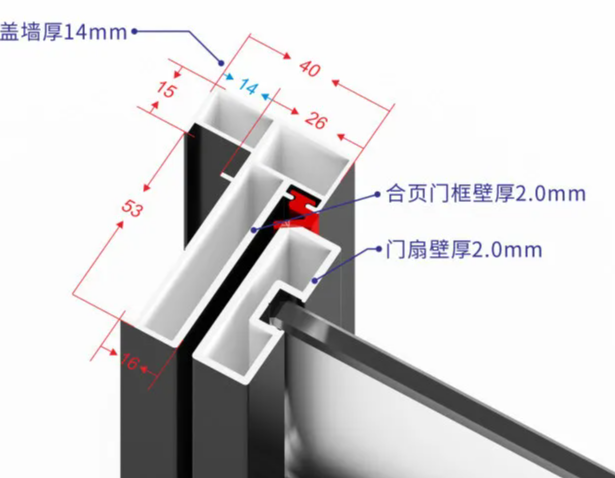
[Profile cross-sectional view | The cross-section of the broken bridge aluminum swing door profile is enlarged, and the wall thickness of the main profile, heat insulation strip, sealing tape, and cavity structure are marked]
Second, swing door profile material, wall thickness standard and cavity structure analysis
6063-T5 aluminum-magnesium-silicon alloy primary aluminum is generally used as the base material for aluminum alloy swing doors on the market, which is stable in extrusion molding, high in strength, good in toughness, and uniform in surface color. Low-priced products will use recycled recycled aluminum, which has high impurity content, high brittleness of the profile, easy to twist and deform after stress, and easy to peel and crack in the spraying layer. Regular manufacturers prefer primary 6063-T5 aluminum.
The wall thickness of the profile is the core indicator of the safety of the swing door, and it is also the hardest hit area for merchants to reduce their distribution. According to the national standard of GB/T 8478 "Aluminum Alloy Doors and Windows", the wall thickness of the main profile of the outer swing door shall not be less than 1.8mm; the force on the indoor partition swing door is small, and the minimum national standard is 1.4mm; for large-size doors, ultra-high door fans, and large-area glass door fans, it is recommended to increase the wall thickness to 2.0mm and above. The larger the door leaf and the heavier the glass, the higher the rigidity requirements for the profile. If the wall thickness is falsely marked, and the door leaf presses the hinge with its own weight for a long time, it is very easy to appear that the door leaf sags, the lock point is misplaced, and it is not tightly closed. Many merchants mark 1.8mm, but the actual real thickness is only 1.4mm or even
The cavity design of the broken bridge swing door also determines the performance. The simple single cavity profile has a simple structure, low cost, and weak sound insulation and drainage capabilities; the multi-cavity structure will divide the heat insulation cavity, drainage cavity, strengthening cavity, and buffer cavity. The isobaric cavity design is the highlight of the high-performance broken bridge swing door. Relying on the principle of air pressure balance, it blocks the rainwater from pouring into the room under the action of air pressure in rainstorm weather, which greatly improves the water tightness. The 55, 60, and 70 series broken bridge swing doors are commonly used on the market. The number represents the width of the frame profile (mm). The larger the series, the larger the cavity space, and can be matched with thicker glass and wider heat insulation strips. The upper limit of sound insulation is higher. But the larger the series, the better the quality. The rationality of the cavity design and the processing accuracy are far more important than the simple numbers.
Indoor narrow side swing door, profile frame width can be 10mm - 20mm very narrow frame, the pursuit of minimalist visual effect, most of these products do not have heat insulation strip, can only be used indoors, not suitable for outdoor balcony doors.
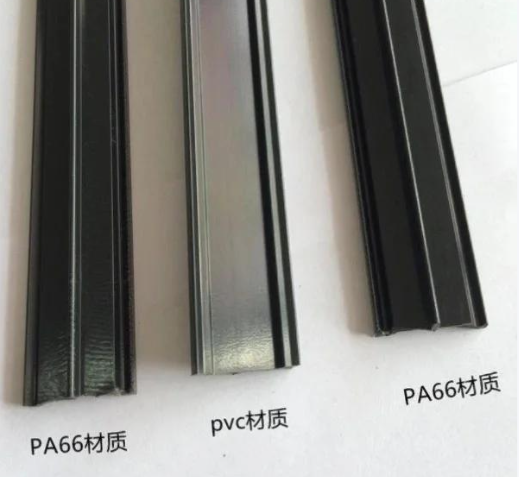
[Heat insulation strip comparison chart | PA66 nylon heat insulation strip and PVC heat insulation strip sample comparison, texture, hardness, combustion test comparison]
Third, the thermal insulation strip of the broken bridge swing door determines the thermal insulation performance and long-term stability
The thermal insulation strip is the core component of the broken bridge structure. Only the broken bridge swing door is equipped with thermal insulation strip, and the indoor narrow side swing door has no thermal insulation structure. The thermal insulation strip is divided into the national standard PA66 glass fiber reinforced nylon thermal insulation strip and the low-cost PVC plastic thermal insulation strip, and the cost and performance gap between the two is huge.
The material of the national standard thermal insulation strip is PA66 + 25% glass fiber, which has stable high temperature and low temperature resistance, and the thermal expansion coefficient is close to that of aluminum alloy. It will not shrink, expand, or remove grooves in a long-term alternating cold and hot environment, and is not easy to age and crack. It guarantees the long-term effectiveness of the broken bridge structure. The surface of the high-quality thermal insulation strip has a fine glass fiber texture, and the laser coding logo can be clearly checked.
PVC plastic thermal insulation strips feel smooth and soft, low cost, soften and deform after high temperature exposure, become brittle and crack in low temperature environment, shrink and fall off after two or three years of use, the broken bridge structure directly fails, the thermal insulation performance of doors and windows is greatly reduced, and the gap of the frame fan becomes larger, resulting in air leakage and water seepage. Many low-priced broken bridge casement doors rely on PVC thermal insulation strips to compress costs, which is a typical invisible reduction.
The width of the thermal insulation strip also affects the thermal insulation capacity. Under the premise of permitting the structure, the wider the thermal insulation strip, the lower the heat transfer coefficient K value, and the better the thermal insulation and energy saving effect. Ordinary broken bridge swing doors have a K value of mostly 2.8-3.5 W/(m2 · K). High-performance system swing doors with wide thermal insulation strips and multiple seals can achieve a K value within 2.0, and the energy saving effect is outstanding.
[Detail picture of sealing rubber strip | Close-up of the cross-section of EPDM rubber strip, comparison of co-extruded rubber strip and splicing rubber strip samples]
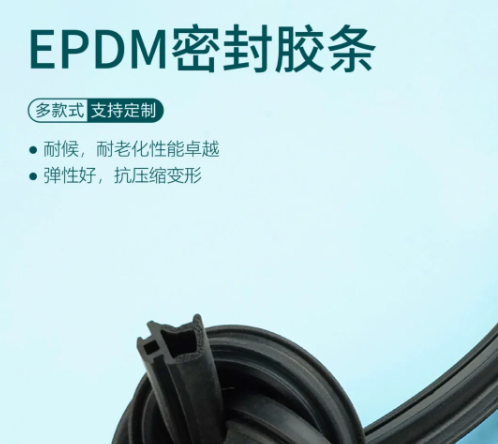
Fourth, the swing door sealing system: the key structure of airtight and watertight performance
The reason why the sound insulation and sealing effect of swing doors are better than that of sliding doors is the core advantage of the sealing system. Sealing relies on rubber strips to fill the gaps between the frame fans to isolate airflow, rain, dust and noise. The mainstream sealing rubber strip material in the industry is EPDM rubber, which is resistant to high and low temperatures, ozone aging, and has a normal service life of more than 15 years. The inferior rubber strips are made of recycled rubber, which has poor elasticity and hardens, cracks, and pulverizes in a short time, and the seal fails quickly.
According to the sealing level, it is divided into two seals and three seals. The two seals are the basic configuration, the first one blocks rain and dust, and the second one forms an airtight layer; the three seals add a buffer chamber to form three-dimensional protection, which has a higher level of airtightness and watertightness, and is mostly used for high-performance balcony swing doors. Many businesses promote four seals, but they simply superimpose rubber strips without matching isobaric drainage cavities. The drainage is not smooth, and the rainstorm environment is still seepage. Don't be blindly superstitious about the number of seals when purchasing.
The rubber strip process is divided into co-extrusion rubber strip and post-assembly splicing rubber strip. The co-extrusion rubber strip and the profile card slot are integrally formed, which fits tightly and is not easy to fall off; the weak point of the splicing rubber strip is at the joint position, and the joint of the rubber strip is prone to gaps, which is the high incidence of water seepage and air leakage. The high-quality swing door rubber strip joint adopts 45-degree diagonal hot joint, the gap is almost closed, and the sealing performance is far better than ordinary direct splicing.
The bottom seal of the swing door is a position that is easily overlooked. The bottom of the outer swing door has a threshold water retaining design, with a bottom rubber strip or an automatic lifting dust strip. When the door leaf is closed, the rubber strip falls to fit the threshold, and it is automatically retracted when opened to reduce friction, taking into account the smoothness of sealing and switching; the threshold of the indoor bathroom swing door is generally designed with a short or no threshold, focusing on waterproof water conduction to avoid stagnant water pouring back into the room.
[Real pictures of hardware accessories | Close-up of heavy-duty hinges, multi-point lock actuators, lock boxes, and anti-fall ropes to distinguish between domestic high-quality and imported hardware]
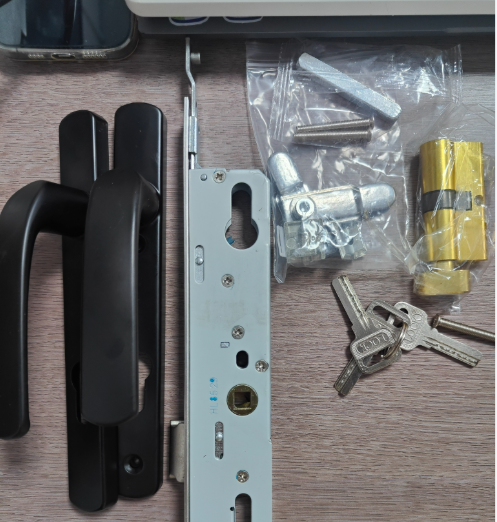
Five, swing door hardware system: the load-bearing core of the door leaf determines the service life
The hardware is called the "joint" of the swing door, and it is also the part that is most easily overlooked by the owner. The swing door hardware includes hinges (hinges), multi-point lock actuators, lock points, lock boxes, handles, and anti-falling ropes. For external swing doors, the anti-falling rope is a safety mandatory accessory to prevent the door leaf from falling due to the failure of the hinge. The high-rise external door must be installed.
Hinges are divided into ordinary hinges and heavy-duty invisible hinges. The larger the weight of a single door leaf, the higher the requirements for the load-bearing grade of the hinge. Conventional glass door leaf single weight within 40kg, choose a single load-bearing 80kg hinge; large-area laminated glass, ultra-high door leaf, single weight more than 60kg, must be equipped with heavy-duty hinges, multi-hinges scattered load-bearing. Hinge substrate 304 stainless steel or zinc alloy thickened substrate is preferred, and the surface is anti-corrosion treated; low-cost hinges are die-cast with thin iron sheet, which is insufficient load-bearing, long-term use wear and rust, door leaf sagging, lock point dislocation, switch card.
Swing doors are divided into single-point locks and multi-point locks. Single-point locks have only one lock point, which is only suitable for indoor lightweight partition doors; balcony open doors recommend multi-point locking systems, with multiple lock points distributed up and down the door leaf. When closing, the rubber strip is pressed synchronously. The frame fan is evenly stressed, tightly sealed, and has stronger wind pressure resistance. It is not easy to shake and leak in windy weather.
Handles are rich in styles, divided into square shaft handles and minimalist hidden handles. In terms of hardware brand selection, there are German Haobo and Gewu imported, and domestic first-line brands also have stable quality. When purchasing, you must match the hardware load-bearing specifications according to the size of the door leaf and the weight of the glass, and cannot uniformly match light hardware.
[Schematic diagram of glass structure | Disassembly diagram of tempered insulating glass and laminated glass, marked with butyl glue, structural glue, desiccant, aluminum spacer]
Six, swing door glass configuration: the carrier of sound insulation, thermal insulation, and safety performance
Most of the area of the swing door door leaf is composed of glass, and the glass configuration directly affects the sound insulation, thermal insulation and safety performance of the whole door. Tempered glass is used in the mainstream of home improvement swing doors. According to the specification, glass with an area greater than 0.5 square meters must use 3C certified tempered glass to prevent sharp and large pieces from being broken and hurting people. Bathroom swing doors are often made of Changhong glass, oil sand glass, and frosted glass, taking into account light transmission and privacy.
Basic configuration: 5 + 12A + 5 double tempered insulating glass, suitable for indoor partitions and low-rise balconies;
Upgraded energy-saving model: 5 + 20A + 5 high-transparency Low-E insulating glass, Low-E film reflects infrared heat, blocks outdoor heat radiation in summer, and retains indoor heat in winter. It is suitable for opening doors outside balconies and reducing air-conditioning heating energy consumption;
Street noise scene: 5 + 0.76PVB + 5 laminated insulating glass, laminated layer can effectively weaken low-frequency noise, sound insulation effect is significantly better than ordinary insulating glass.
Insulating glass focuses on the two-way sealing process: the inner layer of butyl rubber blocks the penetration of water vapor, and the outer layer of structural glue guarantees the bonding strength. Small workshops only use a single layer of glue, and the water vapor slowly enters the hollow layer. The inside of the glass is fogged and white, which cannot be repaired, and can only be replaced in one piece. The hollow layer of high-end system swing doors can be filled with argon gas, which further reduces the heat transfer coefficient and improves the performance of sound insulation and insulation.
[Profile surface treatment sample diagram | Electrostatic powder spraying, fluorocarbon spraying, wood grain transfer, anodizing sample comparison]
Seven, profile surface treatment process, determine the appearance of weather resistance
The surface treatment of aluminum alloy swing doors plays a decorative role on the one hand, and on the other hand protects the aluminum substrate and delays oxidative corrosion. There are four mainstream processes on the market:
Electrostatic powder spraying: the highest market penetration rate, rich color selection, high cost performance, strong coating adhesion, can be used indoors and outdoors, high-quality outdoor powder can withstand more than 10 years of weather; inferior recycled powder is prone to fading and pulverization.
Fluorocarbon spraying (PVDF): UV resistance, acid rain resistance, salt spray resistance is the strongest, the first choice for seaside, open-air balconies, outdoor high-corrosion environments, higher cost, long-term sun exposure is not easy to change color.
Wood grain transfer: simulates the texture of logs, with a warm texture, mostly used for indoor kitchens and room partitions; outdoor wood grain models must use fluorocarbon-based wood grain, and ordinary powder wood grain will fade in two or three years outdoors.
Anodizing: forms a natural oxide protective film, matte metallic texture, wear resistance, but few color options.
It is necessary to avoid the cheap painting process. The adhesion of ordinary paint is poor, the skin peels off quickly in the wind and the sun, and the later maintenance is difficult. Many indoor very narrow swing doors use sandblasting and anodizing matte processes, which fit the minimalist decoration style