

Industrial swing door
Industrial swing door professional detailed explanation: classification, parameters, material selection, installation acceptance and selection guide
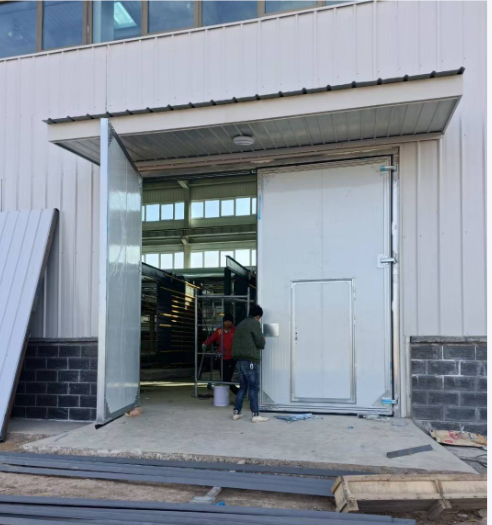
(The overall completion picture of the industrial swing door in the factory workshop, multiple swing doors for the start-up industry, and supporting the outer wall of the factory)
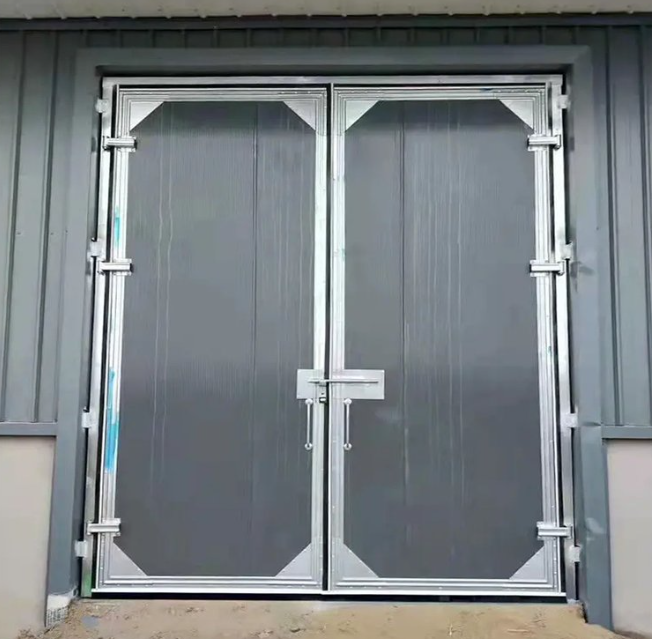
Industrial swing doors are a special category of products widely used in industrial plants, warehouses, workshops, machine rooms, cold storage, fire escapes, equipment rooms and other places. Different from home improvement indoor swing doors and villa entry doors, it is a heavy-duty category specially designed according to industrial use conditions. It bears industrial requirements such as high-frequency switches, large hole access, dust insulation, airtight isolation, anti-collision and durability. Many purchasers easily confuse industrial swing doors with ordinary commercial swing doors. In fact, industrial swing doors have independent industry standards in profile structure, plate thickness, hinge load-bearing, sealing system, and impact resistance.
The industrial swing door can be opened single and folio, with flexible opening direction, can be opened inward or outward, and can be adapted to forklifts, trolleys, personnel, and small equipment. With the advantages of moderate cost, simple installation, low failure rate, and convenient later maintenance, it has become a popular choice for factory renovation and new plant projects. This paper systematically explains professional knowledge from the definition and classification of industrial swing doors, structural parameters, material selection, sealing and matching, hardware system, construction and installation, acceptance standards, maintenance, procurement pit avoidance, etc., taking into account project procurement, plant person in charge, door and window engineering
(Schematic diagram of the cross-sectional structure of the industrial swing door, marked with door leaf panel, keel, filling, door frame, hinge, sealing strip)
First, the applicable scenarios and core function positioning of industrial swing doors
The core positioning of industrial swing doors is the separation and enclosure of industrial buildings. The core appeal is not decorative effect, but practicality, durability, airtightness and traffic reliability. Home improvement doors value appearance, and industrial doors prioritize working conditions.
Mainstream application scenarios include: steel structure production workshop doors, raw material warehouses, finished product warehouses, power distribution rooms, pump rooms, auxiliary doors of clean workshops, cold storage buffers, constant temperature workshops, hazardous chemicals storage rooms, factory doorman passages, fire evacuation passages, garbage stations, breeding plants, etc.
According to the functional breakdown, industrial swing doors can be divided into ordinary passable models, thermal insulation airtight models, clean and dustproof models, fireproof models, explosion-proof models, and cold storage insulation models. Standard models are used for ordinary workshop personnel; food and medicine clean workshops need to be equipped with silicone rubber seals and dust-free flat panels; cold storage doors focus on controlling thermal insulation coefficients; fire escape industrial swing doors must meet fire protection codes and meet evacuation opening requirements.
Compared with industrial lift doors, sliding doors, and fast rolling shutter doors, industrial swing doors have the advantages of low cost, no need for complex motor control systems, and can be opened manually after power failure, making maintenance simple. The shortcoming is that opening will occupy the space in front of the door, and it is not suitable when the opening is too large. Generally, the maximum width of a conventional single fan is within 1.5m. Lifting doors are preferred for oversized openings. Therefore, the first step in selection is to confirm whether there is enough door-opening swing space in front of the door to avoid hitting shelves and forklifts when the door leaf is opened after installation.
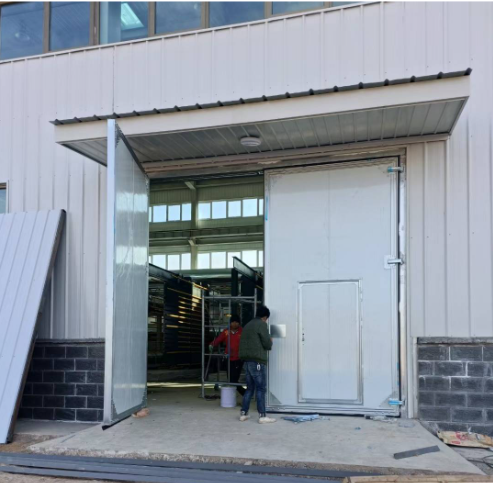
(Real shot of the opening state of the industrial swing door in the workshop, forklift traffic scene)
Mainstream classification and specification parameters of industrial swing doors
According to the structure, material and function, industrial swing doors are divided into several categories, and the basic parameters of different categories vary widely, which is also the most prone to errors in bidding and procurement.
Color steel sandwich panel industrial swing door (the most common in the market)
Core material Common EPS polystyrene board, rock wool, polyurethane PU. Conventional plate total thickness 50mm, 75mm, 100mm. Color steel plate substrate thickness: panel 0.4mm - 0.6mm color coated board, back plate 0.3 - 0.5mm. Rock wool models have flame retardant and fireproof properties, and are mostly used in workshops with high fire protection requirements; polyurethane PU core material has the best thermal insulation performance and is suitable for constant temperature and cold storage buffer rooms. Conventional single fan size: width 700 - 1500mm, height 2000 - 3000mm, support non-standard customization.
Steel industrial swing door (steel whole plate welded door)
The door leaf is formed by bending cold-rolled steel plate, reinforced with internal square tube keel, without sandwich or filled with fireproof rock wool, the thickness of the steel plate is 1.0-1.5mm for the door leaf panel and 1.5-2.0mm for the door frame. The overall strength is extremely high, and it is resistant to impact. It is suitable for heavy-duty, heavy-duty equipment workshops, and hazardous chemical warehouses.
Aluminum alloy industrial swing door
6063-T5 aluminum alloy profile frame, with insulating glass, aluminum honeycomb panel or color steel panel, light weight, not easy to rust, wet workshop, sewage treatment plant, chemical industry area preferred, strong anti-corrosion ability.
Stainless steel industrial swing door (201/304 stainless steel)
304 stainless steel is the first choice for humid and corrosive environments. It is resistant to water vapor and acid and alkali in food factories, slaughtering workshops, sewage treatment stations, and coastal plants. 201 stainless steel is cost-effective and dry for use in ordinary warehouses. It is prone to rust in long-term humid environments.
Clean and closed industrial swing door
Commonly used in dust-free workshops and laboratories, the surface of the door leaf is flat without exposed screws, the arc is closed, and the seamless design is matched with thickened silicone rubber one-piece sealing strips to reduce dust accumulation and facilitate cleaning and disinfection.
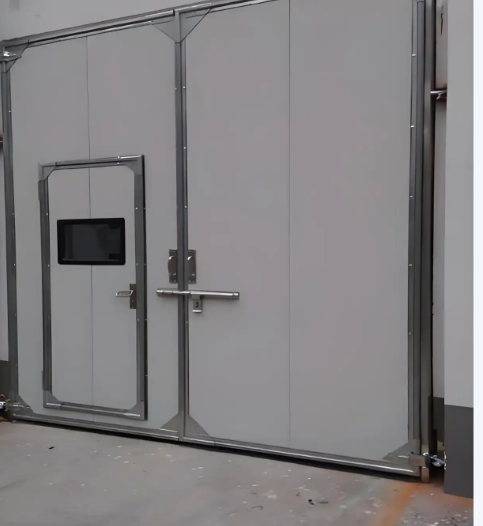
Opening form: single-opening swing door, folio swing door, mother-and-child industrial swing door. The mother-and-child door is suitable for people walking at ordinary times, and the whole fan is open when large goods pass.
(Color steel sandwich door, steel door, stainless steel clean industrial swing door side by side comparison real shot)
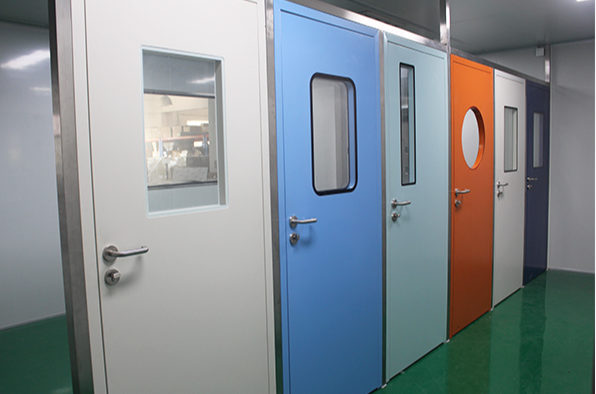
Third, the main material analysis of industrial swing doors, the material directly determines the service life
3.1 Door leaf panel
Color coated steel plate: surface polyester coating, weather resistance, color can choose white gray, blue, gray, the most cost-effective; inferior color steel plate coating is thin, fading and peeling in 1-2 years;
Cold-rolled steel plate: high strength, welding forming, surface spraying epoxy primer + topcoat, spraying process is not in place and easy to rust;
Stainless steel plate: 304 has far better anti-rust performance than 201. The purchase must state the material grade in the contract. Many merchants use 201 as 304;
Aluminum honeycomb panel: high flatness, lightweight, clean workshop use, not easy to deform.
3.2 Door core filling material
EPS foam: well-insulated, low-priced, flammable, and high fire protection requirements are prohibited from being used alone;
Rock wool: A-class flame retardant, excellent fire performance, large weight, and heat preservation decreases after moisture absorption;
Polyurethane PU: low thermal conductivity, the best thermal insulation effect, closed-cell structure does not absorb water, cold storage, constant temperature workshop preferred;
Glass wool: fireproof insulation, mostly used for sound insulation doors in computer rooms.
3.3 Door frame material
Common galvanized square pipe door frames, color steel bending door frames, stainless steel door frames. Galvanized square pipe door frames have the best stability and are not easy to deform. Thick-walled square pipe door frames are the best choice for industrial doors; thin-walled bending door frames are cheap, and large-size door leaves are easy to distort and deform when switched on and off for a long time.
(Close-up of the cutting sample of the internal keel and sandwich core material of the door leaf)
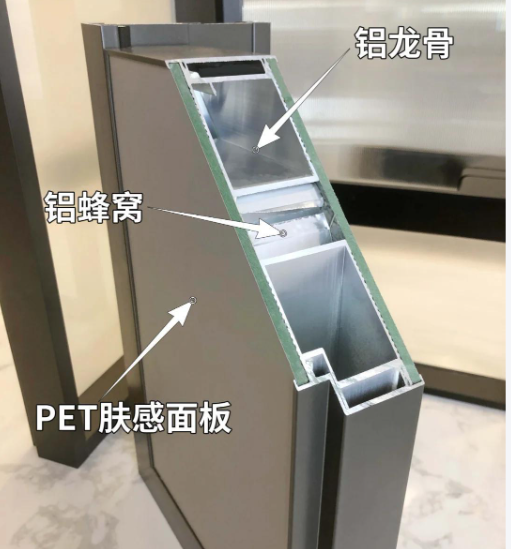
Fourth, the core hardware accessories of industrial swing doors, the most easily overlooked key points of industrial doors
The hardware load of home improvement doors is small, and industrial swing doors are repeatedly switched on and off dozens or hundreds of times a day. Hardware is the core of wear and tear. Many doors are not broken panels, but hinges and locks that fail first.
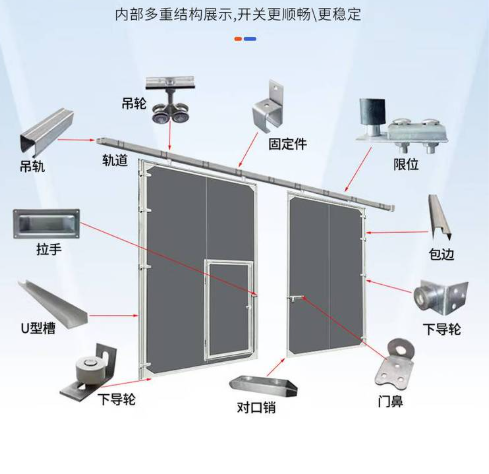
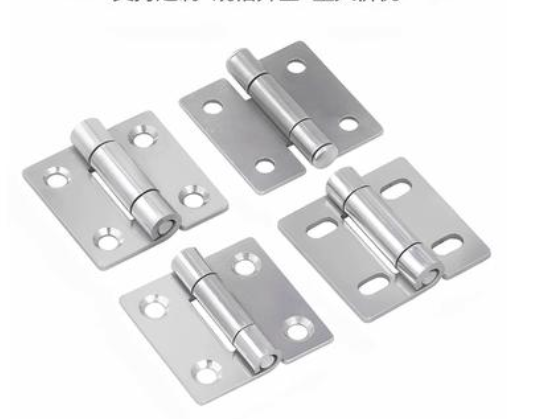
Heavy-duty hinges (hinges): divided into ordinary hinges, load-bearing hinges, and stainless steel load-bearing hinges. 2 hinges are selected for light door leaves; 3 load-bearing hinges are required for steel doors and stainless steel doors with a height of more than 2.4m and a large weight. Inferior ordinary hinges long-term high-frequency switches are easy to sink, the door leaf sags and rubs against the ground, and the door is not tightly closed. Heavy-duty industrial doors are preferably thickened with 304 bearing hinges, which are stable in load-bearing and silent in rotation.
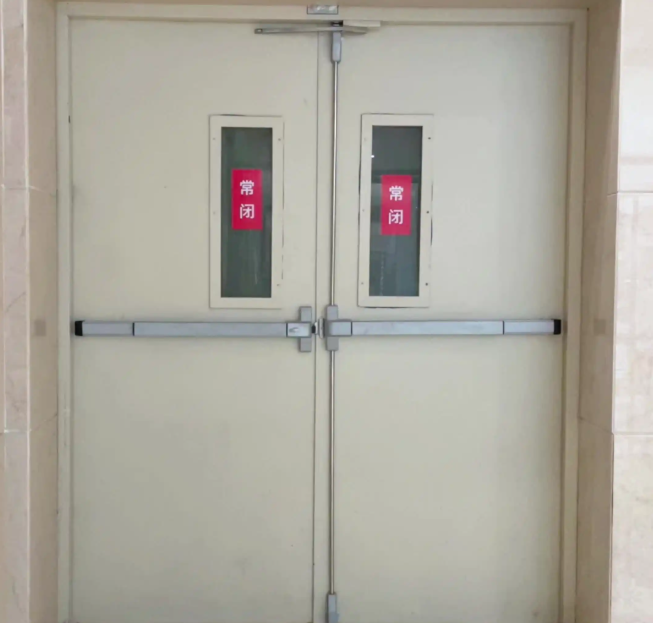
Industrial locks: channel locks, escape push bar locks, spherical locks, clean door sealing locks. Industrial swing doors for fire evacuation channels require escape push bar locks, which are directly pushed open without a key to meet fire evacuation specifications; ordinary warehouse doors use anti-theft channel locks; clean doors use arc embedded locks, no bulges and no dust accumulation.
Door suction and door stop: Factory forklifts frequently enter and exit, and ordinary magnetic door suction is easily damaged. Industrial scenes prioritize anti-collision rubber door stops and ground-mounted door blocks to prevent forklifts from hitting the door after it is opened.
Sealing strip: EPDM EPDM sealing strip, silicone rubber sealing strip, one-piece surround seal. Double-channel sealing is used in cold storage and constant temperature workshop. The aging and hard sealing strip is the main reason for air leakage, condensation and dust to enter the workshop. PVC sealing strip is low-priced but has a short life. It hardens and cracks in 1-2 years. It is not recommended for long-term industrial use.
Anti-collision corner wrap, anti-collision plate: metal anti-collision corner guard is installed at the door of the warehouse to avoid the forklift directly hitting the corner of the door leaf and prolong the life of the door body.
(Close-up of heavy-duty bearing hinges, escape push bar locks, one-piece sealing strips, rubber door stop accessories)
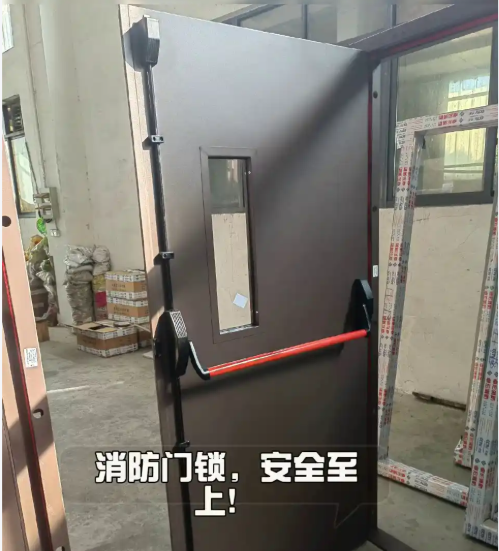
Five, industrial swing door waterproof, airtight, thermal insulation structure design points
The design focus of industrial casement doors lies in the sealing pressure relief structure between the door frame and the wall, the door leaf and the door frame. After many factory doors are installed, air leakage, water seepage, and mosquitoes fly in are all structural design defects.
The wall hole is generally a brick wall, a color steel envelope, and a light steel wall. The door frame and the wall gap are filled with foam insulation inside, and the outside is closed with weather-resistant sealant. Like home improvement doors, it is forbidden to expose the foaming agent directly as a waterproof layer.
The thermal insulation type industrial swing door will be equipped with a heat insulation structure to block the cold bridge. If there is no heat insulation design, the door frame position in winter is prone to condensation and dripping, and the cold storage door has very strict requirements for the heat insulation structure.
The clean door is made of circular arc corners without right-angle grooves, making it difficult to accumulate dust, which is convenient for rinsing, disinfection and sterilization. The door body of the food factory requires resistance to disinfectant corrosion, and the rubber strip can be disassembled and replaced for regular cleaning.
In addition, high-humidity workshops and cold storage doors will be equipped with drainage holes, and drainage channels will be reserved at the bottom of the door frame to avoid water accumulation in the sealing tank and accelerate the decay of the core material and the aging of the sealing strip.
(Sectional view of the door frame sealing node, marked with heat insulation strip, sealing rubber strip, drainage hole)
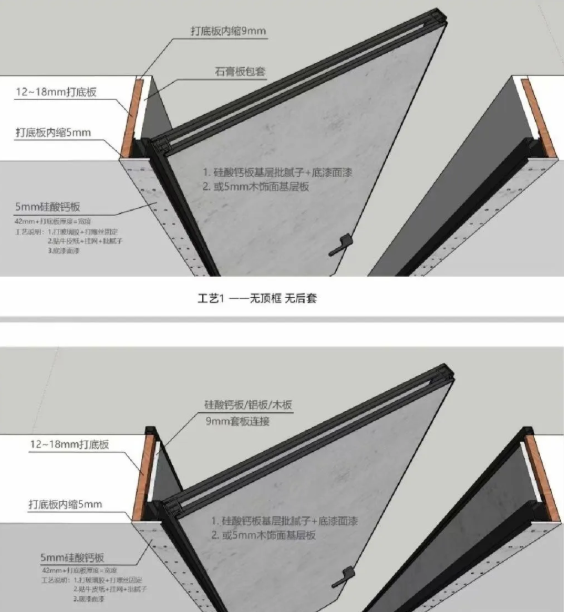
Standardized installation and construction process and control points for industrial swing doors
The installation quality of industrial swing doors directly affects whether the switch is smooth and the seal is tight. Industrial walls are divided into brick-concrete openings and color steel enclosure openings, and the two installation methods are different.
Step 1: Review the measurement of the opening. Measure the width and height of the opening, check the thickness of the wall, and check whether the opening is square. If the opening is too skewed, repair it in advance, and do not force the door. Otherwise, the door leaf closing gap is large on one side and small on the other. Distinguish between three installation methods: exterior, interior, and middle.
Step 2: The door frame is pre-installed and leveled. The door frame is put into the hole, and the wooden wedge is padded to adjust the horizontal and vertical. The diagonal error is controlled within the specification. The distortion of the door frame will directly cause the door leaf to sink and get stuck.
Step 3: Fix the door frame. The brick-concrete wall is fixed with expansion bolts; the color steel light steel wall needs to be lined with reinforced square pipes. It cannot be directly locked on the thin color steel plate with self-tapping screws, which are easy to loosen and fall off. The fixed points are evenly distributed, and there must be fixed points up and down and in the middle, not just the two ends.
Step 4: Fill the gap. Fill the gap between the frame walls with polyurethane foam, cut the excess part after the foam solidifies, and apply weather-resistant sealant on the inside and outside. The glue seam is continuous, without breakpoints, and without bubbles.
Step 5: Hang the door leaf and debug the hinge. After installing the door leaf, repeatedly debug the hinge gap to ensure that the door leaf switch is not stuck, the gap around is uniform after closing, and the sealing strip is evenly pressed, and cannot be partially crushed or partially suspended.
Step 6: Install locks, door stops, anti-collision corner guards, test opening and locking, and clean up protective films and construction waste.
Key taboos: Do not tear off the protective film immediately after installation. There are many cross-operations in factory construction. The protective film can prevent welding sparks, paint, and forklifts from scratching the door panel. Tear the film before the overall completion acceptance.
(The master leveled the industrial swing door frame and expansion bolt fixing construction on site)
Seven, industrial swing door acceptance inspection project
Acceptance is divided into data verification and on-site physical acceptance. The project must be implemented to avoid rework after delivery.
In terms of information: plate material certificate, core material test report, fire door requires fire inspection certificate and hardware certificate.
On-site acceptance inspection items:
Appearance: The door panel has no bumping depression, coating scratches, the paint surface is sprayed evenly, and the sealant is smooth without cracking;
Opening test: The door leaf opens smoothly, without card, without self-opening and self-closing, and the gap is uniform after closing;
Sealing inspection: After closing, the rubber strip is fitted around, and there is no obvious light transmission gap;
Lock test: the escape lock and channel lock switch are normal, and the fire push bar lock is pressed and opened smoothly;
Firmness: door frame without shaking, hinge fixing screw without loosening;
Fire door special project: fire seal complete, fire signs complete, to meet fire requirements.
For thermal insulation and cleaning projects, simple testing can be done: close the door and observe the infiltration of indoor dust and hot and cold air. If possible, thermal imaging can be used to check the location of the cold bridge.
(Acceptance personnel check the gap of the industrial swing door and test the actual picture of the escape push bar lock)
Eight, industrial swing door daily maintenance and troubleshooting
Industrial swing doors belong to the category of high-frequency loss, simple regular maintenance, and can multiply the service life.
Hinged bearings: add a small amount of silicone grease every 3-6 months, do not use oil, it is easy to absorb dust to form sludge, and the rotation is getting more and more stuck;
Sealing strip: regular wiping, timely replacement of hardening, cracking, shrinking, and falling off is the most cost-effective item in maintenance;
Lock: regularly clean the lock hole dust, a small amount of lubrication, and the key is inserted and unplugged smoothly; the escape push bar lock is strictly prohibited from being disassembled and changed without permission, and belongs to fire protection parts;
Cleaning: Color steel and stainless steel door fans are wiped with neutral detergent, and the coating should not be rinsed with strong acid and alkali;
Anti-collision inspection: Door stops and anti-collision corners are strengthened in a timely manner. Forklift impact is the leading cause of damage to industrial doors.
Simple judgment of common faults:
The door leaf sinks and rubs against the ground: most of them are loose hinges or insufficient hinges, tighten screws or replace heavy hinges;
The door is not closed tightly, air leakage: the rubber strip is aging or the door frame is deformed;
Switch card: hinge oil shortage, door frame shift.
Reminder: Fire-fighting industrial fire-proof swing doors cannot be cut, opened, or replaced at will. After modification, the fire protection fails and cannot be accepted.
(Maintenance master overhauls industrial swing door hinges and replaces sealing strips)
Nine, industrial swing door procurement selection pit avoidance guide
The market price difference of industrial swing doors is very large, and many purchases only compare the appearance, ignoring the internal configuration. Common pit points are sorted out:
Virtual label plate thickness: 0.6 color steel plate is marked, and the actual 0.35 thin substrate looks the same in the short term, and it is easy to sag and deform;
Material pretending: 201 stainless steel pretending to be 304, rusting in humid environment for half a year; ordinary EPS pretending to be flame retardant rock wool;
Hardware reduction: Replace the industrial load-bearing hinge with a light home improvement hinge, and the door leaf sags quickly; do not match the escape lock to deal with the fire escape;
Does not distinguish between wall working conditions: color steel thin wall without lining reinforcement, door frame later loose;
Ignore the use of the environment: cold storage with ordinary EPS doors, serious condensation; acid and alkali workshop with ordinary color steel doors, rapid corrosion;
The quotation does not include matching: only the price of the door leaf is quoted, and the price of the door frame, anti-collision corner protectors, and transportation and installation is increased separately.
Selection summary: ordinary dry warehouse chooses color steel EPS sandwich door; fire truck chooses rock wool sandwich door; food factory, humid area chooses 304 stainless steel door; cold storage, constant temperature workshop chooses polyurethane thermal insulation closed door; fire evacuation channel must be equipped with qualified escape push bar lock. The purchase contract states the thickness of the plate, the type of core material, the material grade, and the hardware specifications as the basis for acceptance.
(Real pictures of industrial swing door finished product yard, loading and delivery)
Summary
Industrial swing doors may seem simple in structure, but they are a special category suitable for the harsh working conditions of factories. They have completely different design logic from home improvement doors and commercial doors. The core values are load-bearing, anti-collision, airtight, durable, and suitable for industrial environments. From color steel sandwich models, steel doors, stainless steel clean doors to fire insulation doors, different categories correspond to different workshop needs.
A set of qualified industrial swing doors is not just a door panel and a door frame, but also requires reasonable structural design, up-to-standard plates, heavy industrial hardware, and standardized installation and fixation. Factory procurement selection should not blindly lower the price. Priority should be given to combining the workshop environment, fire protection requirements, traffic methods, and forklift usage matching plans to control the thickness of the board, core material, sealing system, and hinge locks, and do a good job of regular maintenance in the later stage.
In many industrial categories, industrial swing doors have long been the mainstream choice for plant renovation, warehouse, and machine room projects due to their advantages of low failure rate, motor-free, and easy maintenance. Reasonable selection and standardized construction can ensure long-term stability and meet the needs of workshop isolation, heat preservation, dust protection, and safe evacuation.