

Wardrobe swing door
Professional in-depth analysis of wardrobe swing doors | Full guide to profile, plate, hinge, sealing, installation selection
[The real scene of the swing door of the wardrobe, the floor renderings of the swing door of the modern minimalist, simple European, and new Chinese wardrobe, the styles of single door, opposite door, and mother and child door]
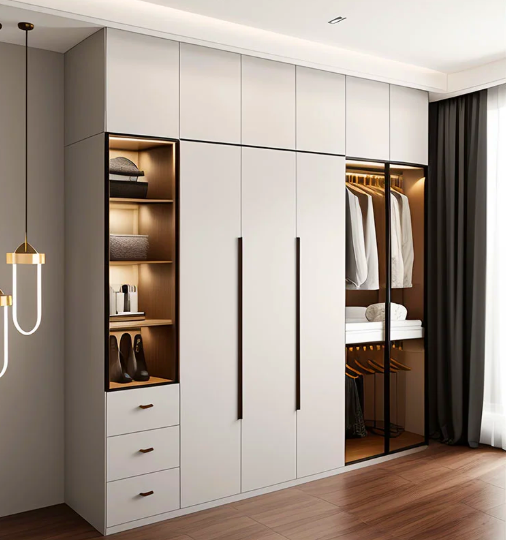
The swing door of the wardrobe is also often called the cover door wardrobe. It is a classic cabinet door structure in the custom home. It relies on hinges to turn inward or outward to open, which is different from the sliding door wardrobe that pushes, pulls and slips. Many owners choose the swing door or the sliding door when customizing the wardrobe. Most of them only look at the appearance and price, but ignore the professional points such as plate structure, edge sealing process, hinge bearing, anti-deformation design, closing process, and opening space requirements. The swing door of the wardrobe seems to have a simple structure, but it is actually a set of supporting solutions composed of plates, hardware, closing, and adjustment systems. The quality of the hardware, the stability of the plates, and the processing accuracy directly determine the experience of the wardrobe for more than ten years. This paper focuses on the classification of wardrobe swing door plates, structural technology, hinge system, edge banding technology, style classification, deformation prevention and control, installation acceptance, purchase and pit avoidance, post-maintenance, etc.
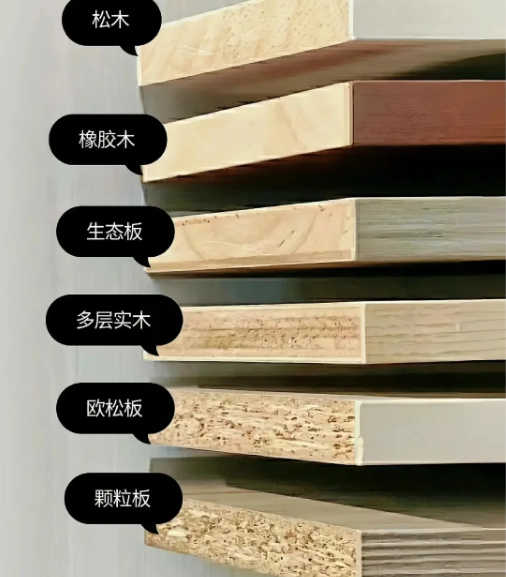
[Plate section sample diagram | Granular board, multi-layer solid wood board, Ou Song board, PET board, excimer board section, marked substrate, veneer, edge banding layer]
First, the mainstream substrate of wardrobe swing doors, stability is the core indicator
The core substrate selection for wardrobe swing doors is the ability to resist deformation. Cabinet doors are made of large-scale thin plates, which are prone to warping and bending due to temperature and humidity changes. The physical properties of different substrates vary significantly.
Granular board (particle board): At present, the most widely used base material for customized swing doors in the whole house, log scraps are pressed at high temperature and high pressure, with uniform internal structure, small internal stress, not easy to warp in one direction, and excellent flatness. It is suitable for PET, melamine, baking paint and other finishes, and is cost-effective. High-quality granular board is made of log raw materials, and the environmental protection grade can reach ENF grade; inferior granular board is doped with bark, miscellaneous materials, and glue. It has poor moisture resistance and swells in contact with water. The disadvantage is that it expands irreversibly after soaking in water, and it is not recommended to use in humid areas.
Multi-layer solid wood board (plywood): Multi-layer wood veneer is staggered horizontally and vertically, with stronger structural stability and better moisture-proof performance than granular board. It is preferred for wardrobes in humid areas in the south and near bathrooms. The multi-layer board has outstanding nail holding force, and the hinge is not easy to loosen after repeated disassembly and assembly; the short board is that the flatness of the board is slightly worse, and the price is higher. Some low-priced multi-layer boards use miscellaneous wood veneer, which is prone to concave and convex surfaces.
OSB Oriented Particleboard: Large pieces of wood are oriented paving, with high structural strength, low deformation coefficient, and good environmental protection. It is mostly used for high-end minimalist large board wardrobe doors, suitable for ultra-high non-straightener cabinet doors. The texture of the board surface is coarse, most of which need to be covered with finishes, and the processing cost is high.
MDF (fiberboard): fine fibres, suitable for modeling, painting, and blister molding European-style doors, but with poor moisture resistance and weak nail grip, large-size cabinet doors are easily bent and deformed. Nowadays, it is rare to make large door panels without straighteners, which are mostly used for small-size door panels.
Buying points: If the height of the cabinet door exceeds 2.2 meters, priority is given to Ozone board and high-quality multi-layer board; if the cabinet door is within 2 meters, the qualified ENF granular board is completely sufficient.
[Comparison chart of veneer process | Comparison of melamine veneer, PET veneer, excimer, blister molding, paint-free veneer samples]
Second, the door veneer process determines the appearance, scratch resistance and stain resistance
In addition to the substrate, the finishing process directly affects the appearance, feel, fingerprint resistance, scratch resistance and wear resistance, and is also the focus of merchants to widen the price difference.
Melamine paint-free board: the most popular finish, hot-pressed impregnated melamine paper, wear-resistant and scratch-resistant, rich in color, complete wood grain and solid color, no need for additional painting, environmentally friendly and stable, cost-effective. The disadvantage is that the texture is matte, the highlight style is prone to orange peel, and the minimalist highlight effect is weaker than PET.
PET finish: Thermal composite PET polyester film on the surface of the substrate, divided into matte PET and high-gloss PET, the surface is delicate and smooth, the high-gloss model is transparent, the anti-fingerprint effect is excellent, and the oil stain is wiped and cleaned. It is a popular choice for minimalist swing doors at present. High-quality PET is a double-layer composite film, and the low-priced product is PVC pretending to be PET, which is easy to remove the film and drum when heated.
Excimer finish: It belongs to a new generation of paint-free process. The surface is cured by excimer, resistant to scratches, acid and alkali, not easy to leave fingerprints, delicate to the touch, and has a higher wear resistance grade than ordinary PET. It is mostly used for high-end customization and the price is high.
Blister molding (PVC film): suitable for European, American, French modeling door panels, vacuum adsorption on MDF modeling, can make arc, groove lines. Short board is PVC film long-term heat aging, corners are easy to warp, high temperature environment is easy to release odor.
Painted door panels: polished and sprayed to cure, the paint surface is transparent and full, and the color expression is strong; the process is complicated, the cost is high, and it is difficult to repair after a bump. The construction period is long, and the use of home improvement is gradually decreasing.
[Structure diagram of the straightener | The aluminum alloy vertical straightener is installed on the back of the door panel, and the comparison close-up of the invisible straightener and the surface-mounted straightener]
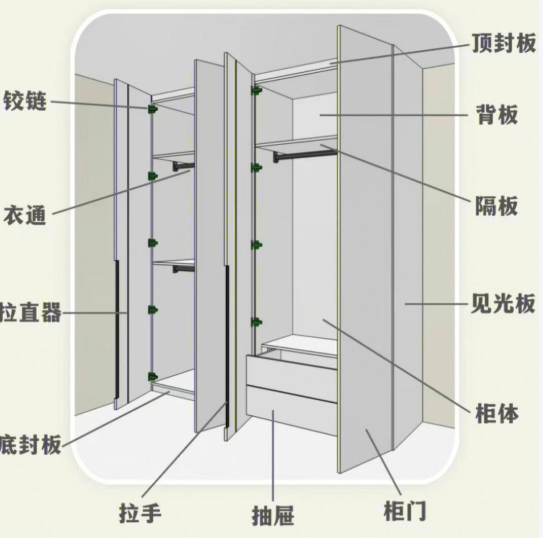
Anti-deformation system: the role and selection criteria of the straightener
The most common problem of large wardrobe swing doors is that the middle of the door panel is arched and warped outward. The ultra-high door panel must be equipped with a straightening structure, and the straightening device is the core accessory of the minimalist high door.
Conventional reference threshold: door panel height ≥2000mm, width ≥450mm, it is recommended to install a straightener; door panel height above 2400mm, regardless of the quality of the substrate, a straightener must be configured. The straightener is divided into surface-mounted aluminum alloy straightener and embedded invisible straightener. The surface-mounted model is a long aluminum profile. The screws are fixed on the back of the door panel. The adjusting screws can fine-tune the curvature of the door panel and correct warping; the invisible straightener is slotted and embedded inside the door panel. The back is flat and beautiful, and the processing difficulty is higher. The accuracy of the slotting is strict. Improper slotting will damage the plate structure and exacerbate the deformation.
The misunderstanding of many businesses: installing a straightener does not mean that it will not deform. The straightener corrects and suppresses deformation, not absolutely does not deform. If the substrate itself is of poor quality and the plate is too thin, no matter how good the straightener is, it is difficult to stabilize it for a long time. The recommended thickness of the door panel is 18mm. Some factories with ultra-high doors will thicken the door panel by 22mm to further improve rigidity and reduce the probability of deformation.
[Hinge disassembly diagram | Two-stage force hinge, damping buffer hinge, large-angle hinge, heavy-duty hinge disassembly, mark the base, hinge cup, buffer cylinder, adjustment screw]
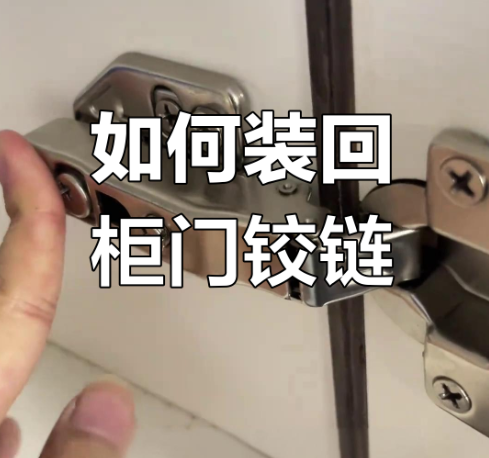
Fourth, the hinge hardware system, the heart of the wardrobe swing door
The opening and closing experience and service life of the wardrobe swing door all rely on the hinge. The load-bearing, cushioning and adjustment capabilities of the hinge are the top priority in the purchase, and it is also the hardest hit area for distribution reduction.
According to the opening force, it is divided into a one-stage force hinge and a two-stage force hinge. A one-stage force hinge will automatically bounce open or close at a certain angle, cannot hover, feels stiff, and has basically been eliminated; a two-stage force hinge can hover at any angle, and the door will not rebound to any position, making it more comfortable to use. Home improvement wardrobes come standard with two-stage force.
With built-in damping buffer hinge, close the last section of automatic slow buffer closure to avoid the door panel hitting the cabinet, reduce noise, protect the edge seal and the plate, which is the mainstream configuration. The buffer is divided into built-in hydraulic damping and external damping, and the built-in damping is preferred, which is not easy to fall off.
Hinge load-bearing classification: ordinary small door panels (width within 40cm) use conventional light hinges; large panels with a width of 45-60cm and a height of 2.2 meters or more must use heavy-duty thickened hinges, and a single hinge bears 40kg and 50kg specifications. Installation quantity is also standardized: door panel height ≤1.6 meters, 2 hinges; 1.6-2.2 meters, 3 hinges; ultra-high door panels above 2.2 meters, 4 hinges are recommended to evenly distribute the weight of the door panel to prevent long-term use of hinges from loosening, door panels falling, and uneven door seams.
The hinge coverage method is divided into full cover, half cover, and embedded (no cover). It corresponds to the different structures of the side panels of the cabinet. The design must match, otherwise the door panels will interfere with each other and not close tightly. Brand hinges have obvious advantages in rust prevention and adjustment accuracy. 304 stainless steel hinges are preferred in humid environments, and cold-rolled steel electroplated hinges in ordinary environments can be used. The hinges support three-dimensional adjustment: up and down, left and right, front and rear, uneven door seams and slight sinking in the later stage can be fine-tuned.
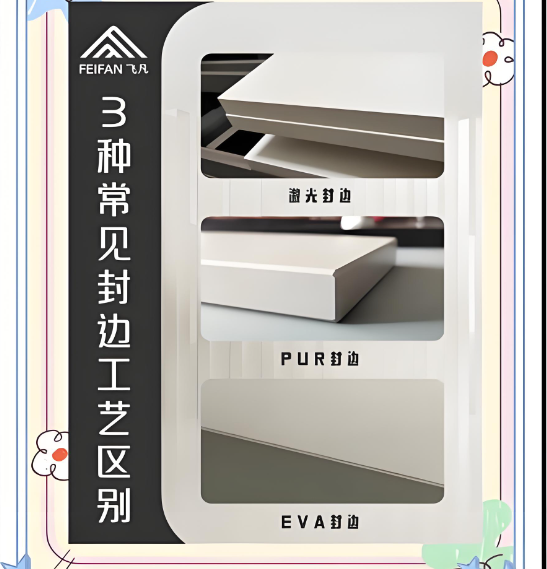
[Close-up picture of edge banding process | Comparison of details of PUR edge banding, EVA edge banding, laser edge banding, edge banding gap, glue line effect real shot]
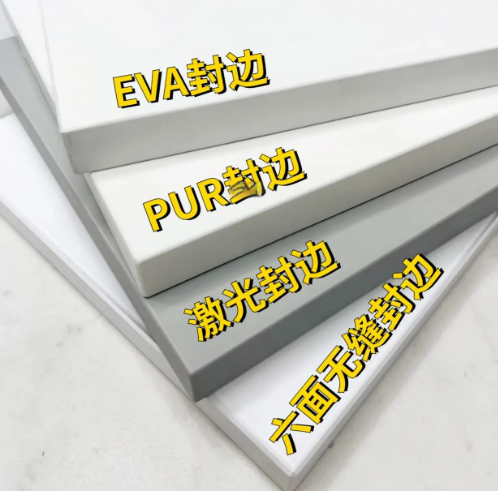
Fifth, the edge banding process, the key to moisture prevention, cracking prevention and environmental protection
Many people ignore edge banding, and the plate incision is exposed, which is not only unsightly, but also releases internal glue, absorbs moisture and swells. The mainstream of wardrobe door panel edge banding is divided into EVA edge banding, PUR edge banding, and laser edge banding.
EVA hot melt adhesive edge banding: market basic model, low price, obvious glue line, average temperature difference performance, high temperature environment in summer, the glue layer softens, and the corners are easy to open. It is suitable for use in a limited budget and dry environment.
PUR edge banding: reactive hot melt adhesive, irreversible after curing, high temperature resistance, moisture resistance, extremely fine glue line, bonding strength is much higher than EVA, wardrobe door panels in humid areas in the south are preferentially PUR edge banding, which is not easy to edge off.
Laser edge banding: no glue line process, edge banding and plate melting combination, the best look and feel, waterproof and stain-resistant, expensive equipment, high-end customized use, high cost.
High-quality edge banding requires that the edge banding belt fits tightly, without burrs, no overflow glue, and the corners are rounded and chamfered, and the sharp right-angle edge banding is easy to bump and collapse.
[Style classification real picture | Minimal no handle swing door, handle model, groove handle, invisible rebound device swing door, segmented door real shot]
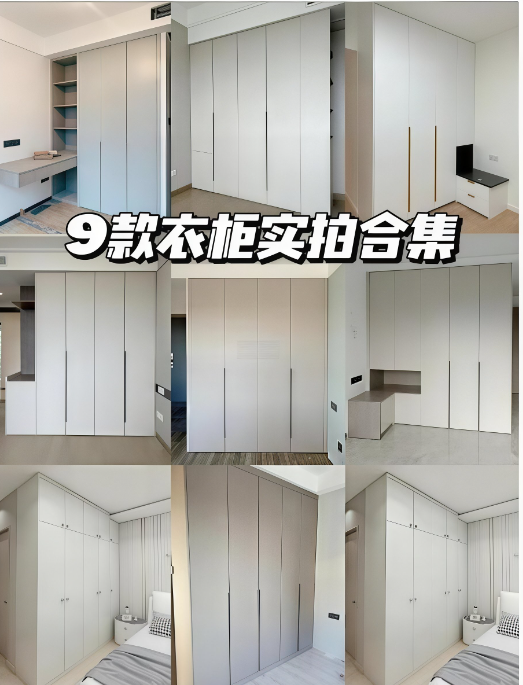
Six, wardrobe swing door style classification, opening method and adaptation scene
Handle type casement door: traditional style, metal long handle, small handle, direct grip when opening the door, low cost, lowest failure rate, friendly to the elderly and children, not easy to open by mistake.
No handle rebound device model: press the rebound door to open the door, the surface is clean and minimalist, suitable for modern and minimalist style. The short board is that the rebound device is a wearing part, and it is easy to fail when used frequently. It is not recommended to use the rebound device alone for super heavy door panels, and it is easy to rebound and fail when the thrust is large.
Groove handle (inner buckle handle): The door panel is slotted or matched with a U-shaped aluminum groove, with an integrated inner buckle, no external handle is required, and the durability is better than the rebound device. It is a more stable choice in the no-handle solution.
Sectional casement door: Super high wardrobe is divided into upper and lower door panels, reducing the size of a single door panel, reducing the risk of deformation, and without expensive heavy hinges and straighteners, cost-effective solution.
French shape door cover: door core line, arc shape, blister or paint process, suitable for retro, French decoration style, rich in shape, but most of the door base material is MDF, moisture-proof weak.
At the same time, it is necessary to pay attention to the rigid conditions of the space: when opening the swing door, it is necessary to reserve the activity space of the width of the door panel, and the small position of the bedside and aisle should be calculated in advance. If the door is opened, it will hit the position of the bed and the dresser, which is not suitable for opening the door.
[Node diagram of closing and gap | Door panel and top panel, side panel, floor closing, door seam reservation, anti-collision strip installation node schematic]
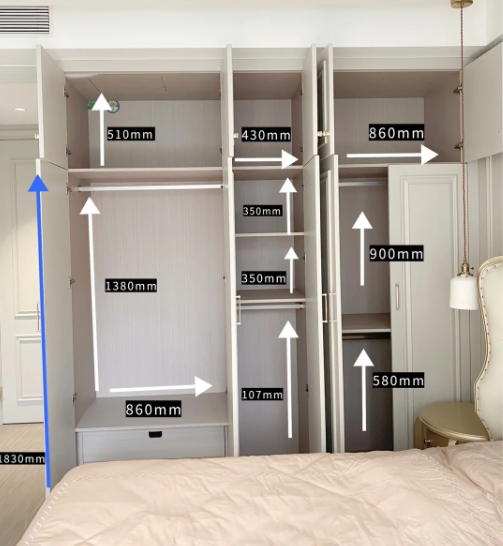
Seven, gap reservation, closure and anti-collision noise reduction design
The swing door of the wardrobe is not tightly fitted and stuck. A reasonable expansion gap must be reserved. The plate will expand and contract slightly with temperature and humidity. If the gap is too small, the door plate will be squeezed and cannot be closed. The conventional door seam is reserved for about 2mm, and the upper and lower gaps are 2-3mm.
Some plans will install silicone anti-collision strips and paste them on the back of the door panel to buffer and reduce noise when closed, reduce impact and abnormal noises, and buffer bumps at the same time to protect the edge sealing. The closure is divided into the closure of the light board and the closure of the sealing board of the same color. The exposed position of the side panel of the cabinet is matched with the light board of the same color, which has a stronger overall feeling, avoids the exposure of the cabinet substrate and improves the appearance.
There are also pit avoidance points: the wall is not vertical, the ground is uneven, which directly affects the uniformity of the door gap. The installer needs to rely on the hinge three-dimensional adjustment to compensate for the error, but the error is too large, the hinge adjustment range is not enough, and the door seam will still be crooked.
[Installation construction map | Cabinet leveling, hinge punching and positioning, door panel hanging, door seam debugging, closing and gluing real shot]
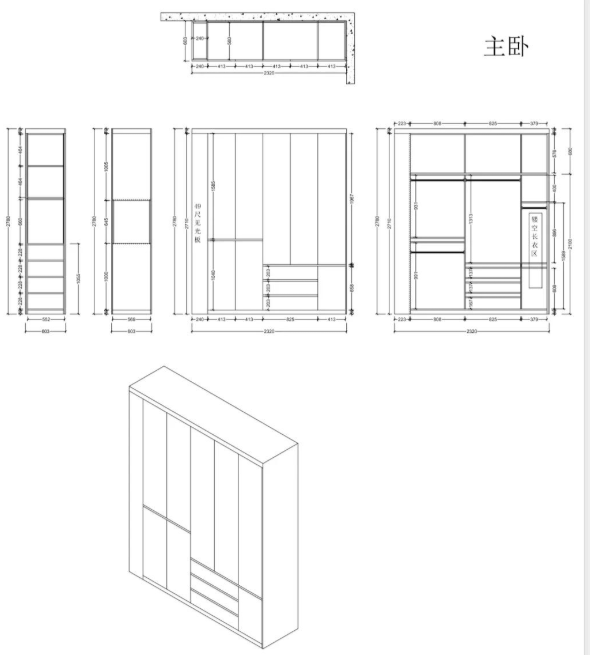
VIII. Standardized installation process and acceptance points
No matter how good the door panel hardware is, if it is not installed properly, the experience will be greatly discounted.
The first step is to install the cabinet frame, and first calibrate the cabinet with a level to ensure that the cabinet is square and vertical, the cabinet is crooked, and the door panel is never adjusted evenly;
The second step is to precisely punch holes in the hinge, the hole depth is appropriate, the board surface cannot be pierced, and the fixing screws of the hinge cup are tightened without slipping;
The third step is to hang the door panel and initially fix the hinge base without locking it;
The fourth step is three-dimensional debugging, adjusting the door seam uniformly to ensure that the left and right, upper and lower gaps are uniform, and the door panel is flush after closing, without height difference;
The fifth step is to repeatedly open and close the test, open smoothly, buffer evenly, and there is no fight or friction between the door panels;
The sixth step is to close the mouth, clean the gap, and install anti-collision strips and closing plates of the same color as needed;
Acceptance criteria: Each door opens smoothly, the second-stage force hovers normally, and the buffer closes softly; the door seams are uniform; the door panel has no warpage or height difference; the door panel does not rub the cabinet after closing; all hinge screws have no slippage loosening; the edge seal has no bumping and edge collapse.
[Comparison diagram of swing door vs sliding door | Advantages and disadvantages of swing door and sliding door, sealing, space, storage comparison]
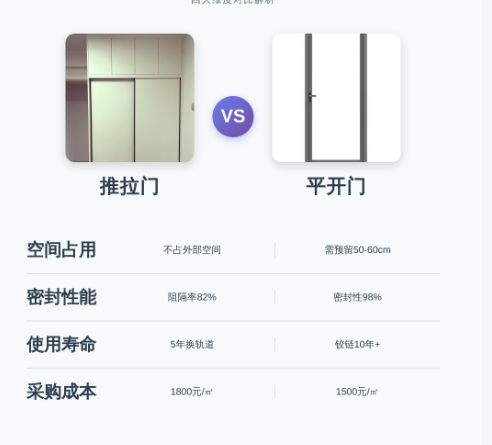
Nine, wardrobe swing doors compare sliding doors to clarify the selection logic
Many owners torn flat doors and sliding sliding doors. Advantages of flat doors: better sealing, dust is not easy to enter the interior of the wardrobe; after opening, the interior of the cabinet is completely exposed, and the deep clothes are not blocked; good sealing, moisture-proof and dust-proof effect is better; There are many styles to choose from, and minimalism and shape can be done. Disadvantages: Opening the door requires external activity space, and the apartment type with narrow aisles is limited; large door panels have the risk of deformation, and the hardware cost is higher.
Advantages of sliding doors: do not occupy external aisle space, suitable for small bedrooms and bedside wardrobes; single fan is light in weight and has a lower risk of deformation. Short board: the track is easy to accumulate dust, and the slide pulley is stuck for long-term use; the door leaf covers half of the cabinet, and it is inconvenient to store in the depth; the sealing is weak, and it is easier to enter the dust.
Simple summary: sufficient space, dustproof and easy access are given priority to flat doors; small bedrooms, bedside wardrobes, sliding doors are given priority.
[Comparison chart of purchasing pit avoidance | Qualified 18mmENF large board + heavy-duty hinge + PUR edge banding VS thin door panel, EVA inferior edge banding, light hinge without straightener inferior door panel]
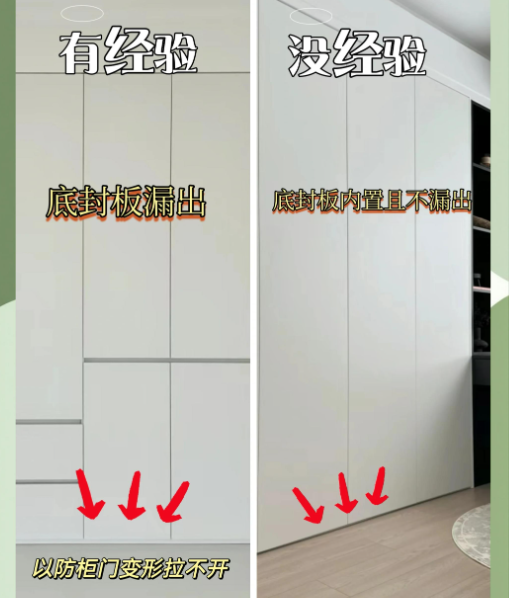
10. Choose a pit avoidance guide to avoid common routines in the industry
The thickness of the door panel is reduced, and the 18mm actual 16mm thin plate is marked, which is very easy to bend in large size;
Concealing the straightener, without a straightener for the super high door, it looks good in the short term, and the door panel arches after half a year;
Ordinary one-stage low-cost hinges pretend to be two-stage force damping hinges, and external simple damping is used for buffering, which is easy to fall off;
EVA edge banding falsely claims that PUR edge banding, and the glue is quickly opened in high temperature environments;
The small hinge is equipped with ultra-high wide door panels, the number of hinges is insufficient, and the door seam is misplaced in the later stage;
The rebound device is blindly used in heavy-duty large boards, and the door panel cannot bounce if it fails to be pressed later;
Environmental grade false standard, claiming ENF grade, no test report, and many base materials;
Ignoring the opening space, the design was completed only to find that the door had hit the furniture.
Signing the contract must specify: the type of substrate, environmental protection grade, door panel thickness, edge banding process, hinge brand specifications, number of hinges, whether to install a straightener, and the type of finish.
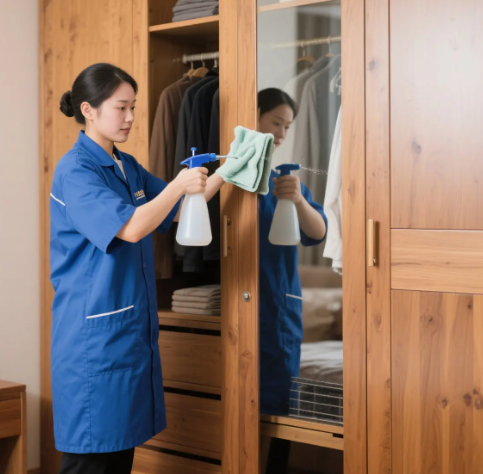
[Maintenance schematic diagram | Door panel cleaning, hinge tightening, anti-collision strip inspection, maintenance indication to avoid moisture]
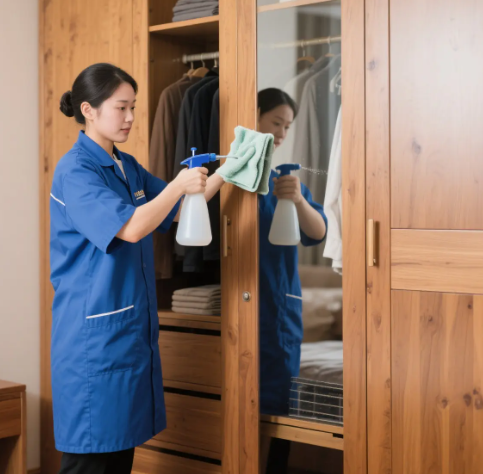
Eleven, daily maintenance to extend the service life of wardrobe swing doors
The swing door is a low-maintenance part, but reasonable maintenance can be used stably for a long time. Wipe it with a slightly damp soft cloth for cleaning, and match the stubborn stains with a neutral cleaner to prohibit strong acids and alkalis to avoid corroding the finish and edge sealing; do not spray the door panel directly with water to prevent moisture from penetrating into the substrate from the gap and expanding;
Check the hinge every six months, if there is abnormal sound or loosening, tighten the adjusting screws, maintain the hinge shaft with a small amount of silicon-based lubricant, and do not fill a lot of oil and dust;
Avoid long-term direct sunlight on the door panel, ultraviolet rays will accelerate the fading of the finish and the aging of the board; keep the interior of the wardrobe ventilated, and a dehumidification box can be placed in the humid season to reduce the moisture absorption and deformation of the board; do not hit the door panel vigorously, and do not press the rebound device frequently.
[Panorama of the whole house floor | The whole set of minimalist swing door wardrobes in the bedroom, the effect of integrated landing of the door panels of the cabinet of the same color]
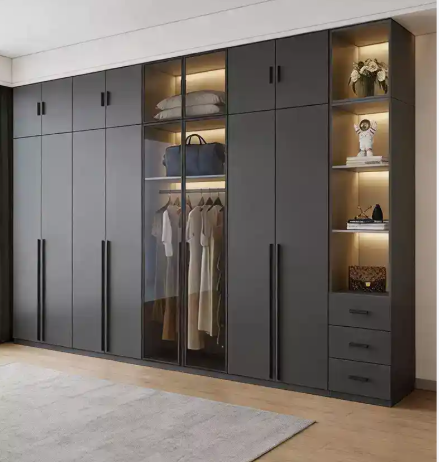
conclusion
The swing door of the wardrobe is not just a door panel with hinges, but also a customized product composed of substrate, veneer, edge banding, straightening system, hinge hardware, and installation and debugging. It takes into account the practicality of storage and the appearance of the home. The advantages of dust-proof sealing are difficult to replace with sliding doors, and it is also an enduring solution in home improvement wardrobes.
Choose a flat door, and give priority to determining the plan according to the height of the door opening and the size of the bedroom space: small-size door panels can focus on cost performance; ultra-high door panels above 2 meters focus on controlling the rigidity of the substrate, PUR edge sealing, heavy-duty hinges, and straightening devices; no handle style, give priority to the aluminum groove inner buckle handle to reduce the probability of failure in the later stage. At the same time, plan the aisle door opening space in advance to avoid interference with furniture in the later stage.
Processing accuracy, hardware quality, and standardized installation are all indispensable, avoiding the trap of low-price reduction. A set of high-quality wardrobe swing doors can keep the door seam neat and open and close smoothly for many years, bringing a comfortable experience to home storage