

Guardrail
Professional detailed explanation of guardrail panels: A complete guide to classification, parameters, construction and acceptance of corrugated guardrail panels
(The actual picture of the overall installation of the highway waveform guardrail plate, the whole picture of the two-way guardrail on rural roads)
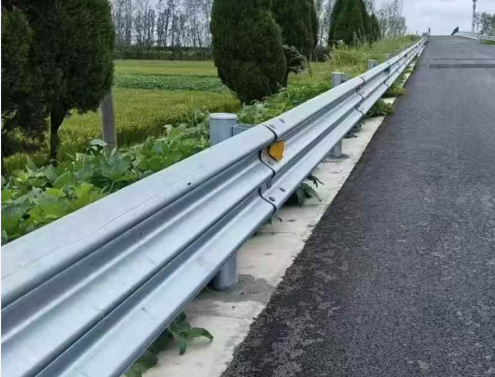
Guardrail, also known as corrugated guardrail and highway corrugated steel guardrail, is the core protective component in road traffic security engineering. It is widely used in highways, national and provincial trunk highways, municipal roads, rural highways, factory roads, parking lots, ramp, bridges and other scenes. Many people simply think that the guardrail is just a steel plate on the roadside. In fact, it is a set of passive safety protection system that has been mechanically checked. It relies on the waveform structure to absorb the impact energy of the vehicle, forcing the uncontrolled vehicle to change the driving direction, preventing the vehicle from rushing out of the road, falling off the slope or colliding in the opposite direction, and minimizing the loss of traffic accident casualties. With the continuous update of domestic traffic security standards, the guardrail has strict national standard specifications from material, plate type, galvanizing process, column matching to installation and construction. This paper systematically explains the professional knowledge of guardrail panels from multiple dimensions such as basic definition, classification specifications, material process, mechanical principle, selection plan, installation process, quality acceptance, post-maintenance, procurement pit avoidance, etc.
(Schematic diagram of the cross-sectional structure of the guardrail plate, marked with wave height, plate thickness, wave peak, wave trough, and overlap direction)
First, the protective principle of the guardrail and the basis for the national standard
The guardrail is a passive safety protection facility for highways, and the core logic of protection is flexible energy-absorbing guidance, which is completely different from the protection mechanism of rigid concrete anti-collision walls and wrought iron fences. When a vehicle accidentally strikes the guardrail, the waveform structure will undergo orderly deformation, and the impact kinetic energy will be gradually consumed through the deformation of the guardrail, column, anti-resistance block, and bracket, rather than hard impact. During the energy absorption process, guide the vehicle to return to the lane smoothly to avoid the vehicle directly climbing over the guardrail and rushing out of the roadbed.
Domestic guardrail panels mainly follow the "Highway Traffic Safety Facilities Design Specifications" JTG D81 and "Highway Corrugated Beam Steel Guardrail" GB/T 31439 standards, which clearly divide the protection grade, plate size, anti-corrosion requirements, and material mechanical properties. According to the protection ability, it is divided into C-level, B-level, A-level, SB-level, SA-level, SS-level and other grades. The higher the grade, the higher the design speed and the stronger the protective bearing capacity.
Many customers choose models that are easy to step on: they only look at the appearance, ignoring the protection level. Low-grade guardrails are used in high-speed, steep slopes, and waterfront cliffs, which are prone to fracture and failure during impact, posing huge safety hazards; high-grade guardrails are used in low-speed rural roads, which will cause budget waste, so the first step in selection is to match the road design speed and road condition risk level.
(Schematic diagram of mechanical simulation of vehicle impact on guardrail plate, demonstration of deformation energy absorption)
Classification of mainstream plate types and basic specifications of guardrail panels
The mainstream guardrail panels on the market are divided into two-wave guardrail panels, three-wave guardrail panels, and three-wave variable two-wave transition panels. The size and protection capabilities of different panel types vary greatly, which is the core distinction between procurement and design.
Two-wave waveform guardrail board: the most common basic model in the industry, with a wave height of 85mm, a board width of 310mm, and a conventional board length of 4320mm (4 meters after the finished product is effectively lapped). Commonly used board thickness: 2.5mm, 2.75mm, 3.0mm, suitable for rural roads, factory roads, municipal auxiliary roads, parking lots. The design speed is generally within 40km/h and 60km/h, corresponding to the protection grade C, B, and A. Two-wave guardrail board is light in weight, moderate in cost, and convenient for transportation and installation. It is also the guardrail board with the largest market demand.
Three-wave waveform guardrail plate: wave height 130mm, plate width 506mm, plate length 4320mm, conventional thickness 3.0mm, 4.0mm. The waveform is wider and deeper, the structural stiffness is greater, and the upper limit of energy absorption is higher. It is mostly used for national highways, provincial highways, expressway main lines, waterfront cliffs, steep slopes, and bridge sections. The protection grade is SB, SA, SS, and it is suitable for 80km/h, 100km/h, and 120km/h high-speed sections.
Three-wave to two-wave transition guardrail plate: It is a special-shaped transition plate, with a three-wave structure at one end and a two-wave structure at one end. It is used for the connection position of different protection grade road sections to achieve a smooth transition of guardrails and avoid protective breakpoints caused by hard docking of two kinds of guardrail plates. It is an easily overlooked but essential accessory.
In addition to the conventional straight plate, there are also curved guardrail plates (hot-bending guardrail plates) dedicated to curves, which are customized according to the turning radius of the road to ensure that the guardrail fits the road alignment and cannot be forcibly bent on site. Forced bending will damage the galvanized layer and steel plate stress, making it easy to break and rust.
(The two-wave guardrail plate and the three-wave guardrail plate compare the real pictures side by side, and mark the size parameters)
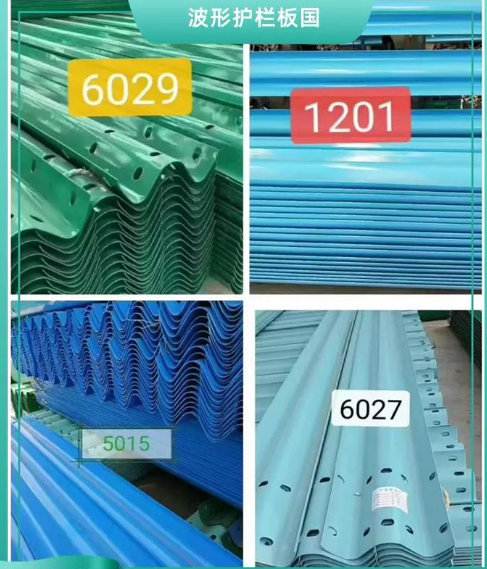
III. Detailed explanation of guardrail material and anti-corrosion process, comparison of service life of different processes
The guardrail plate substrate is generally made of Q235 low-carbon hot-rolled steel strip. Low-carbon steel has good toughness and can absorb energy through plastic deformation upon impact. High-carbon steel has high hardness but is brittle, and is prone to direct fracture upon impact. It cannot be used as a corrugated guardrail plate substrate. After the substrate is determined, the anti-corrosion process directly determines the service life of the guardrail plate, which is also the core reason for the price gap.
Hot-dip galvanizing (hot-dip galvanizing): The national standard preferred anti-corrosion process. The formed guardrail plate is immersed in the molten zinc liquid, and the steel plate and zinc layer are metallurgically combined, and the adhesion of the zinc layer is extremely strong. The average thickness of the national standard hot-dip galvanized layer: generally not less than 85 μm, and the zinc layer on the road section with high anti-corrosion requirements is ≥100 μm. Normal field environment, the service life of the hot-dip galvanized guardrail plate is 15-25 years, and the anti-corrosion performance is stable. It is suitable for rain, humidity, close to rivers and lakes, and
Hot-dip galvanizing + plastic spraying (galvanized plastic spraying/double coating): first hot-dip galvanizing as a base, and then electrostatic spraying polyester powder on the outer layer. The advantage is that it is rich in color, can be made in blue, green, gray, white, with high aesthetics, and is widely used on municipal roads, tourist highways, and scenic roads. The zinc layer and plastic layer are double protected, resistant to ultraviolet rays and acid rain, and the service life is 15-20 years; the disadvantage is that after the plastic layer is bumped and damaged, the damaged position is easy to slowly rust from the damaged point.
Cold galvanizing (electrogalvanizing): The zinc layer is very thin, generally only 5-15 μm, with poor corrosion resistance and low cost. It is not a national standard recommended process and is mostly used for temporary construction site enclosures. It will rust in a large area in 1-3 years. It is prohibited from being used in regular traffic security projects. It is also the hardest hit area for low-cost and inferior guardrails in the market.
Immersion process: The steel plate is directly soaked and wrapped, and the coating is thick, but the coating is easy to age and crack, and the outdoor exposure environment ages quickly. At present, the waveform guardrail plate is rarely used alone. Immersion process.
Purchasing distinction tips: hot-dip galvanized surface is matte silver gray, crystalline snowflake-like zinc flower; cold galvanized surface is bright and white, no zinc flower, looks good in the short term, and has poor anti-corrosion ability.
(Comparison close-up of hot-dip galvanized guardrail plate, plastic-sprayed guardrail plate, and cold-dip galvanized inferior guardrail plate)
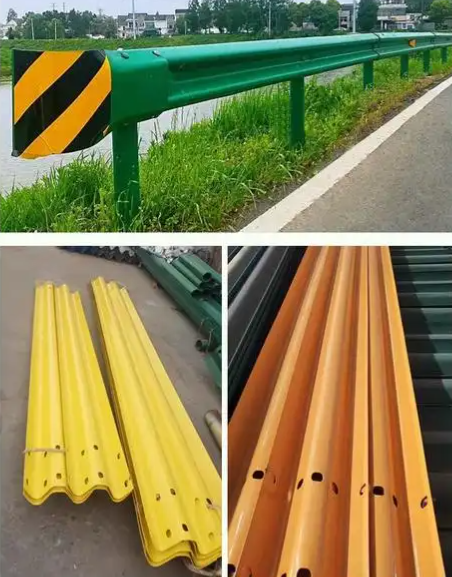
Fourth, the guardrail plate supporting accessories system: the guardrail plate is not a single steel plate
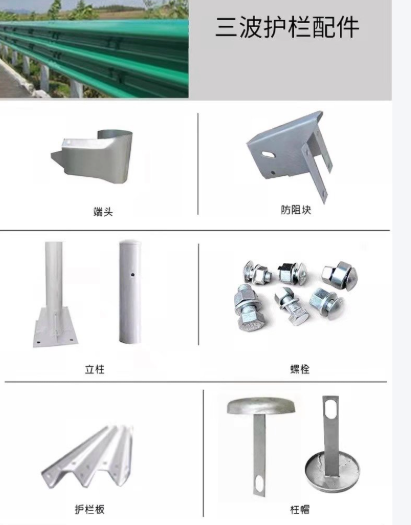
A complete set of waveform guardrail protection system, the guardrail is only the main body, and must be matched with supporting components to play a protective role. Without or using inferior accessories, even the best guardrail cannot achieve the designed protective effect.
Column: round tube column and square tube column are mainly two kinds. Two-wave conventional φ 114 round column, wall thickness 4.0mm; three-wave multi-use φ 140 round column. The column is a support member, which cooperates with the deformation of the guardrail plate during impact to transmit the impact force to the roadbed.
Anti-resistance block: three-wave guardrail standard, hexagonal anti-resistance block, placed between the guardrail plate and the column, to buffer, advance, disperse stress, prevent the guardrail plate from directly sticking to the column, there is no deformation space; two-wave guardrail commonly used brackets instead of anti-resistance block, the bracket structure is simple, suitable for low protection level road sections.
Bolts: divided into splicing bolts, connecting bolts, all require hot-dip galvanized anti-theft bolts, high-strength 8.8 bolts. The overlap between the guardrail plate and the guardrail plate relies on splicing bolts, and the connection bolts are used between the guardrail plate and the bracket/anti-resistance block. The bolt strength is insufficient, and it is directly cut when impacted, and the guardrail plate is instantly disengaged and fails.
End, Baotou: The end components at the start and end positions of the guardrail, R160, R250 ends, prevent vehicles or pedestrians from directly hitting the sharp incision of the guardrail, and play a passivation protection role.
Gasket, waterproof gasket: reduce friction and abnormal noise between steel plates, prevent rainwater from entering the contact surface along the gap to accelerate corrosion.
Many low-priced suppliers only thicken the guardrail plate, and reduce the matching columns, bolts, and anti-resistance blocks, which is a typical "board meets the standard, and the whole system does not meet the standard". The acceptance is easy to fail, and there are major safety hazards.
(The assembly decomposition diagram of the full set of accessories for the guardrail, marked with anti-resistance blocks, brackets, bolts, and columns)
Key points of construction specifications for on-site installation of guardrail panels
The installation of guardrail panels has strict sequential and linear requirements, and the construction quality directly affects the protection effect. Many projects have qualified guardrail panels, but the installation is not standardized, the acceptance fails, and the protection is greatly reduced.
First, lofting positioning. Release the column points according to the design drawings, strictly follow the road line, the straight line section is straight, the curve is smooth, and the column spacing is conventional 4 meters (standard section) and 2 meters (reinforced section, dangerous section encryption). Lofting needs to avoid culverts, pipelines, and sign foundations. When encountering the plan of changing the rock roadbed in advance, the flange pre-embedded foundation is used, and forced punching is prohibited.
Second, the column is buried. The soil subgrade is generally driven into the subgrade by piling, and the depth of the penetration is in line with the drawings; for concrete subgrade and rock foundation, pre-embedded flanges or drilled holes are used to pour the concrete base. The column must be perpendicular to the road surface, and the tilting column will cause the installation of the guardrail board to be twisted and deformed.
Third, the overlapping direction of the guardrail plate is a very crucial detail: along the driving direction, the latter board presses the previous board, and when the vehicle strikes, the lap position will not be directly pulled apart or tripped. The reverse lap is a major construction error, and the splicing position is directly spread out at the moment of impact, and the guardrail fails.
Fourth, splicing and leveling. The guardrail plate is spliced in place, and the bolts should not be tightened at one time. After all are installed, the alignment should be adjusted uniformly to ensure that the guardrail is straight as a whole, consistent in height, and there is no distortion or warping. After the alignment debugging is completed, the bolts should be tightened uniformly. The bolts are moderately tight, too tight to limit deformation, and too loose to shake abnormally.
Fifth, finishing treatment: end installation, seam cleaning, on-site zinc paint repair of damaged galvanized layer to avoid rust from the damaged position later.
After the construction is completed, the road waste and waste will be cleaned up in a timely manner without occupying the traffic lane to ensure road safety.
(Construction personnel lofting piling, installing guardrail on-site construction map)
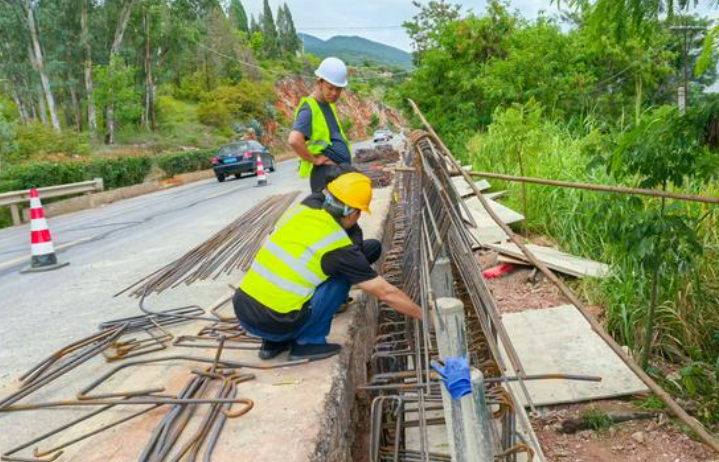
VI. Quality acceptance standards for guardrail panels, key inspection items for acceptance
The acceptance of the guardrail board project is divided into two links: factory inspection and on-site delivery acceptance. Many Party A and project supervisors do not know the key points of acceptance. You can refer to the following items:
Appearance inspection: no cracks, no delamination, no serious deformation on the surface of the guardrail, no large-scale shedding, bulging, or hanging of the galvanized layer and the plastic sprayed layer; uniform zinc flowers, no leakage of plating black spots.
Size sampling: caliper sampling plate thickness, wave height, width, length, many merchants false standard thickness, marked 3.0mm is actually only 2.75mm, which belongs to cutting corners.
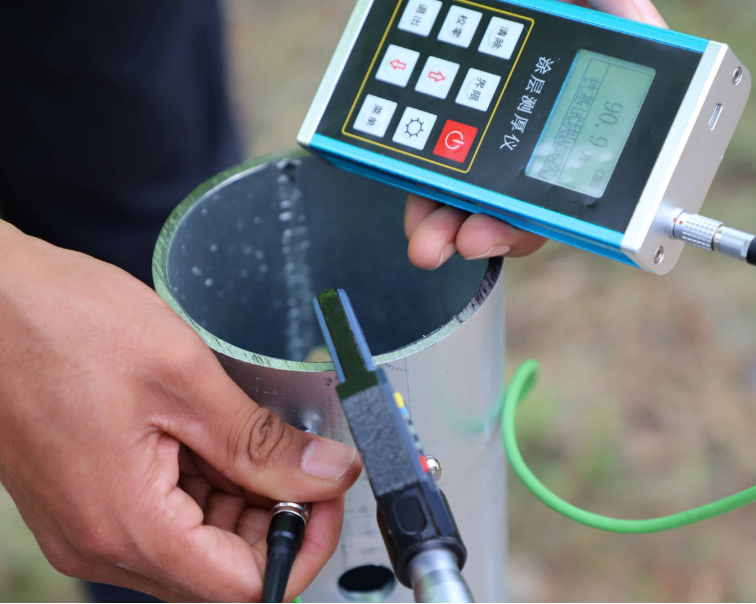
Anti-corrosion sampling inspection: The thickness of the zinc layer was detected by a zinc layer thickness gauge, and random samples were sent for mechanical tensile and bending tests. The Q235 material bending test was 180 without cracks.
Linear acceptance: The whole line is visually straight, the curves are smooth, there are no obvious corners or twists, and the overlapping directions are all correct.
Acceptance of accessories: Check the wall thickness of the column, the thickness of the anti-resistance block, and the bolt grade. The specifications of the accessories are consistent with the design drawings.
Spacing, burial depth: tape measure spot check column spacing, burial depth, encryption dangerous road sections shall not be changed to 4 meters regular spacing without authorization.
Road sections that fail the acceptance inspection must be rectified and replaced, and they cannot be opened to traffic due to illness.
(The supervisor uses a thickness gauge to detect the zinc layer of the guardrail and the thickness of the caliper plate.)
Seven, guardrail board daily maintenance, fault repair plan
The guardrail is an outdoor long-term exposure facility, which requires regular inspection and maintenance to prolong the service life and ensure the protective function.
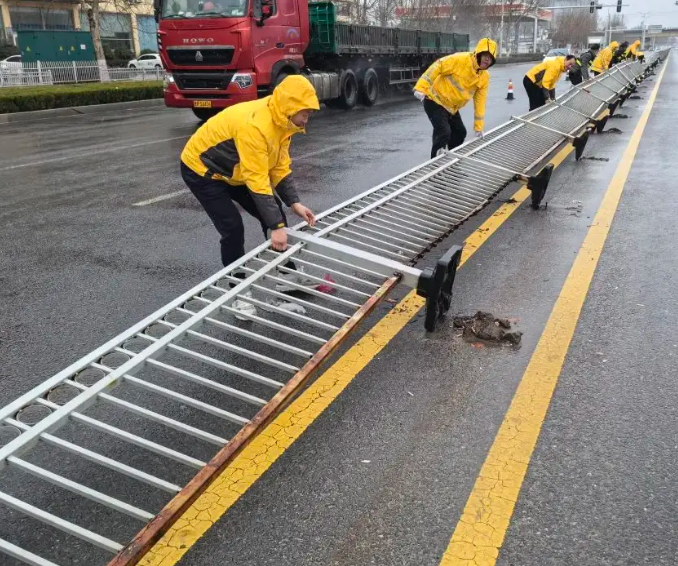
Daily inspection cycle: the main road inspection once a quarter, semi-annual inspection of rural roads. Inspection focus: steel plate corrosion, deformation and distortion, loose bolts lost, end damage, column tilt.
Slight scratches, coating damage: the damage area is small, the steel plate is not deformed, clean and polish the rust position, and apply matching zinc-rich paint to repair the anti-corrosion layer to prevent the spread of rust.
Minor deformation: small angle bending, no cracking and fracture, conditions permit on-site correction, and anti-corrosion after correction; large deformation, cracks in the steel plate, direct replacement of the whole plate, the internal stress of the corrected steel plate has been destroyed, and it is easy to break when impacted. It is not recommended to continue using it on high-risk road sections.
Large-scale corrosion: the zinc layer completely fails, the steel plate becomes thinner, and the protective strength decreases. Replace the guardrail directly.
Lost or loose bolts: fill in the anti-theft bolts in time to prevent the guardrail from falling apart.
Attention: Do not cut, polish, or modify the waveform structure of the guardrail at will. After the modification, the mechanical properties will change, and the protection level will directly decrease.
(Site map of maintenance personnel inspecting and repairing damaged guardrail panels)
Eight, guardrail purchase selection pit avoidance guide
The price gap of guardrails on the market is huge. Many novice purchasers only compare prices, ignore core parameters, and summarize high-frequency pit points:
Confuse the national standard board and the non-standard board: the non-standard board is thinned, the length is shortened, and the zinc layer is not up to standard. It looks similar in appearance and has a much lower cost, but it cannot pass the traffic acceptance and is not safe.
Cold galvanizing pretends to be hot galvanizing: The merchant verbally says it is hot galvanizing, but the actual cold galvanizing does not see any problems in the short term, and a large area rusts after a year.
Stealing protection level: replace three waves with two waves, do not make transition plates, and do not encrypt columns on dangerous road sections, lowering protection standards.
Only the price of the board is quoted, and the accessories are individually priced at a high price: the quotation does not include columns, anti-resistance blocks, bolts, freight, and installation fees, and the price will be increased later.
Ignore the road environment: coastal saline, acid rain areas, do not increase the thickness of the zinc layer, short-term corrosion scrap.
Simple summary of the selection: three waves of hot-dip galvanizing/galvanizing spraying for high-speed, national highways, and waterfront cliffs; two waves of hot-dip galvanizing for rural roads, factory areas, and park roads are preferred; scenic spots and tourist highways pursue aesthetic selection of galvanizing and spraying. Make it clear before purchase: plate thickness, anti-corrosion process, zinc layer thickness, protection grade, and a full set of specifications for accessories, and write them into the contract and acceptance terms.
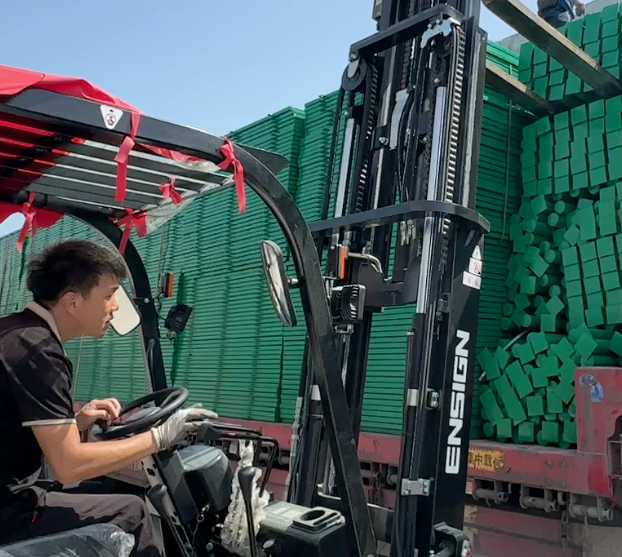
(Real pictures of guardrail plate loading and delivery, yard stocking)
Summary
The guardrail seems to be just a simple corrugated steel plate, behind which is a complete mechanical design, national standard system, supporting components and standardized construction technology. It is not a simple isolation decorative fence, but a passive protective barrier to protect road safety. The two-wave and three-wave guardrails have a clear division of labor. Hot-dip galvanizing, galvanizing spray and other anti-corrosion processes are suitable for different outdoor environments. From factory production, transportation, on-site lofting and installation to post-inspection and maintenance, every link will ultimately affect road safety.
For project purchasers and road construction units, the purchase of guardrail panels cannot blindly pursue low prices. Priority should be given to matching road design speed and risk level, identifying national standard materials and anti-corrosion processes, selecting manufacturers with experience in the production and installation of transportation facilities, supporting standardized construction and acceptance, in order to truly give full play to the anti-collision guiding role of guardrail panels and reduce the safety risks caused by road traffic accidents. Waveform guardrail panels, as the most widely used protective products for road traffic security in China, can be reasonably selected, standardized construction, and regularly maintained to achieve long-term and stable protection value.