

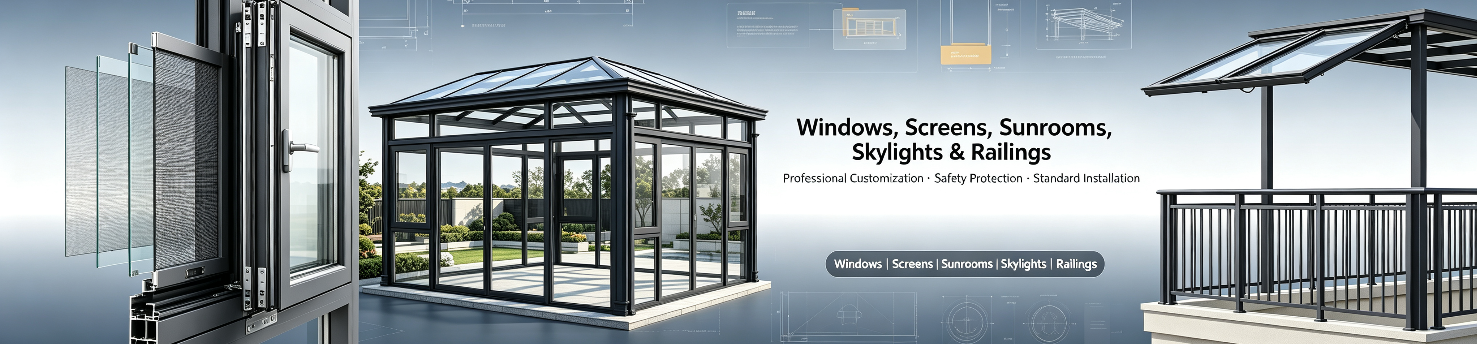
Aluminum alloy guardrail
Professional in-depth analysis of aluminum alloy guardrails | Full guide to profile, surface process, structure, load, installation selection
[Aluminum alloy guardrail real scene collection, balcony guardrail, stair guardrail, courtyard fence, bay window aluminum alloy guardrail real shot]
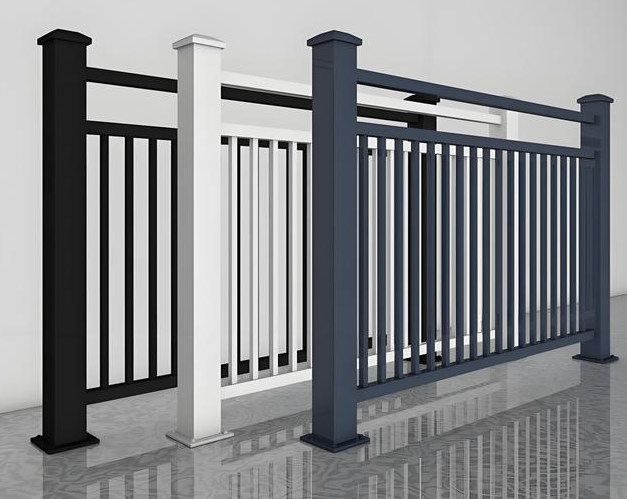
Aluminum alloy guardrails, also known as aluminum art guardrails and aluminum alloy protective railings, are widely used protective enclosure products for home improvement, villas, real estate projects, factories, and landscape projects. Compared with stainless steel guardrails, wrought iron guardrails, and zinc steel guardrails, aluminum alloy guardrails have gradually become the mainstream choice due to their core advantages of no rust, light weight, rich shape, and maintenance-free in the later stage. Many purchasers and owners easily understand aluminum alloy guardrails as "aluminum pipe welded fences", only looking at the style and price, ignoring profile specifications, alloy grades, wall thickness, connecting structure, load standards, surface spraying process, and safety acceptance specifications. Later, there will be shaking, weld cracking, paint falling off, and even protection standards cannot be accepted.
Aluminum alloy guardrail is a safety protection component, which is bound by clear national mandatory norms, and is not a simple decorative product. This article explains from the dimensions of aluminum alloy guardrail material grade, profile classification, surface treatment process, structural connection method, load safety standard, style classification, construction and installation, acceptance specification, selection comparison, maintenance and pit avoidance, taking into account industry expertise and ordinary people's reading habits, and implanting SEO keywords, suitable for home improvement owners, engineering party A, decoration companies, door and window dealers
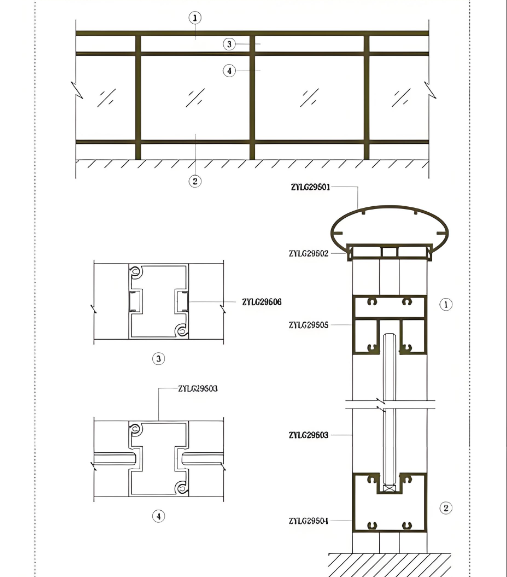
[Profile section sample diagram | Aluminum alloy square tube, flat tube, flower tube, groove profile section, marked with wall thickness and reinforcement structure]
First, aluminum alloy substrate grades and profile specifications, the foundation for safety
6063-T5 aluminum alloy is the mainstream of guardrails on the market, and it is also a general alloy grade for doors, windows and aluminum art products. 6063 belongs to aluminum-magnesium-silicon alloy, which has good plasticity, easy extrusion molding, stable welding performance, excellent anodic oxidation, spray adhesion, and strength that fully meets the requirements of conventional protective guardrails; a few heavy-duty and high-demand projects will choose 6061-T6, which has higher strength, greater processing difficulty, and higher cost. Home improvement guardrails are rarely used.
The wall thickness of the profile is the top priority, and it is also the main reduction item of the merchant. The recommended wall thickness of the national standard is different in different use scenarios: the main column of the residential balcony and bay window guardrail, the conventional home improvement ≥2.0mm; the column of the project real estate acceptance model ≥1. 8mm; the horizontal bar (horizontal pipe) ≥1. 4mm; the vertical bar (small vertical bar) ≥1.2mm. Many low-priced guardrail columns have a wall thickness of only 1.0-1.2mm., shaking by hand is obvious, the impact load is not up to standard, and there is a great potential safety hazard.
Profiles are divided into hollow round tubes, hollow square tubes, rectangular flat tubes, carved profiles, and cast aluminum flower parts combined profiles. Profiles with built-in reinforcing ribs have better rigidity and better bending resistance than ordinary thin-walled hollow aluminum tubes. Here it is necessary to distinguish between primary aluminum and recycled aluminum: the internal organization of primary aluminum extruded profiles is uniform and the surface is flat; there are many impurities in recycled aluminum, and the extrusion is prone to trachoma and pores. After spraying, it is easy to burst paint and crack, and the service life is greatly shortened.
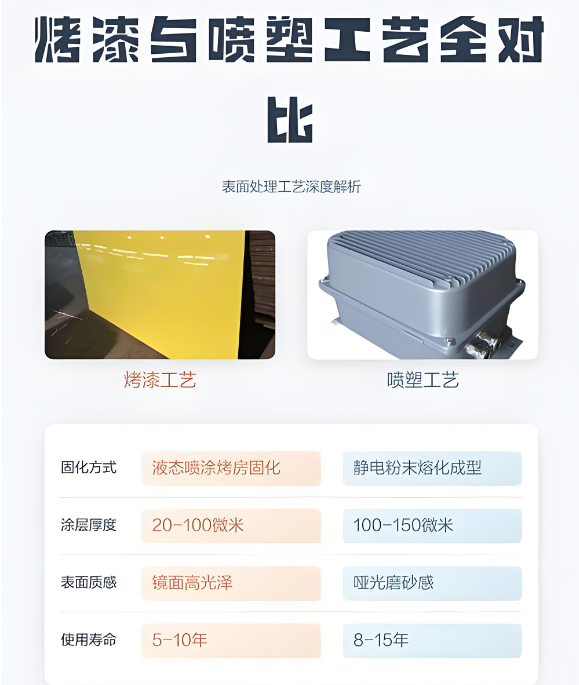
[Surface process comparison chart | Electrostatic powder spraying, fluorocarbon spraying, wood grain transfer, anodizing sample comparison]
Second, the four major surface treatment processes determine rust prevention, weather resistance and service life
Aluminum alloy itself will form a layer of natural oxide film, with basic anti-rust ability, but long-term outdoor sun and rain, acid rain, coastal salt spray environment, simple bare aluminum is easy to turn white and lose light, and surface protection treatment must be done. The four mainstream processes vary greatly.
The first type is electrostatic powder spraying, which is the most commonly used for home improvement guardrails. Polyester powder is electrostatically adsorbed on the surface of aluminum, cured and formed at high temperature. The paint film has uniform thickness, strong adhesion, and rich color choices. It can be matte or matte. It is resistant to ordinary rain corrosion and can be used outdoors for 8-12 years. The disadvantage is that the long-term strong salt spray environment by the sea makes ordinary polyester powder easy to powder and fade.
The second type, fluorocarbon spraying (PVDF), is the first choice for high-end projects and coastal villas. Fluorocarbon coating contains fluorine resin, which is resistant to ultraviolet rays, acid and alkali, and salt spray. It has strong resistance to fading and powder. The outdoor service life can reach more than 20 years. The cost is much higher than powder spraying, and it is mostly used for guardrails in high-corrosion areas such as seaside and around chemical plants.
The third type is the thermal transfer wood grain process, which does wood grain transfer on the basis of powder spraying, simulates the texture of walnut, oak, and mahogany, and solves the pain point that solid wood guardrails are easy to rot and crack. It is a popular choice for villa courtyards and new Chinese balconies. The wood grain layer is attached to the powder primer. The wood grain model with poor primer quality will peel and delaminate in 1-2 years.
The fourth type is anodic oxidation, an early old-fashioned process that forms an oxide film on the surface, with a single color (mainly silver gray) and weak decoration. Nowadays, guardrails are rarely used alone.
Key points for purchasing pit avoidance: Many low-priced wood grain guardrails are only simply painted, not powder spraying + heat transfer, and the paint film peels off in one or two years.
[Schematic diagram of connection structure | Detailed diagram of welded aluminum alloy guardrail and assembled (screw card) guardrail nodes]
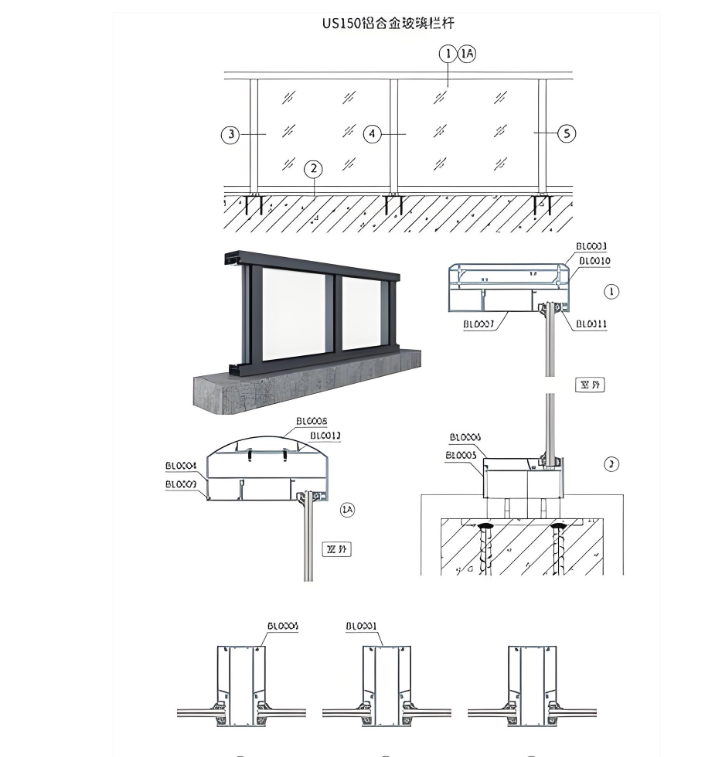
Third, the connection structure: welding type vs assembly card type, two mainstream systems
The aluminum alloy guardrail is divided into two major systems: welded aluminum art guardrail and modular assembled guardrail, with different structural forms, advantages and disadvantages, and completely different application scenarios.
Welded aluminum art guardrail: After the pipe is cut, argon arc welding is formed, and the weld is polished and then sprayed as a whole. The advantages are strong in integrity and good in stability. It can be made into complex carvings, arcs, and artistic shapes. Most of the guardrails supporting villa courtyards and gates are welded. The disadvantage is that the high temperature of welding will destroy the original oxide layer of aluminum. If the weld position is polished and the powder is not in place, the weld will easily turn white and corrode first. High requirements for welder technology, rough welds and missed sprays are hidden quality hazards.
Modular Assembly Guardrail: Relying on special aluminum alloy clamps, stainless steel hexagonal screws, embedded parts splicing assembly, factory prefabricated accessories, no need to weld on site. Advantages: There is no open flame on site, the construction speed is fast, and there is no hidden danger of welding weld corrosion. The damage of a single rod in the later stage can be replaced separately. The bulk project of the real estate and the balcony bay window guardrail are used a lot. Short board: The clamps and screws are worn parts. If ordinary 201 stainless steel screws are used, the screws will rust and get stuck in the humid environment, and they will become loose after long-term use. 304 stainless steel fasteners must be matched.
There is no absolute good or bad, the pursuit of complex modeling, courtyard landscape welding aluminum art; real estate batch balconies, the pursuit of post-maintenance convenience priority assembly guardrail.
[Style classification real picture | Simple vertical rod guardrail, aluminum art carved guardrail, new Chinese-style lattice guardrail, stair handrail guardrail]
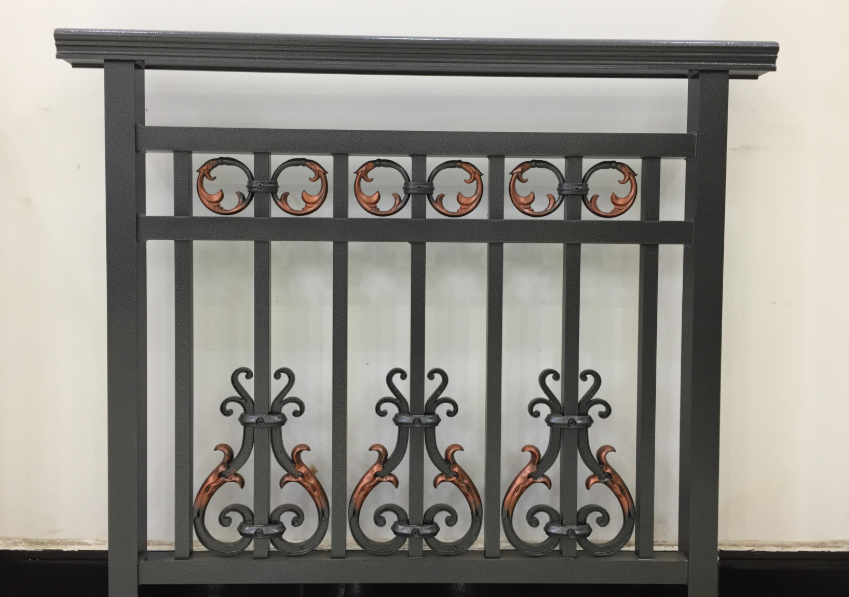
Fourth, aluminum alloy guardrail mainstream style classification and adaptation scene
Simple vertical bar model: isometric vertical small aluminum bars with main horizontal pipe, simple and transparent shape, unblocked field of vision, is the most mainstream style of high-rise residential balconies and bay windows, in line with residential protection specifications, vertical bar net distance ≤11cm, to prevent children's head from getting stuck, safety attributes are preferred.
Aluminum art carved guardrail: with cast aluminum flower parts, curved flower shape, European-style, American-style villa courtyard wall guardrail, home platform guardrail is commonly used, with strong decoration, beautiful appearance, and protective performance can also meet standards.
New Chinese-style lattice guardrail: paper lines, ice cracks, grille shape, with tea room, Chinese courtyard, self-built balcony, the national style texture is prominent, the grille gap design needs to take into account protection and safety, and the gap cannot be too large.
Stair aluminum alloy handrail guardrail: diagonally follow the step customization, divided into column models, card slot pre-embedded models, taking into account the comfort of walking handrails, cross bar height, column spacing has mandatory specifications.
Wall isolation guardrail: heightened model, used for factory and yard peripheral fencing, with a height of 1.2-1.8 meters, taking into account protection and isolation.
[Safety specification marking diagram | Guardrail height, vertical rod clear distance, ground clearance, handrail height national standard parameter marking]
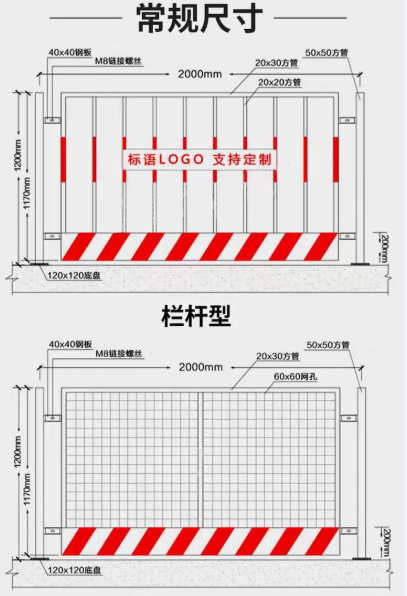
V. National safety regulations and load performance indicators (core professional points)
The aluminum alloy guardrail is a building safety protection component, and the implementation of the "Residential Design Code" GB50096 and "Building Guardrail Technical Regulations" JGJ/T 451, many owners and engineering parties ignore the specifications and fail to complete the acceptance.
Core mandatory parameters: six-story and above high-rise residential balcony guardrail net height of not less than 1.1m; low-rise, multi-story residential not less than 1.05m; stair handrail height of ≥0.9m; vertical pole clear distance must be ≤110mm (11cm) to prevent children from drilling out, stuck; guardrail bottom off the ground if there is a platform can be stepped on, from the stepping surface to calculate the height, not from the ground.
Load requirements: the horizontal load standard value of the top of the residential balcony guardrail ≥1 kN/m, simple understanding, the top of the guardrail is evenly applied thrust, no obvious deformation, fracture, overturning; the load requirements of the public area of the project are higher, ≥1.5 kN/m.
Many low-priced guardrails only pursue good-looking, with vertical rod gaps of 13cm and 15cm, which are insufficient in height and are illegal products. Property, fire protection, and completion acceptance will directly require demolition and rectification.
In addition, the bottom of the guardrail prohibits easy-to-climb horizontal pedals to prevent children from stepping over. The high-rise balcony guardrail is designed with priority to vertical railings, and less horizontal multiple crossbars are used.
[Embedded parts installation node diagram | baseplate embedding, chemical anchor bolt, expansion screw fixing, concrete base node]
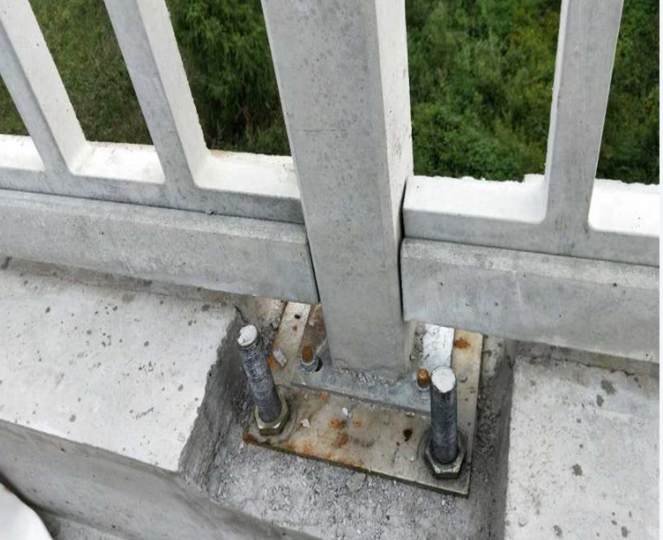
Standardized installation process, three points of stability, seven points of product installation
No matter how good the aluminum alloy profile is, if it is not installed and fixed properly, it will shake and overturn. The core of the installation lies in the anchoring of the base.
The first step: on-site investigation, distinguish the installation base, concrete floor, red brick wall, hollow brick, insulation layer wall treatment plan is completely different. Hollow brick, insulation layer wall can not be directly hit ordinary expansion screws, need to be embedded steel plate or chemical anchor reinforcement, otherwise directly pull off after force.
Step 2: Position the pay-off line, mark the column point, and control the column spacing. The conventional column center spacing is 1.0-1.2 meters. The larger the spacing, the higher the requirements for the wall thickness of the pipe.
The third step: anchor fixed, embedded baseplate or chemical anchor bolt fixed column base, gasket leveling, base sealing glue to prevent rainwater along the bolt hole into the base surface, resulting in anchor corrosion.
Step 4: rod assembly/welding, the assembled type locks the stainless steel screws, and the welded type is repaired and polished on site;
Step 5: The gap is closed, and the gap between the base, the ground and the wall is sealed with weather-resistant glue, taking into account waterproof and beautiful;
Step 6: Shake test, shake the guardrail vigorously with both hands, no obvious shaking or abnormal sound is qualified, and check whether the height and vertical rod spacing meet the specifications.
Common installation errors: directly fixed to the external wall insulation layer, without reinforcement, and later the guardrail is loose, which is a very large safety hazard.
[Material comparison schematic diagram | Comparison of advantages and disadvantages of aluminum alloy guardrail, wrought iron guardrail, zinc steel guardrail, 304 stainless steel guardrail]
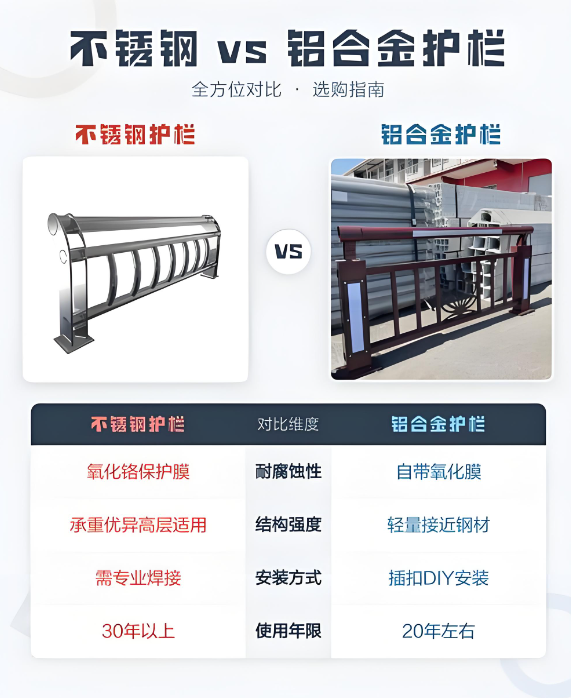
Horizontal comparison of aluminum alloy guardrail and other guardrail materials
Wrought iron guardrail: retro in shape, moderate in price, but extremely easy to rust, requires polishing and painting maintenance every year, and now home improvement is gradually being phased out;
Zinc steel guardrail: inexpensive, easy to assemble, thin coating, 3-5 years of coating peeling, substrate rust, mostly used for temporary workplaces and simple walls;
304 stainless steel guardrail: rust-proof and stable, but the style is monotonous, the color is single, it is difficult to make complex shapes, and there are still rust points along the coast;
Aluminum alloy guardrail: The original aluminum substrate itself is stainless, the qualified fluorocarbon/powder coating is stable outdoors for a long time, free of paint maintenance, and the shape is highly malleable, taking into account the appearance, safety and durability. The only shortcoming is that under the same specifications, the unit price is higher than that of zinc steel and ordinary iron.
[Comparison of advantages and disadvantages details | Thickened primary aluminum + 304 fasteners qualified guardrail VS thin-walled recycled aluminum, 201 screws, weld leakage spray inferior guardrail]
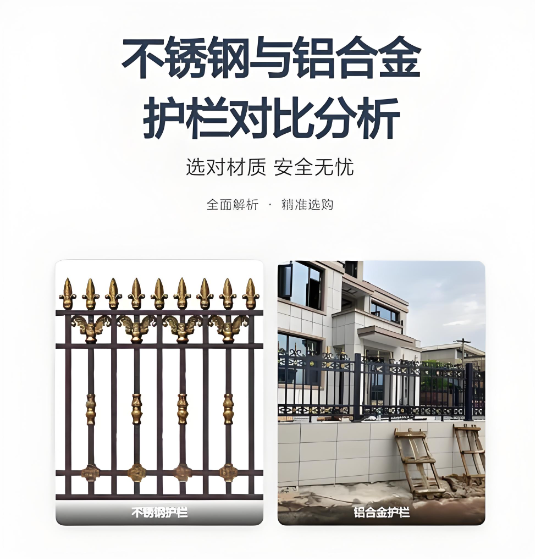
Eight, buy pit avoidance guide, see through the industry reduction routine
The wall thickness of the virtual label is marked with 2.0mm, but the actual recycled aluminum is only 1.0-1.4mm, which is shaken and soft;
Confuse powder spraying and fluorocarbon spraying, and ordinary polyester powder is sold at a high price pretending to be fluorocarbon;
The assembled model uses 201 stainless steel screws, and the screws in humid environments rust and crack the base;
The vertical rod spacing exceeds the standard and the height of the guardrail shrinks, which does not meet the residential safety specifications;
The weld of the welding model is not polished or sprayed, and the weld position will soon turn white and corrode;
The quotation only counts as rods, embedded parts, chemical anchors, reinforcement, and gluing will be charged separately;
The wood grain model is sprayed with ordinary paint, not a heat transfer process, and is short-term peeling.
The contract must state: aluminum alloy grade, column/crossbar wall thickness, surface technology, fastener material, guardrail height, vertical rod net distance, quality assurance years.
[Maintenance schematic diagram | Guardrail cleaning, paint inspection, base sealant re-inspection, screw tightening maintenance]
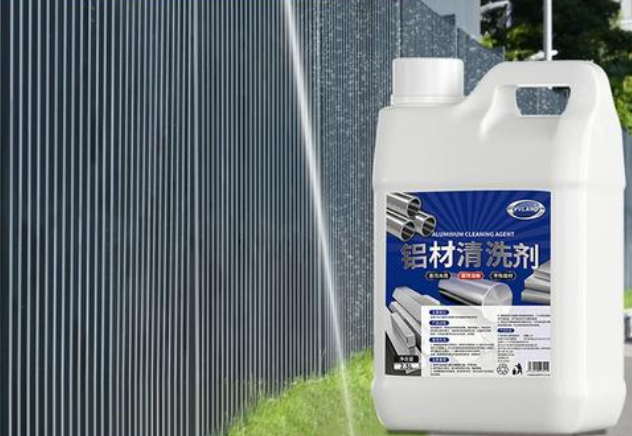
Nine, post-maintenance methods to extend service life
Aluminum alloy guardrails are low-maintenance products, but it does not mean that there is no need to check at all. Just wipe them with water and a neutral rag for daily cleaning. Do not use strong acid cleaners such as hydrochloric acid and oxalic acid, which will corrode the surface coating;
Check the base sealant once a year, crack and fall off, and replenish the glue in time to avoid water from entering the anchoring position; check the fastening screws every 1-2 years for the assembled model, and tighten them in time if they are slightly loose;
If the paint surface is partially bumped and peeled off, it can be painted with the same color refinish paint to prevent the bottom aluminum from being exposed for a long time;
Although fluorocarbon guardrails in coastal areas are resistant to salt spray, it is recommended to rinse the surface salt with fresh water once a year to delay the aging of the coating.
[Completed panorama | Villa courtyard complete set of aluminum alloy guardrail + door matching floor scene]
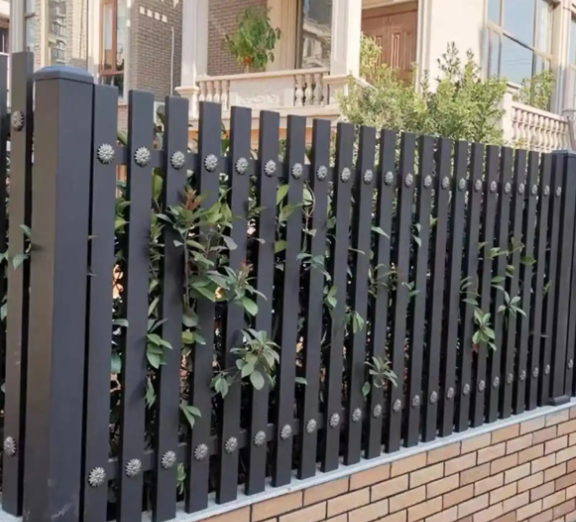
conclusion
Aluminum alloy guardrail is not a simple decorative fence, but a safety component with both aesthetic effects and protective functions. From 6063 aluminum substrate, profile wall thickness, surface spraying process, connecting structure, to anchoring installation, and national protective load codes, each ring determines the final safety and durability.
The simple vertical rod model is suitable for high-rise balcony bay windows, the carved and new Chinese grille model is suitable for villa courtyards, the assembled type is suitable for engineering batch projects, and the welding aluminum art is suitable for personalized modeling and customization. When purchasing, you can't just focus on the appearance and price, and give priority to verifying the wall thickness of the profile, surface technology, safety size specifications, and fastener configuration, with professional anchoring installation solutions.
A set of qualified aluminum alloy guardrails can not only meet the beautification needs of courtyards, balconies, and stairs, but also provide long-term protection, safeguard the safety of family members, and achieve long-term maintenance-free and rust-free core advantages.