

Car sunroof
Automotive sunroof professional in-depth analysis | A complete guide to types, structural principles, purchase, failure repair and maintenance
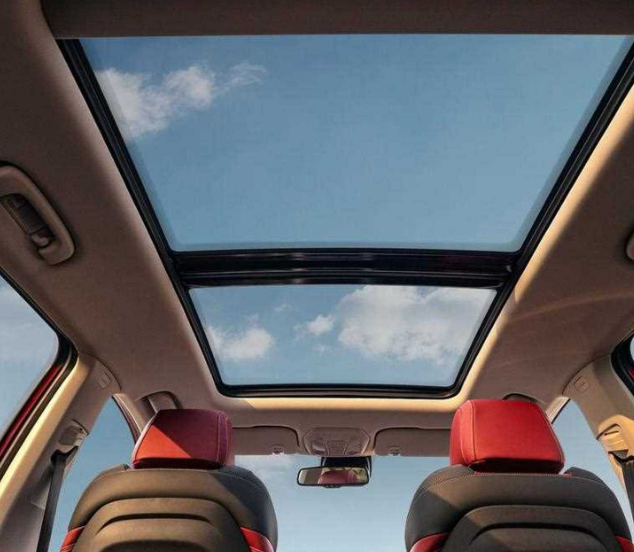
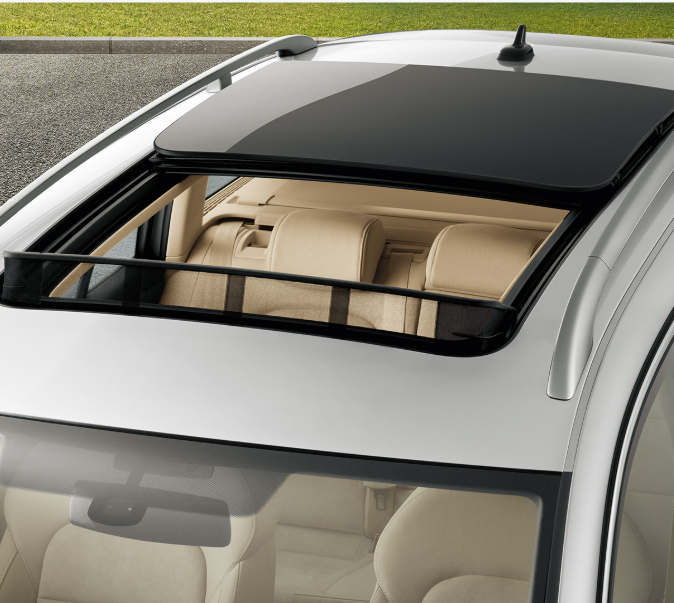
[Car panoramic sunroof, segmented sunroof, small size single sunroof appearance real shot, car, SUV sunroof renderings collection]
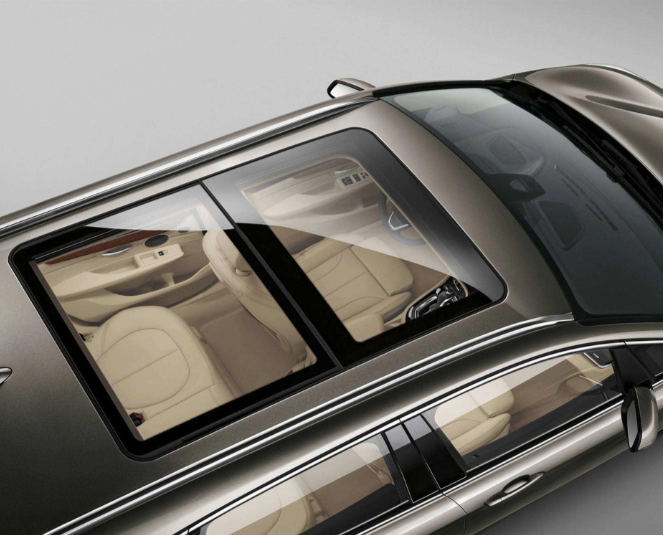
The car sunroof is an openable lighting and ventilation component installed on the roof position, which is the configuration that many car owners pay attention to when purchasing and modifying their cars. Many consumers simply equate the car sunroof with "roof glass", only looking at the lighting and looking good, but they know very little about the sunroof structure type, sealed drainage system, drive hardware, heat insulation and sound insulation, common faults, post-maintenance and other professional knowledge. Sunroof is a composite assembly of precision electromechanical + sealed and waterproof. Once it is designed, assembled, used and maintained improperly, it is prone to water leakage, abnormal noise, motor failure, sunshade stuck and other problems. This paper starts from the aspects of automobile sunroof classification, internal structure, working principle, core performance indicators, advantages and disadvantages, the difference between original and modified sunroof, high-frequency fault investigation, maintenance points, long-term maintenance and pit avoidance, etc.
[Schematic diagram of sunroof classification | Built-in sunroof, external flip sunroof, panoramic segmented sunroof, panoramic integrated sunroof, sunroof comparison real shot]
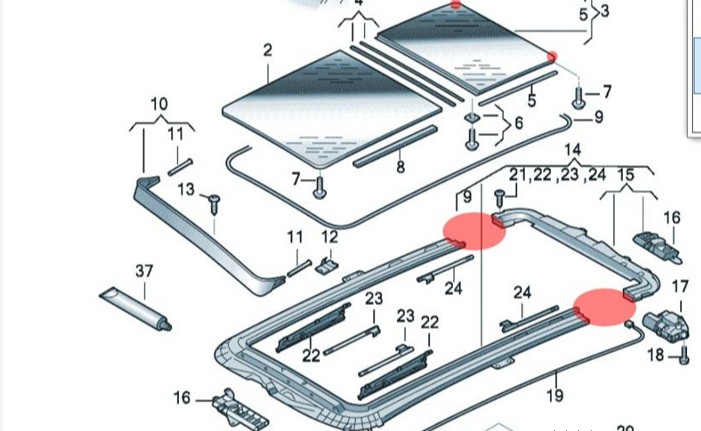
First, the mainstream types of car sunroofs have huge differences in the application scenarios of different structures
According to the open structure of car sunroofs on the market, they are mainly divided into external flip-up sunroofs, built-in sliding sunroofs, segmented panoramic sunroofs, integrated panoramic sunroofs, and niche folding sunroofs. The ventilation logic, cost, and reliability of each structure are completely different.
Lift-up sunroof (lift-up sunroof): Also called a lift-up sunroof, it is the most classic small sunroof in the early days. The glass rear end is tilted up, and the front end does not move, forming negative pressure ventilation, which will not occupy the head space in the car. Simple structure, few parts, low failure rate, cheap cost, more common in entry-level models. Ventilation relies on negative pressure to extract hot air and exhaust gas from the car, which has the advantage of good wind noise control; the disadvantage is that the opening area is very small, and the lighting is limited, so it cannot be fully opened backwards.
Built-in sliding sunroof: After the glass is opened, it slides inward to be stored between the roof lining and the roof steel plate interlayer, resulting in a larger opening area, and the ventilation and lighting effects are better than those of the outer lift. However, the interior of the roof needs to reserve storage space, which will occupy part of the head height, and has high requirements for the roof structure design. There are more guide rails, wire ropes, and motor components, and the number of failure points will increase. At present, most of the ordinary single sunroof windows in family cars are in this form.
Sectional panoramic sunroof: It is composed of two independent glass pieces at the front and rear. The front glass can be slid/lifted up to open, and the rear glass is fixed. Taking into account the lighting and ventilation capabilities of a large field of view, it is now standard for SUVs and mainstream household models. The roof is retained in the middle to strengthen the beam, the body rigidity is better, the safety is better than the integrated canopy, and the front glass can be replaced separately during maintenance, and the maintenance cost is lower.
One-piece panoramic canopy: The whole piece of oversized glass covers the roof, most of the canopy cannot be opened, only lighting and heat insulation function, no ventilation function. The visual transparency is the strongest, and the appearance is high; the short board is that it is impossible to open the window for ventilation. Under the summer sun exposure, the heat conduction of the roof is obvious, which requires extremely high heat insulation film and sunshade, and once the whole piece of glass is damaged, the replacement cost is expensive.
Differentiate the key points: Many sales will directly refer to the canopy as a panoramic sunroof. Here, there is a confusion of concepts. The one that can open the ventilation is the real sunroof, and the fixed canopy is only daylighting glass.
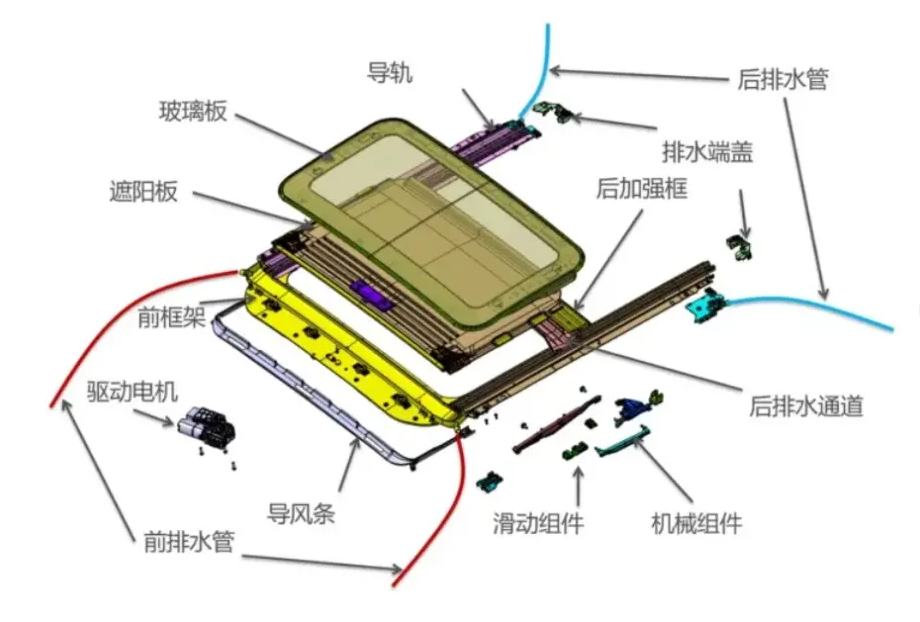
[Disassembly diagram of sunroof assembly | Disassembly and marking of glass panel, sealing tape, guide rail assembly, drain pipe, motor, wire rope, sunshade assembly]
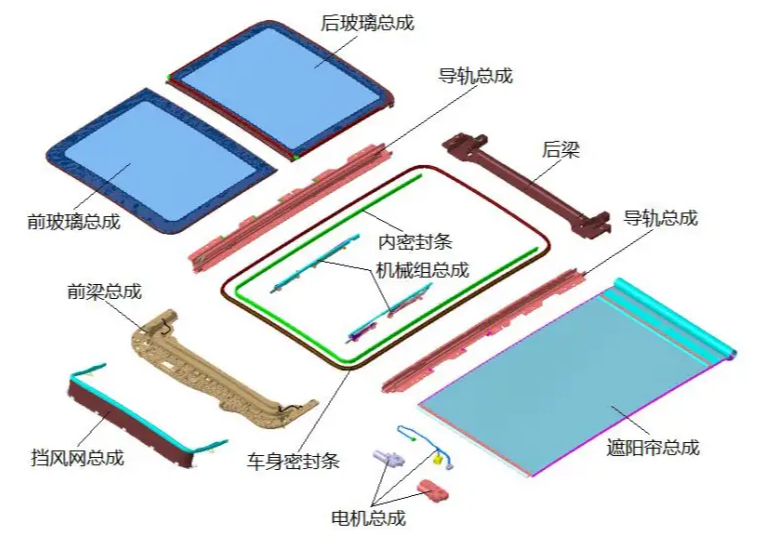
Second, the internal assembly structure and working principle of the car sunroof
A complete set of openable automotive sunroof is a set of precision electromechanical assemblies, mainly including tempered laminated glass, peripheral sealing strips, aluminum alloy guide rails, transmission wire ropes, drive motors, control modules, sunshade assemblies, four-way drainage pipes, limit sensors, anti-pinch modules.
Working principle: The sunroof motor receives the button signal in the car, drives the wire rope to pull the sunroof bracket, and the bracket slides along the guide rail to realize the lifting and sliding closing actions; the sunroof comes with a Hall sensor, which is used to identify the position and speed of the sunroof, and integrates anti-pinch function. It detects resistance during the closing process and automatically reverses it to prevent pinching personnel, which is an important safety configuration.
Many car owners mistakenly believe that sunroof waterproofing relies on a circle of rubber strips to "compress and seal", which is the biggest cognitive misunderstanding. The car sunroof adopts an isobaric drainage structure, which is similar to the drainage logic of the system sun room and doors and windows: the main function of the rubber strip is sound insulation, buffering and dustproof, not the main waterproof. Rainwater falls on the water receiving tray in the sunroof frame, and follows the drain holes at the four corners, connects the rubber drain pipe, and flows along the inner side of the A-pillar and C-pillar to the bottom of the car. Once the drain hole is blocked and the accumulated water overflows the water receiving tray, there will be water leakage in the roof of the car. This drainage system is the core of the reliability of the sunroof.
[Close-up of sunroof glass and sealing strip | Double-layer laminated glass, coating layer, EPDM sealing strip, details of water guide tank]
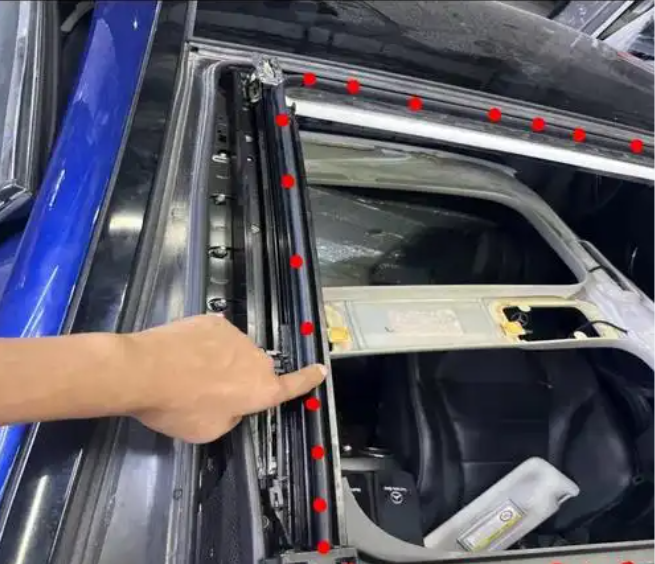
Third, sunroof glass, sealing strip core materials and performance indicators
Sunroof glass is basically double-layer laminated tempered glass, which is different from ordinary window tempered glass. The laminated layer can stick fragments after the glass is broken to prevent splashing and hurting people; high-end model glass comes with Low-E thermal insulation coating and ultraviolet barrier coating to isolate infrared heat and ultraviolet rays, reducing the temperature of the car after exposure. Some low-equipped sunroof glass has no thermal insulation coating, and the thermal insulation ability is poor. In summer, the roof is obviously hot.
The main material of the sunroof sealing rubber strip is EPDM rubber, which is resistant to high and low temperature, ozone aging, and is not easy to harden and crack in the long-term wind and sun. The rubber strip is an elastic buffer. After the sunroof is closed, the rubber strip is fitted to the roof frame to isolate high-speed wind noise and dust, and at the same time block most of the rainwater from flowing directly into the water guide tank. The rubber strip is a worn part, which is repeatedly squeezed and exposed to the sun all year round. After 5-8 years of use, it will harden, shrink, and crack, and there will be precursors to increased wind noise and water seepage.
When selecting a sunroof configuration, focus on two points: whether the glass is coated with heat insulation, whether the rubber strip is an integrated continuous rubber strip, and whether the segmented splicing rubber strip is more prone to aging and water seepage.
[Schematic diagram of the direction of the sunroof drainage system | The four corners of the sunroof receive water trays, drain holes, drain pipes along the column, and the position of the water outlet under the car is marked]
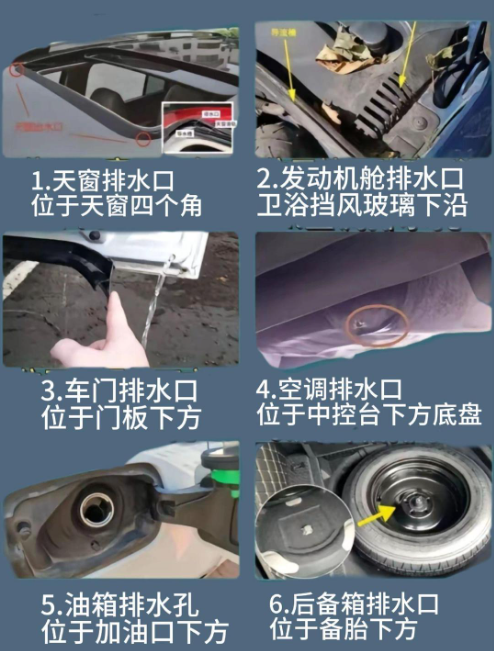
IV. Skylight drainage system, the core source of water leakage
The root cause of 90% of the failure of the sunroof leakage is not the damage of the rubber strip, but the blockage of the drainage pipe. A drain port is set in each of the four corners of the sunroof frame, which is connected to the flexible rubber drain pipe. Generally, two A-pillars go on the front side, and two C-pillars go on the rear side. The final drain port is in the chassis wheel arch or the lower edge of the chassis.
The blockages are generally leaves, dust, sediment, catkins, and the rotten silt of fallen leaves, which is high in spring, summer and autumn. After the drain hole is blocked, the rainwater cannot be discharged, and the stagnant water continues to rise in the sunroof sink, crosses the edge of the sink, and penetrates into the roof lining, which is manifested as water seepage from the ceiling, moisture in the interior of the A-pillar, and water accumulation on the floor mats.
Another type of leakage is the falling off and cracking of the drain pipe: the drain pipe is simply plugged into the drain nozzle, causing the vehicle to experience long-term turbulence, thermal expansion and contraction, loose joints, and rainwater flowing directly into the interior of the column. This kind of leakage will slowly seep regardless of heavy rain or light rain, making it more difficult to check than blockage.
Professional maintenance specifications: dredging sunroof drainage can not only use thin iron wire to stab hard, iron wire is easy to puncture the rubber drain pipe; the standard method is low-pressure air gun purging + low-speed water filling test to confirm that the four pipes are smooth.
[Sunroof drive guide rail transmission structure diagram | Guide rail slider, wire rope, motor, grease position marking]
V. Guide rails and transmission systems: high-risk areas for abnormal noise and stagnation
The sunroof guide rail, slider, and wire rope form a transmission structure. The sunroof slides repeatedly, and special silicone-based grease is required between the slider and the guide rail. The original factory will add long-lasting grease, but over time, the grease will mix with dust to form sludge, and the lubrication will fail. There will be sunroof sliding cards and "creaking" friction abnormal sounds.
Many car owners make maintenance mistakes: add oil and butter by themselves. Ordinary butter is easy to flow at high temperature, absorb a lot of dust, and form sludge in just a few months, exacerbating wear and tear, and even jamming the sunroof. The sunroof guide rail can only use the long-lasting silicone grease specified by the manufacturer, which is resistant to high temperature and is not easy to accumulate dust.
At the same time, if the wire rope is pulled back and forth for a long time, there will be fluffing and broken wires. Once the wire rope is broken, the sunroof cannot be opened and closed directly. Maintenance requires the replacement of the entire sunroof bracket assembly, and the maintenance cost is high.
[Comparison chart of the original sunroof vs the retrofitted sunroof | Comparison of the structure of the original roof reinforced structure and the later perforated roof]
Sixth, the difference between the original factory's own sunroof and the later modified sunroof, safety priorities
Many owners are torn: The original car has no sunroof, can it be installed later? Here are some important body structure knowledge points.
Original sunroof: At the beginning of the design of the vehicle, the roof structure, reinforced beam, solder joints, and stress distribution have been matched with the sunroof opening. The roof steel plate is reserved for the forming frame, which has been tested for body torsion and collision safety. The integrated design of the drainage pipe, wiring harness, and sealing structure guarantees safety and waterproof reliability.
Later modification sunroof: need to cut the opening on the complete roof steel plate, damage the original car roof reinforcement, the rigidity of the body decreases, and the risk of collision increases; the sealing and drainage process of the modification shop is uneven, and the probability of water leakage and abnormal noise in the later stage is much higher than that of the original sunroof. After the vast majority of models are modified sunroof, the manufacturer will directly lose the relevant quality assurance of the roof, and some annual inspections will also be controversial.
Industry suggestion: Preference is given to the factory-built sunroof version, and it is not recommended that ordinary household cars be punched and installed with sunroofs later.
[Sunroof high-frequency fault comparison picture | Ceiling leakage, sunshade card, sunroof abnormal sound, anti-pinch failure, glass warping edge failure real shot]
Seven, car sunroof common faults, causes and professional investigation ideas
Fault 1: The sunroof leaks. Priority is given to checking whether the four drain holes are blocked and whether the drain pipe falls off and cracks; secondly, check the aging and cracking of the rubber strip and the deformation of the sunroof frame.
Fault 2: The sunroof is opened with abnormal sound and stuck. Most of the guide rail grease is greasy, the slider is worn, and the guide rail is deformed; first clean the guide rail grease, re-fill the special grease, and then check the wire rope and motor load if it is invalid.
Fault 3: The sunshade is stuck and derailed. The sunshade webbing is aging and the reel guide rail is deformed. Do not force the button to open and close, it is easy to break the webbing, and the ceiling needs to be disassembled for maintenance.
Fault 4: The sunroof is not tightly closed, the position is offset, one side is high and the other is low. The bracket slider is displaced and the guide rail is deformed. It is necessary to re-calibrate the position of the sunroof and initialize learning.
Fault 5: The anti-pinch function fails. The sensor is dirty, the motor calibration is lost, and the anti-pinch protection is lost when closed. There is a risk of pinch injury, and the sunroof initialization needs to be re-done.
Fault 6: The high-speed wind noise is obvious. The rubber strip is worn and collapsed, the sunroof is not completely locked, and the frame gap is offset.
Important reminder: If the sunroof fails and is stuck, do not press the switch repeatedly, it is easy to burn the sunroof control motor.
[Schematic diagram of sunroof maintenance operation | Cleaning drain holes, cleaning rubber strips, guide rail lubrication, sunshade cleaning practical operation]
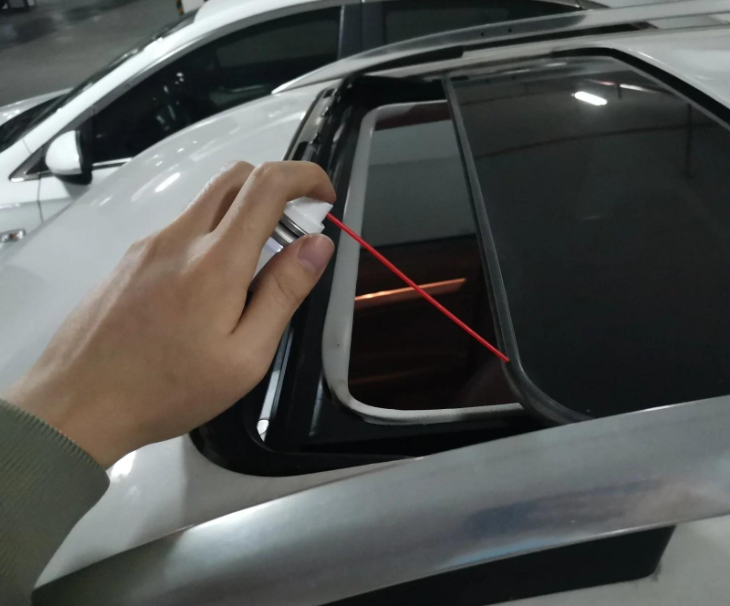
Eight, automotive sunroof standardized maintenance program to extend the life of the assembly
The sunroof belongs to a wear-and-tear electromechanical assembly. Standardized maintenance can greatly reduce the probability of water leakage and maintenance. It is recommended to check the maintenance cycle every six months, and focus on maintenance in the rainy season and catkins season.
1. Drainage system inspection and dredging: during the high incidence period of catkins and fallen leaves in spring and summer, check the four drains of the sunroof, clean up the fallen leaves and debris, and test the low pressure water to ensure the smooth water outlet of the chassis;
2. Sealing tape maintenance: use a wet rag to clean the dust in the gap of the tape, use a rubber protective agent to spray the tape to delay the aging of the rubber and avoid the drying and cracking of the tape; do not use an oily curing agent, it will corrode the EPDM tape;
3. Guide rail transmission maintenance: open the sunroof, wipe the internal sludge of the guide rail, clean up the old grease, and re-apply the special silicone-based grease for the sunroof;
4. Sunshade cleaning: Sunshades are mostly knitted fabrics, dry dust removal with a vacuum cleaner brush head, local wipe with a neutral cleaner for stubborn stains, prohibit a lot of flushing, and avoid soaking the ceiling sponge;
5. Functional test: Regularly open and close the sunroof several times a month, do not completely close it all year round. If it stands still for a long time, the rubber strip will stick and the grease will solidify, which is more likely to get stuck and fail;
6. Attention when washing the car: Do not charge the high-pressure water gun directly to the drainage position at the four corners of the sunroof for a long time. The high-pressure water will flush the drain pipe joints, causing internal water to enter.
[Purchase comparison chart | Advantages and disadvantages of panoramic sunroof and fixed canopy sunroof that can be opened]

Nine, choose to avoid pits: how to choose a sunroof when buying a car, it is best for you
1. If you often run at high speed and long distances, if you want to ventilate, you should give priority to opening the segmented panoramic sunroof. Negative pressure ventilation can quickly discharge odor and heat from the car;
2. Year-round sun exposure in the south, rarely open windows, value appearance, choose a canopy with high-quality heat insulation coating, with thickened sunshades, cost-effective, simple structure and low failure rate;
3. In underground garage parking, humid and rainy areas, the original factory can open the skylight first, but it is necessary to insist on regular dredging and drainage;
4. There is a lot of rain and snow in the north in winter. Be careful not to forcibly open the sunroof on snowy days. The snow freezes the rubber strip. Forcibly opening it is easy to tear the rubber strip and damage the transmission bracket;
5. If there are children at home, give priority to confirming that the sunroof anti-pinch function is normal. Do not let children's heads stick out of the sunroof during driving, which is a serious safety hazard, and the traffic regulations also expressly prohibit it.
[Wrong operation warning picture | Snow and ice forcibly open the sunroof, high-pressure water gun goes straight to the drain, and butter is added to lubricate the guide rail. Error demonstration]
Ten, daily use taboos, many people have been hurting the sunroof
First, it is forbidden to open the skylight in the state of ice and snow, and the ice body can jam the glass, which is easy to tear the rubber strip and break the wire rope;
Second, do not open the sunroof immediately after long-term exposure to the sun, as the temperature difference is large, the glass stress changes, and there is a small risk of glass self-explosion.
Third, do not place heavy objects on the skylight. Skylight glass is only a lighting component and does not have load-bearing capacity.
Fourth, do not disassemble the sunroof frame by yourself. The sunroof is equipped with torque and position calibration, and the assembly deviation directly leaks water and makes abnormal noises;
Fifth, after the sunroof leaks, don't just dry the interior without dealing with the root cause of drainage. If the water remains inside the column, it will corrode the body sheet metal and become moldy and smelly.
[Vehicle renderings | Real scene of lighting and ventilation in SUV with panoramic sunroof]
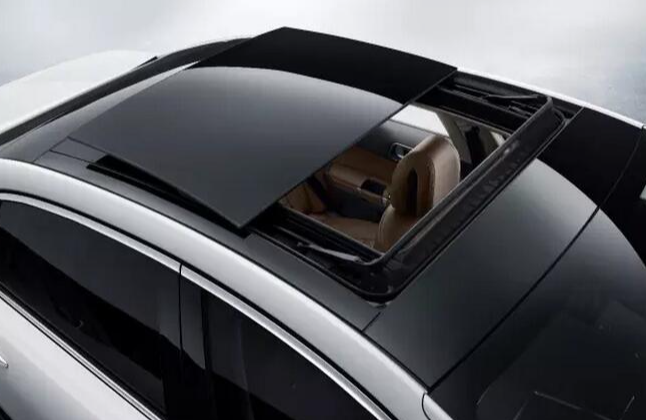
conclusion
A car sunroof is not a simple piece of roof glass, but a complex assembly that integrates body structure, isobaric drainage system, rubber seal, precision electromechanical drive, and safety anti-pinch module. Many car owners have two major misunderstandings about sunroofs: one is that they rely on rubber strips for waterproofing, and the other is that the canopy is equal to a panoramic sunroof.
The maximum value of the openable sunroof is negative pressure ventilation, quick ventilation, and hot air discharge in the car; the canopy focuses on lighting appearance, sacrificing ventilation, simple structure and fewer failures. The original sunroof has been verified for vehicle safety, and its reliability is much higher than that of later punching and modification; while the vast majority of sunroof leaks and abnormal noises are not inherent quality problems of the product, but long-term lack of maintenance. The drainage holes are blocked by fallen leaves and sediment, and the guide rail lubrication fails.
Only by mastering the principle of sunroof structure, regularly dredging drainage, maintaining rubber strips and guide rails, and avoiding violent operation can long-term stable use and reduce high maintenance. When purchasing a car, choose a canopy or an open sunroof according to your own car environment and usage habits, and look at the sunroof configuration rationally. Do not blindly pursue large-size panoramic sunroof, taking into account practicality, reliability and later maintenance costs