

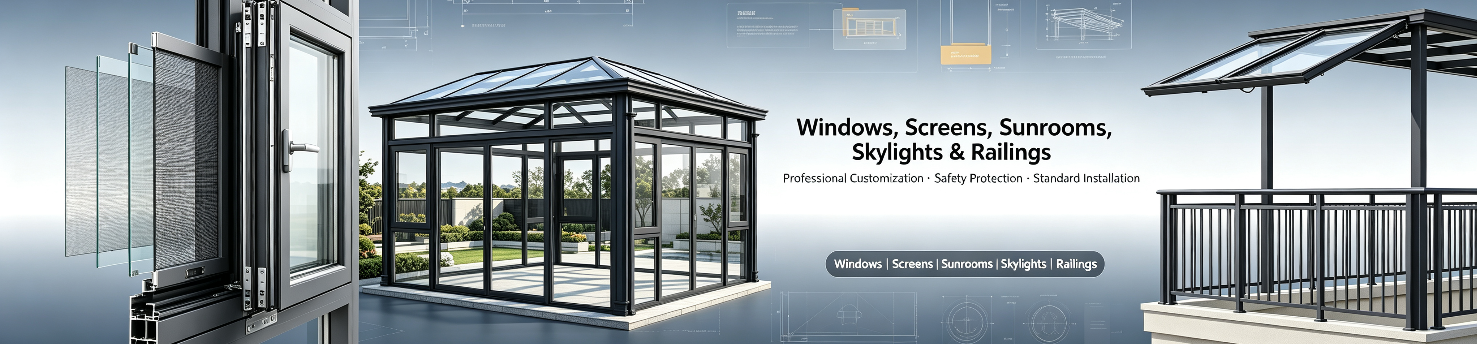
Invisible screen window
Invisible screen depth professional science popularization | Structure principle, profile accessories, fabric parameters, installation and adaptation, maintenance and purchase guide
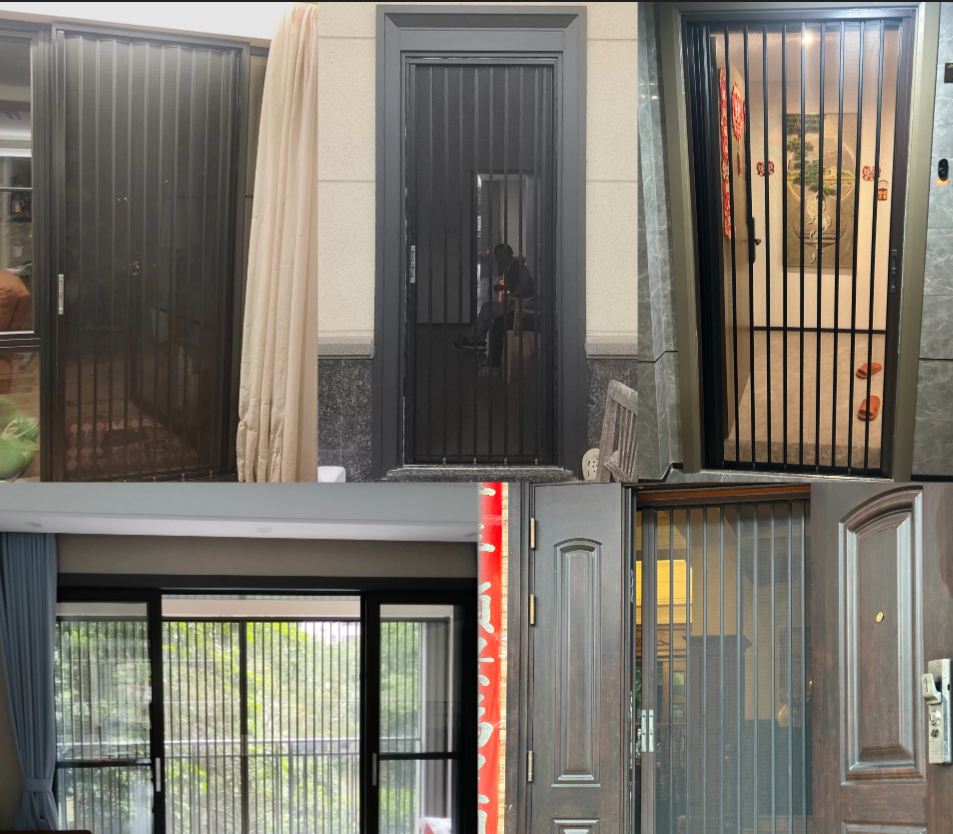
[The real scene of the completed invisible screen window installed on the home improvement window, the screen window is completely retracted from the reel, the appearance is simple, and it is integrated with the window frame]

In home decoration, old house window replacement, sun room matching, and engineering door and window supporting projects, screen windows are rigid demand accessories to solve mosquito infestation and ventilation. Traditional fixed diamond mesh screens and folding screens have obvious occlusion, heavy and abrupt vision. Many owners pursue simplicity and beauty, and will give priority to invisible screens. Invisible screens, also known as reel screens and roller shutters, rely on spring-wound structures. When not in use, the screen mesh is automatically stored inside the top reel, which will not block the window's vision for a long time and will not damage the appearance of the facade of doors and windows. It is a popular screen category for broken bridge aluminum windows, system windows, sun rooms, casement windows, and sliding windows.
However, many consumers only look at the price and color when purchasing invisible screens, and do not understand the internal structural differences of invisible screens, screen materials, spring types, profile wall thickness, and windproof systems. It is easy to buy inferior products. In just a few months of use, problems such as inability to pull, weak rebound, screen derailment, torn corners, broken springs, and leaking mosquitoes can occur. Invisible screens look simple in structure, but they are actually precision accessories with mechanical transmission and sealing. The quality of each component directly determines the overall service life and service experience. This article explains the classification, internal structure, core accessory parameters, screen fabric, windproof scheme, suitable window type, installation standard, fault repair, and key points of purchasing and avoiding pits from the professional perspective of the industry. It is suitable for decoration owners, door and window stores, decoration companies, and project procurement.
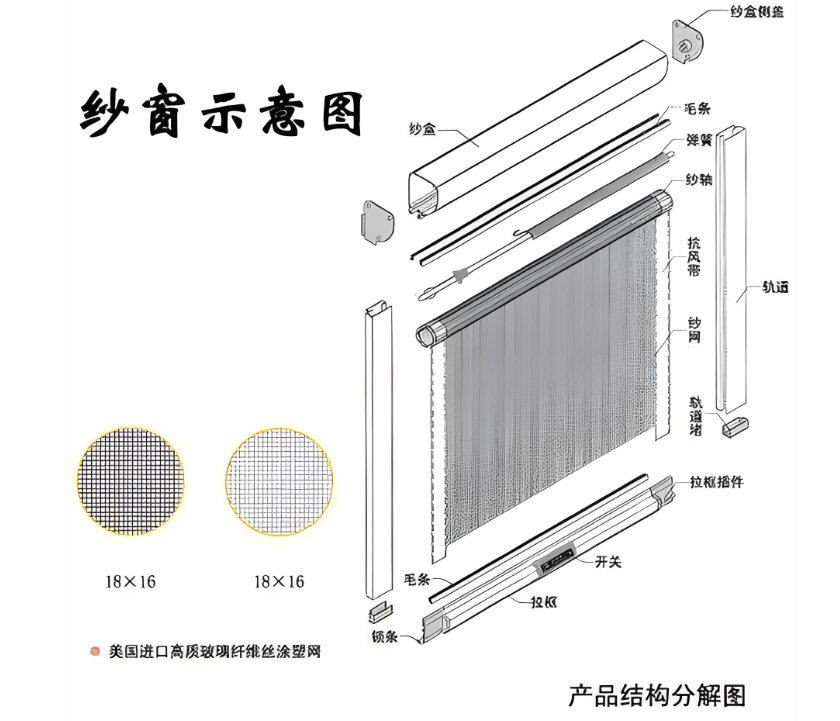
[Schematic diagram of structural disassembly | Invisible screen reel, spring, end cover, windproof rail, gauze net, handle, magnetic strip accessories split marking diagram]
First, the basic definition and mainstream classification of invisible screens, and different styles are suitable for scenarios
Invisible screen window, the core principle is the built-in scroll spring, which uses the spring elastic force to drive the screen to roll and store. Pull the handle down, and the screen unfolds to block mosquitoes; release the handle or unlock the magnetic attraction structure, and the screen automatically rolls up and back to the reel to hide. According to the structure and windproof form, the mainstream of the industry is divided into four categories: magnetic suction invisible screen window, side pull invisible screen window, upper and lower reel invisible screen window, and trackless invisible screen window.
The upper and lower reel magnetic invisible screen window is also the style with the highest market share. It is pulled vertically up and down, equipped with windproof card slots on the left and right sides, and a magnetic pull handle at the bottom. It is fixed by magnetic adsorption. It is suitable for most inner open windows, outer open windows, and fixed windows. It is installed on the inside of the window frame. It is easy to operate, cost-effective, and most used in household scenes.
Side-pull invisible screen window, the reel is arranged vertically, and the screen is pulled horizontally left and right, suitable for large horizontal wide windows, balcony sliding doors, and sun room opening fans. Because of the large horizontal span, the requirements for windproof strips, spring tension, and profile rigidity are higher. If the material used for the wide-width model shrinks, the screen in the windy environment is easy to bulge and remove the groove.
Trackless invisible screen window, eliminating the left and right hard windproof grooves, relying on soft windproof top limit, the advantage is that the window frame size compatibility is strong, does not bump the handle, the disadvantage is that the windproof ability is weak, only suitable for low-level windless environment, high-rise, street wind location is not recommended.
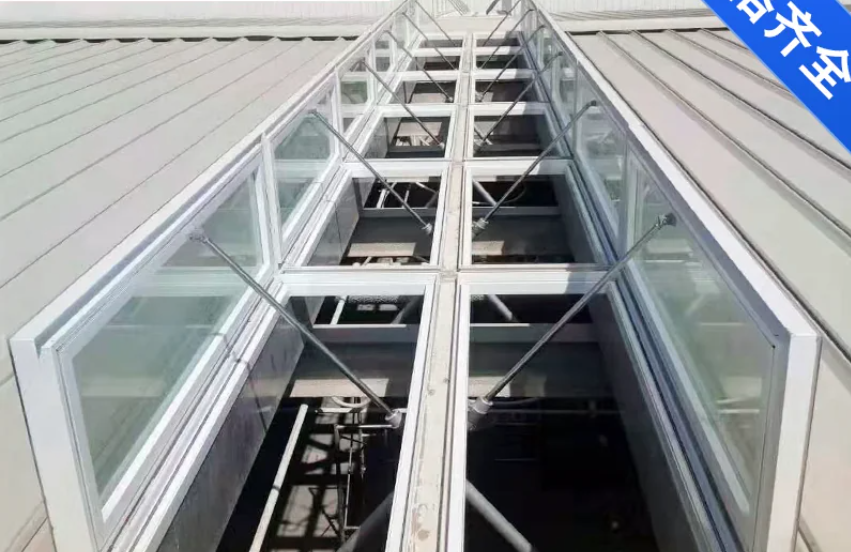
There is also a cable-stayed invisible screen window for the sunroof, which is suitable for the special-shaped hole of the pitched roof skylight. The structure has been optimized by angle to prevent the weight of the screen from sliding down, which is a customized special model.
Here is an important knowledge point: invisible screens are naturally more suitable for small and medium-sized opening fans. For holes with a height of more than 1.8 meters and a width greater than 1.5 meters, ordinary invisible screens are not recommended. High-transparency folding screens or diamond mesh screens are preferred; wide and high holes, the screen surface of invisible screens is easy to shake and the wind resistance is insufficient.
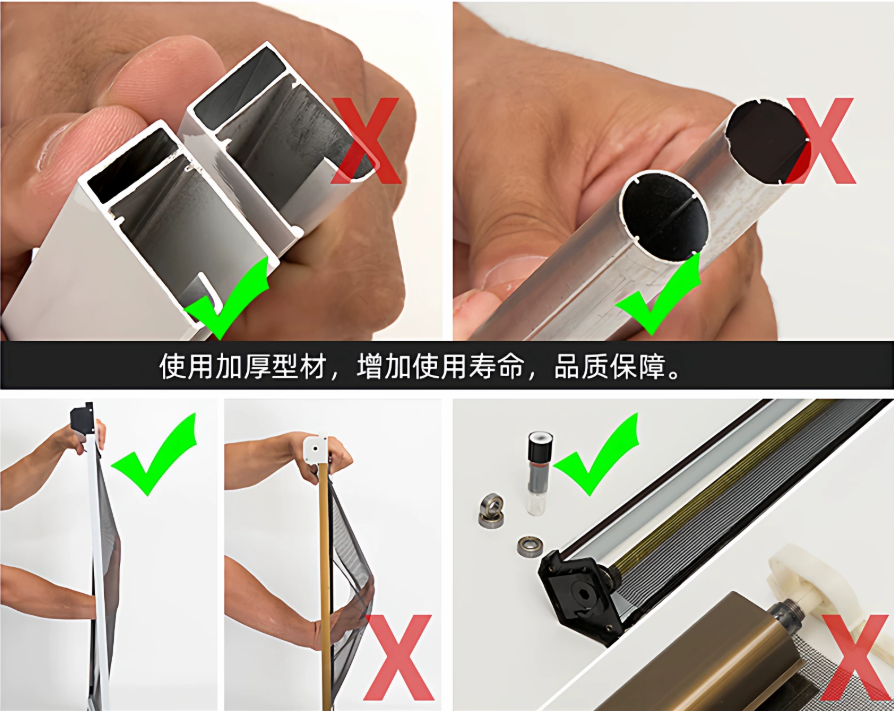
[Detailed drawing of profile section | Invisible screen aluminum alloy reel, track profile section, caliper to measure wall thickness, distinguish thin material and national standard thickened profile]
Second, aluminum alloy profile parameters, surface technology, and the skeleton of invisible screens
The main frame of the invisible screen window is all aluminum alloy profiles, including the reel shell, left and right windproof tracks, and bottom handle profiles. The wall thickness, material, and surface treatment of the profiles determine whether the frame will be deformed or faded. The base material is made of 6063 aluminum alloy, which is lightweight and rigid enough to not be easily distorted.
The wall thickness of industry profiles is an important watershed: the wall thickness of ordinary low-cost invisible screen profiles is only 0.6mm-0.7mm, the reel is thin, and it will be sunken and deformed when squeezed by a little force. After the track is twisted, the screen mesh is frequently stuck; the wall thickness of high-quality invisible screen profiles is 0.8mm-1.0mm. The reel shell is thick, and it is not easy to deform after long-term use. It is the basis for stable use. Many merchants do not take the initiative to explain the wall thickness when purchasing, which is a typical invisible reduction item.
Profile surface treatment is divided into three types: electrostatic powder spraying, anodizing, and fluorocarbon spraying. Electrostatic powder spraying is rich in color, can match coffee gray, fluorocarbon gray, black, and white of broken bridge aluminum doors and windows, with good adhesion and stable indoor environment. It is the mainstream of household use; anodizing is a native metal matte color, wear-resistant, and has few color choices; fluorocarbon spraying has the highest cost, is resistant to ultraviolet rays and acid rain, and is suitable for sun rooms and outdoor long-term sun exposure locations. It is not easy to fade and lose light for many years. Low-priced products use a painting process, which will peel and fade in half a year to a year, and there will be obvious color difference with the color of doors and windows.
The internal shape of the profile track is also exquisite. The high-quality windproof track has a snap-on windproof groove inside, which can firmly jam the windproof rubber strip on the side of the gauze; the inferior track slot is very shallow, and the rubber strip is easy to come out. When the wind blows, the gauze directly runs out of the track and loses its protective effect.
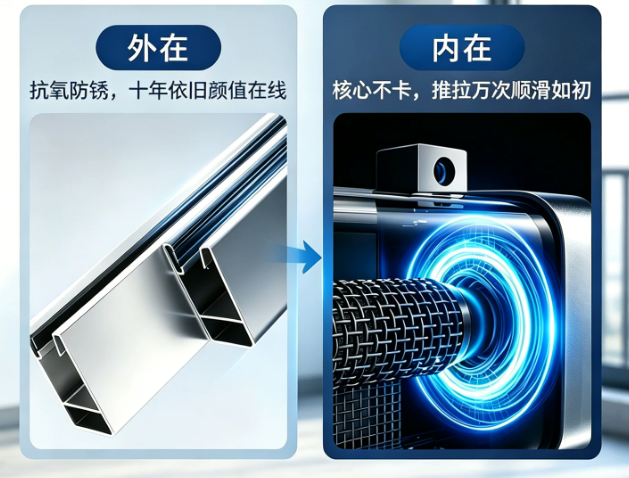
[Close-up picture of spring accessories | 304 stainless steel scroll spring, carbon steel spring comparison, structure diagram of the spring placed inside the reel]
Third, the scroll spring: the power core of the invisible screen, determines the rebound life
The spring is the heart of the invisible screen window. The entire winding function is realized by the scroll spring, which is also the part with the highest failure rate. Springs on the market are divided into two categories: ordinary carbon steel springs and 304 stainless steel springs, and the service life gap between the two is huge.
Carbon steel springs are inexpensive and easy to oxidize and rust. In a humid indoor environment, close to the bathroom, and in a long-term high temperature environment in the sun room, they will rust and elasticity will attenuate in a few months. There will be weak rebound, and they will not be able to be pulled down. Finally, they will be stuck directly. Many low-priced invisible screens are broken in carbon steel springs.
304 stainless steel scroll spring is the best in the industry, with corrosion resistance, stable elasticity, high temperature resistance, and higher repeated expansion and contraction fatigue life. Qualified stainless steel spring, the standard number of reciprocations can reach tens of thousands of times, and the elastic force decays slowly after 5-8 years of use in normal household environments. High-end products will also be equipped with a uniform speed damping device, that is, a buffer invisible screen window. When closing the net, it will not suddenly rebound and hit the reel to avoid the impact tear of the screen and loud noise. It is not easy to clamp hands if there are children at home. The damping model is an upgraded configuration.
The spring tension also needs to match the size of the hole: the higher the height, the larger the area of the gauze, the greater the spring tension required. Small windows use strong tension springs, the handle is very heavy, and it is laborious to pull; large windows are matched with springs with small tension, and the gauze cannot be retracted. Regular manufacturers will match the corresponding specification springs according to the height of the screen window, and small workshops use one spring uniformly, which has poor adaptability and poor experience.
[Comparison chart of gauze mesh fabrics | Comparison of polyester fiber high-transparency mesh, PP ordinary gauze mesh, encrypted mosquito-proof mesh samples, and the light transmission effect is real]
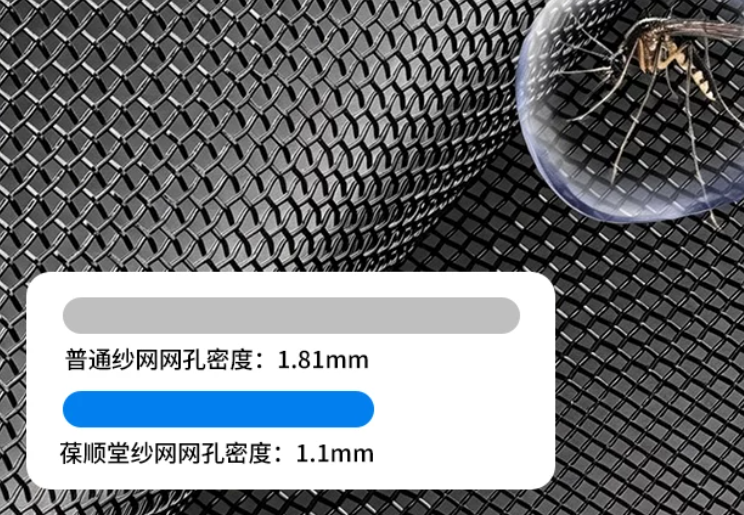
Fourth, the material of the gauze fabric, the parameters of the mesh number, the key to mosquito prevention, ventilation and vision
Many owners only look at whether the mesh can prevent mosquitoes, ignoring the material, gram weight, and mesh number of the gauze. The inferior gauze is easy to age, become brittle, pulverize, fluff, and break directly in one or two years. The mainstream gauze materials for invisible screens are divided into PP polypropylene gauze and polyester fiber PET high-transparency mesh.
PP screen: low cost, hard texture, cheap price. The disadvantage is poor weather resistance, long-term sun exposure to ultraviolet rays, easy to become brittle, broken, white color, generally low-end invisible screen standard.
Polyester fiber PET high-transparency mesh is the mainstream high-quality configuration at present, also known as high definition high-transparency gauze mesh. After anti-ultraviolet UV coating treatment, it has high flexibility, anti-aging, excellent light transmittance, and transparent vision, and will not block the line of sight like traditional gauze. The mesh number of the gauze mesh represents the mesh density. Household conventional 20-24 mesh, the mesh aperture is enough to block mosquitoes and small flying insects; encrypted 28 mesh style can block smaller midges and flying dust, suitable for the first floor of the house with many green plants and dense mosquitoes.
There is another indicator that is easy to ignore for gauze mesh: gram weight. Under the same mesh, the higher the gram weight, the more solid the silk thread, and it is not easy to tear the silk. High-quality PET high-transparency mesh is not easy to hook, and curtains and mops are not easy to break if occasionally scratched; low-cost tulle mesh, slightly sharp objects will break when touched. After the hole is broken, mosquitoes directly enter the room, and it is difficult to change the mesh alone. Most of them need to replace the screen window in a complete set.
There is also a kind of glass fiber yarn mesh, which has good tensile strength, but it feels hard and is easy to break when bent. Nowadays, household invisible screens are rarely used.
[Windproof sealing accessories diagram | PVC windproof rubber strip, magnetic magnetic strip, top strip samples, showing the side windproof structure]
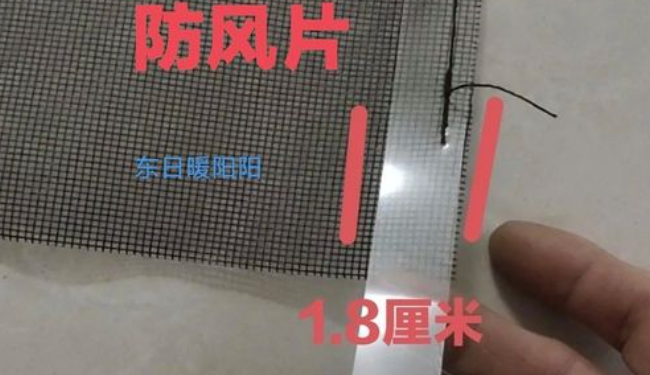
Windproof, sealing, and magnetic accessories: the key to solving the problem of derailment and leaking mosquitoes
If the invisible screen window wants to not leak mosquitoes and not derail in strong wind, it relies on a complete windproof sealing system. The accessories include side windproof rubber strips, bottom magnetic suction strips, and track dust-proof tops.
The windproof rubber strip on the side is inlaid on the left and right sides of the gauze, and embedded in the track card slot. The first function is to limit the position, prevent the gauze from shaking and derailing; the second is to seal, block the gap between the gauze and the track, and avoid mosquitoes from drilling in from the side gap. The windproof rubber strip is divided into soft PVC rubber strip and TPU rubber strip. TPU rubber strip has better toughness, does not harden at low temperature, is wear-resistant, and is not easy to break due to repeated friction; ordinary PVC rubber strip hardens, cracks, and fails to seal in winter.
The bottom magnetic attraction structure is divided into single magnetic strip and double magnetic strip. The double magnetic attraction is stronger, it is not easy to be blown open in a strong wind environment, and the closing gap is smaller; the single magnetic suction is weak, and it is easy to disengage when the wind pressure is large. The outer layer of the magnetic strip must be wrapped with soft rubber, and the hard magnetic strip collides directly. Long-term impact is easy to break, and at the same time the closure noise is large.
The dust-proof tops at the top and bottom of the track are used to fill the gaps and prevent dust from entering the inside of the reel. Dust enters the reel and accumulates, which will wear the spring and screen, accelerating the damage of the screen window. Many low-priced products directly omit the dust-proof tops, and the inside of the reel is easy to accumulate dust.
Correct a misunderstanding here: the windproof of invisible screens is limited windproof. Its windproof structure can only deal with daily breezes, high-rise trend positions, windward windows, even if the windproof tape is thickened, it will still bulge and derail under strong wind pressure. This working condition gives priority to diamond mesh screens, do not force invisible screens.
[Schematic diagram of window type adaptation | Renderings of installing invisible screens for inner opening windows, outer opening windows, sliding windows, and sun room opening fans respectively]
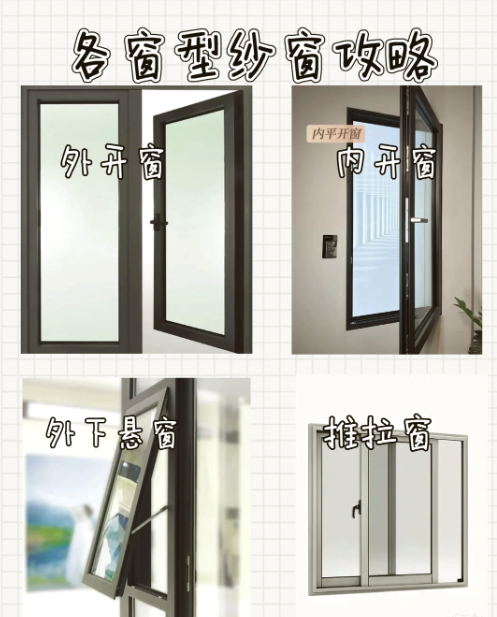
Six, different window type adaptation schemes, which windows are suitable for invisible screens and which are not
Invisible screens are not universal screens, and there are hard requirements for window type, handle position, and window frame width. Many owners find that they conflict with window handles after finishing, and cannot open windows normally.
The inner casement window is the window type with the highest degree of adaptation for invisible screen windows. When the screen window is installed on the indoor side, the reel and track will not interfere with the opening fan. The inner opening and inner inverted system window can also be customized. When customizing, you need to reserve a handle to avoid the gap.
Open the window outside: The screen window is also installed indoors. Pay attention to whether there is enough installation width on the inside of the window frame. For narrow frame system windows with a profile width of less than 2cm, the space is insufficient, and conventional reel invisible screens cannot be installed. Only ultra-thin models can be selected.
Sliding window: suitable for side-pulling invisible screen windows, but pay attention to the activity gap of the sliding fan to avoid the sliding of the sliding fan blocked by the screen window track.
Sunshine room skylight: only special oblique damping invisible screen window can be selected. Ordinary vertical screen windows will automatically slide down due to gravity, and the locking structure is different.
Not suitable for invisible screen window scenarios: large windward openings on the first floor, strong coastal wind areas, hole widths exceeding 1.6 meters, and pets scratching screens at home (cats and dogs can easily scratch PET screens). This type of scenario gives priority to diamond screen windows.
[Installation and construction map | hole measurement, positioning and punching, fixed track, debugging rebound, magnetic attraction alignment on-site real shot]
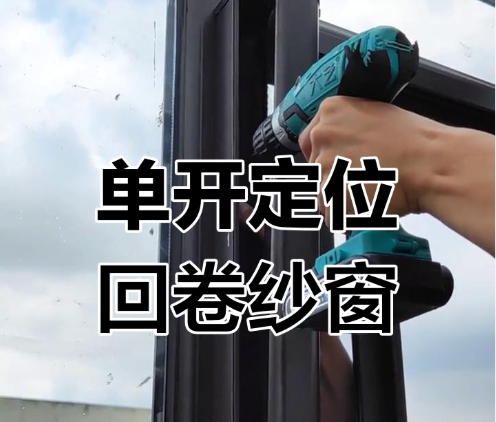
VII. Standardized installation process and acceptance standards for invisible screens
Invisible screen windows are customized products, "three-point products, seven-point measurement and installation", measurement errors and installation skew, no matter how good the accessories are, there will be card nets, uneven magnetic attraction, and poor rebound.
The first step of the standard process: accurately measure the opening, distinguish the size of the net inner frame and the size of the outer cover, confirm the material, thickness, and handle position of the window frame, and avoid the handle in advance; the opening direction of the inner opening and inner inverted window should be marked to avoid interference. The allowable error of measurement is controlled within 1mm.
Step 2: On-site positioning and punching, the aluminum alloy window frame is fixed with self-tapping screws; the wall position is fixed with an expansion tube, and the punching avoids the position of tempered glass and heat insulation strips to prevent damage to doors and windows.
Step 3: Fix the upper and lower reels and the left and right tracks, the level correction tracks are vertical, and the two tracks must be parallel. Once tilted, the gauze will continue to get stuck when pulled.
Step 4: Load the gauze mesh, adjust the spring tension and damping speed, align the bottom magnetic attraction, and adjust the position of the magnetic strip to ensure that the magnetic attraction is completely fitted after closing, and the gap is uniform.
Step 5: Repeat the full-stroke pull test many times to check whether the net is smooth, whether there is a card, abnormal sound, and the gauze is deviated, clean up the punching debris, and deliver it for acceptance.
Acceptance key points: smooth pulling, no sticking, no ear friction noise; gauze unfolded flat, no distortion, no bulging; magnetic attraction closed tightly, no obvious gaps around; uniform rewinding speed, damping will not rebound violently; track fixed firmly, shaking does not loosen; gauze no scratches, twisting.
[Maintenance schematic diagram | Clean up reel dust, wipe gauze, check magnetic stripe, clean track debris]
Eight, invisible screen daily maintenance, common failures and repair methods
Rational maintenance can effectively prolong the service life of invisible screens, and many failures are caused by daily use and improper cleaning.
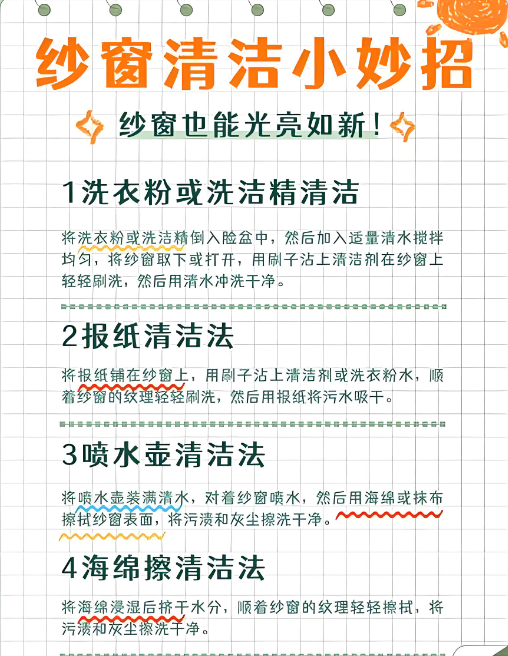
Clean the gauze: Use a soft brush and a wet rag to gently wipe, flush directly with a high-pressure water gun, and brush vigorously with a hard brush, which will cause the gauze thread to shift and the windproof rubber strip to fall off. Do not use strong acid and alkali cleaners, which will corrode the rubber strip and magnetic strip coating.