

Workshop warehouse fence fence
Workshop warehouse fence fence, also known as industrial isolation net, equipment protection fence, warehouse partition fence, is the core facility to achieve safety control and functional zoning in the factory area. Unlike civilian decorative guardrails, industrial fences are primarily aimed at meeting safety production specifications, impact resistance, and durability. Many enterprises only look at the price when purchasing, ignoring key parameters such as material, wire diameter, frame wall thickness, and anti-corrosion process. Not long after it is put into use, it will deform, paint peeling, solder joints falling off, and even fail to pass the safety inspection. This article explains the technical parameters, product classification, production process, installation standards, and purchase points of workshop warehouse fence fences from an industry professional perspective, which is convenient for factories, warehouses, and automation enterprises to quickly select models.
$280
Product Details
Product Details
Workshop warehouse fence | Industrial isolation fence parameters, process, selection and installation
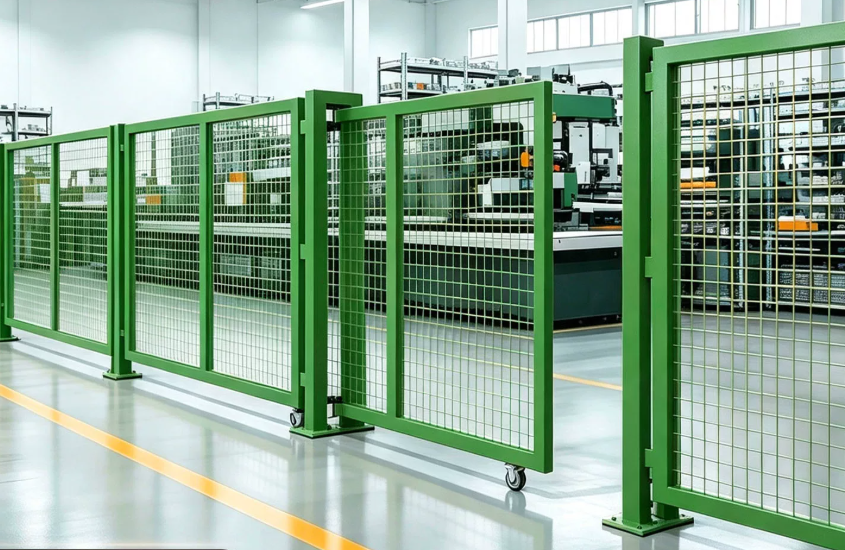
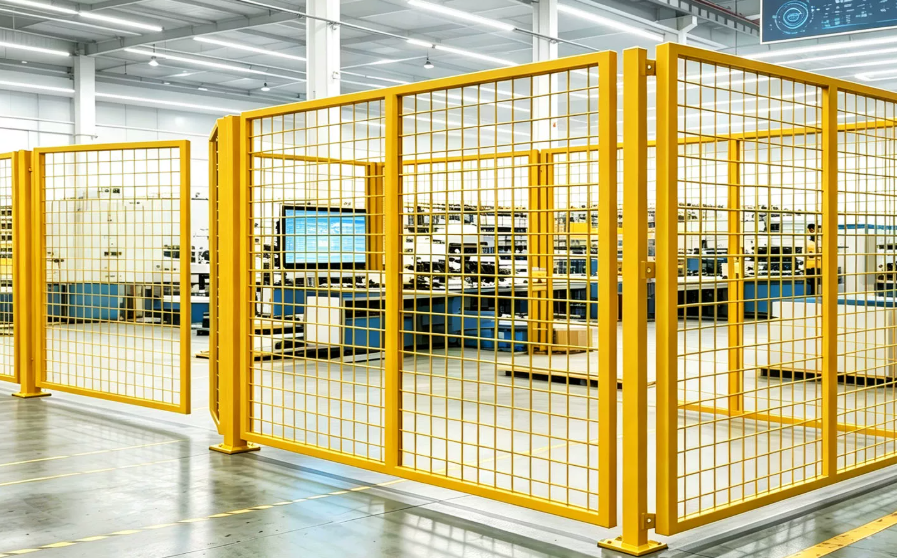
[The overall real scene of the workshop warehouse fence, the neat modular isolation fence in the factory building, divided into production areas and storage areas, the picture is clean and atmospheric]
In the management system of modern factories and warehousing and logistics parks, workshop and warehouse fences, also known as industrial isolation nets, equipment protection fences, and warehouse partition fences, are the core facilities for achieving safety control and functional zoning in the factory area. Unlike civilian decorative guardrails, the primary goal of industrial fences is to meet safe production specifications, impact resistance, and durability. Many companies only look at the price when purchasing, ignoring key parameters such as material, wire diameter, frame wall thickness, and anti-corrosion process. They will deform, paint peeling, solder joints falling off soon after they are put into use, and even fail to pass safety inspections. This article explains the technical parameters, product classification, production process, installation standards and purchase points of the workshop warehouse fence from the perspective of industry professionals, so as to facilitate the quick selection of factories, warehouses and automation enterprises.
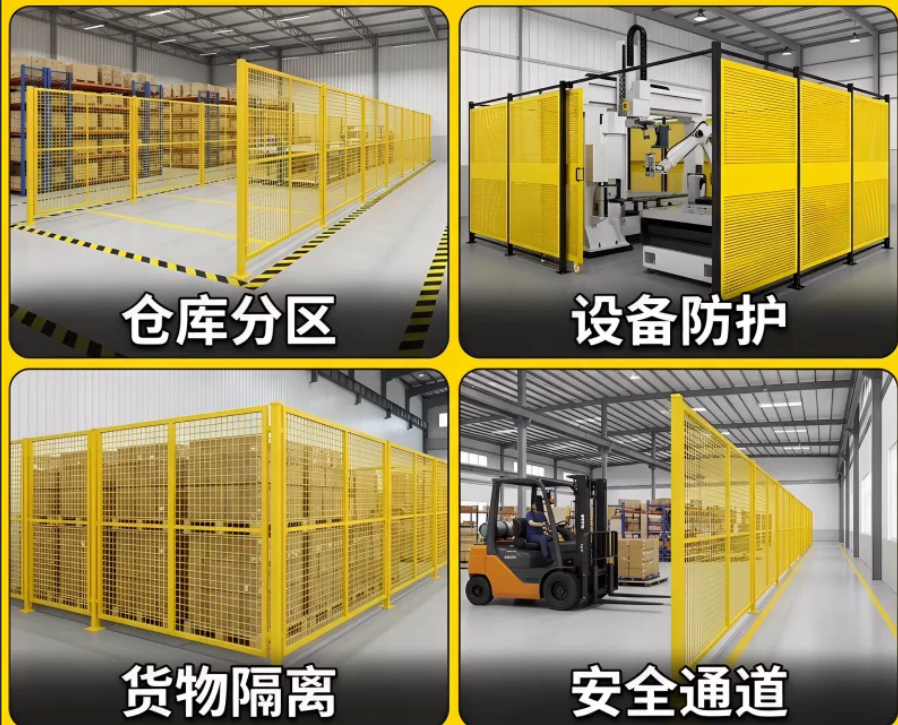
[Scene schematic diagram Multi-scene combination diagram: equipment protection, warehouse material partitioning, passenger and vehicle channel isolation, robot safety protection]
The internal functions of the workshop and warehouse are complex. The production line, storage shelves, forklift passages, automation equipment, and dangerous goods storage areas are staggered together. Once there is no clear isolation, it is easy to cause safety accidents such as personnel accidentally breaking into the equipment operation area, material mixing, and forklift collisions. The fence fence of the workshop warehouse relies on a modular structure to flexibly divide the area, and plays the role of isolation protection, warning zoning, and people and vehicles diversion. It can be used as a fixed partition for a long time, and can also be disassembled, assembled, and displaced on demand. It is suitable for production line adjustment and warehouse layout transformation. It is a supporting product for intelligent manufacturing and standardized management of the warehousing industry.
First, the workshop warehouse fence fence basic material and detailed technical parameters
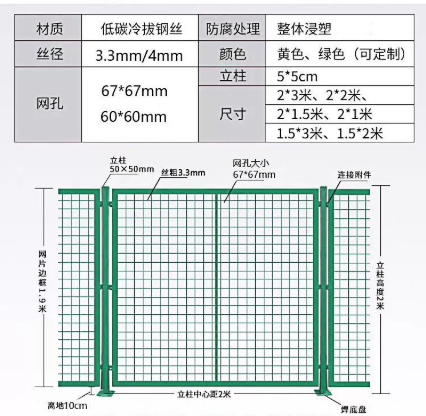
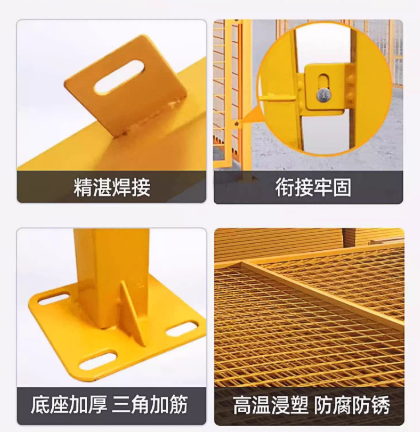
[Parameter details | Close-up of mesh, square tube frame, column section, marking wire diameter, mesh, pipe wall thickness and other dimensions]
The quality of industrial fences is reflected in the raw materials and specifications. The main body of the fence of the mainstream workshop warehouse adopts Q235 low-carbon carbon steel, which has good toughness and impact resistance, and is suitable for industrial environments where forklifts are scratched and heavy objects are bumped. The following are the general industry standard parameters:
mesh parameter
Wire diameter conventional specifications: 3.0mm, 3.5mm, 4.0mm; 5.0mm, 6.0mm thickened wire can be selected for heavy-duty and high-protection scenarios.
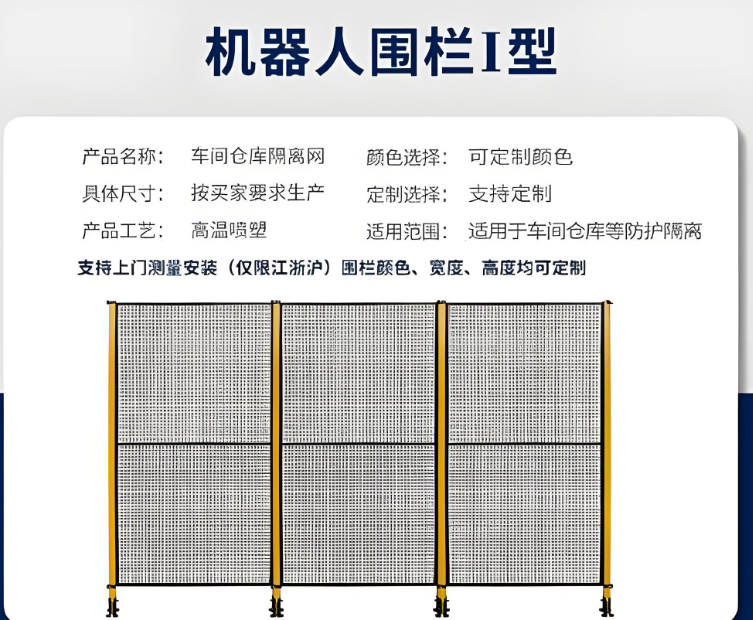
Mesh specifications: 5050mm, 50100mm, 8080mm. 5050 encryption models are mostly used for robot and automation equipment protection to prevent limbs from penetrating; 50100 is a general-purpose model for warehouse partitions, with transparent vision and protection and lighting. The mesh adopts numerical control automatic resistance welding, the solder joints are uniform and full, the tensile strength is high, and it is not easy to strip.
Frame and column parameters
Border rectangular tube: 2040mm, 3050mm, wall thickness 1.0mm - 1.5mm; heavy-duty version wall thickness up to 2.0mm.
Column square tube: 4040mm, 6060mm, wall thickness 1.2mm - 2.0mm, column bottom with thickened base flange.
Height specifications: 1.2m, 1.5m, 1.8m, 2.0m, 2.2m, 1.8m is the most commonly used in indoor workshops; 2.0m and above are selected for warehouse periphery and high security areas.
Single mesh standard width: 2.0m, also supports 1.5m, 2.5m, 3m customization, modular splicing, flexible layout.
Surface anticorrosion process parameters
Electrostatic spraying: preferred in indoor drying workshops, coating thickness 60-80 μm, friction resistance, normal use for 8-10 years, colors can be selected from gray, blue, and yellow warning colors.
Hot-dip galvanizing: outdoor warehouses, humid workshops, chemical plants, with a zinc layer thickness of ≥85 μm, strong rust resistance, and a service life of more than 15 years.
Dipping: PVC dipping layer thickness 1.0 - 2.0mm, acid and alkali corrosion resistance, suitable for corrosive dust, heavy water vapor special workshop.
Mainstream styles and applicable scenarios of workshop and warehouse fences
[Style comparison chart | Four styles of frame isolation net, robot fence, sliding door fence, and mobile fence are displayed side by side]
According to the structure and opening method, industrial fences are divided into four main types, and different styles are suitable for different needs.
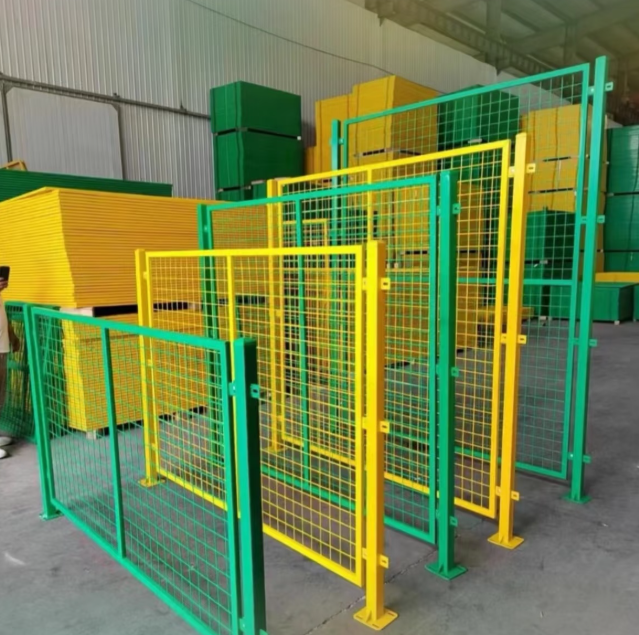
Frame-type fixed fence: general-purpose model in the market, mesh + frame + column bolt assembly, no need for on-site welding, easy disassembly and assembly, suitable for ordinary workshop partitioning, warehouse raw materials and finished products isolation, channel division, and the highest cost performance.
Automatic robot safety fence: using encrypted mesh, thickened frame, can be matched with safety door locks, photoelectric induction brackets, specially used for robotic arms, numerical control machine tools, automated assembly line protection, in line with intelligent manufacturing safety specifications.
Push-pull fence: matching track and silent pulley, the gate can be pushed and pulled left and right, suitable for forklifts, large materials in and out of the warehouse channel, large opening and closing space, does not occupy the site.
Mobile fence: with a universal wheel at the bottom, it can be moved at any time. It is mostly used for temporary isolation, exhibition partitioning, and short-term operation enclosures. It has strong flexibility and is suitable for workshops with frequent changes in layout.
Three, workshop warehouse fence fence production process and product core advantages
[Process details | Rust removal and pickling, spraying assembly line, finished product grinding and deburring real shot]
Regular workshop warehouse fence production process: raw material cutting pipe bending cutting numerical control welding grinding deburring pickling degreasing rust electrostatic spraying/hot dip galvanizing finished product inspection.
First, the impact resistance is excellent. Q235 carbon steel is matched with a thickened frame, and the solder joints are firm. It is not easy to deform in the face of slight collision of forklifts and material impact. Compared with thin-walled simple fences, the stability is significantly improved.
Second, anti-corrosion and anti-rust, suitable for complex working conditions. Multiple pretreatment processes ensure the adhesion of the coating, not easy to peel off, and can be used stably for a long time in the dusty and humid environment of the workshop.
Third, modular design, efficient construction. All are assembled with bolts, and there is no open flame welding on site, which will not affect the normal production of the workshop. In the later stage of factory renovation, the fence can be disassembled for secondary use, reducing the cost of repeated procurement.
Fourth, safety compliance. The corners are all polished smooth without burrs to prevent scratching workers; the mesh size conforms to industrial safety specifications, and the safety inspection acceptance rate is high.
Fifth, it is transparent and does not block the line of sight. The mesh structure does not block the surveillance cameras and workshop lighting, and the management staff can directly observe the production operation inside the fence without the oppressive feeling of the closed wall.
Four, workshop warehouse fence fence standardized installation construction process
[Installation construction map | pay-off positioning, base fixing, mesh assembly, leveling and tightening, completion acceptance step diagram]
Industrial fences have a saying of "three points of product, seven points of installation". If the installation is not in place, no matter how good the pipe is, it will shake and tilt. Standard construction steps:
Site survey release line: mark the column point according to the drawings to ensure that the straight line is straight, and reserve the position of the channel and the gate, and the size is accurate.
Column fixing: expansion bolts are used to fix the flange base on the cement floor; adjusting foot pads are installed at uneven positions on the ground to ensure that the column is vertical.
Mesh assembly: Use special connection buckles and bolts to lock the mesh, column and frame, and tighten all the screws.
Overall correction: uniformly adjust the verticality and flatness, and keep the entire row of fences neat without skewing.
Final acceptance: check all connection points and coatings for bumps, clean up on-site garbage, and deliver for acceptance.
V. Workshop warehouse fence fence procurement selection pit avoidance guide
[Comparison of advantages and disadvantages | Comparison of inferior thin material desoldering fence and national standard thickened fence]
Many purchases are easy to step on the pit, blindly pursuing low prices, and buying non-standard products: first, the wall thickness of the pipe is false, the actual thickness is much lower than the label, and it bends when touched; second, manual spot welding, virtual welding is often used, and short-term use breaks the wire; third, the pickling and rust removal process is omitted, and the coating is directly sprayed on the rust surface, which quickly peels and rusts.
Selection suggestions: indoor drying workshop, choose 3.5mm wire diameter, spray model; humid, outdoor yard priority hot-dip galvanizing; robot protection must encrypt mesh, thickened frame; need to frequently pass the forklift position, priority sliding door style. Ask the manufacturer for a material test report before purchasing to confirm that the parameters are up to standard, not just look at the appearance.
VI.
Workshop warehouse fence fence
conclusion
Workshop warehouse fence fence is not just a simple isolation fence, but an important part of the factory safety production management system. Selecting an industrial fence that meets the national standard parameters and process specifications can not only divide the production and storage area, avoid safety risks, and pass the safety inspection smoothly, but also can be reused for a long time to reduce the operation and maintenance cost of the enterprise. When purchasing, enterprises cannot only compare the unit price, but also focus on checking the wire diameter, square pipe wall thickness, anti-corrosion process, and welding quality. Combined with the use scenarios of the workshop and warehouse, match the corresponding style to choose a durable and compliant workshop warehouse fence
First, the workshop warehouse fence fence basic material and detailed technical parameters
Mainstream styles and applicable scenarios of workshop and warehouse fences
Three, workshop warehouse fence fence production process and product core advantages
Four, workshop warehouse fence fence standardized installation construction process
V. Workshop warehouse fence fence procurement selection pit avoidance guide
VI.