

Bridge guardrail
Bridge guardrail professional science popularization: type, material, specification, construction and selection guide
First, what is the bridge guardrail and its core function?
Function diagram of bridge guardrail
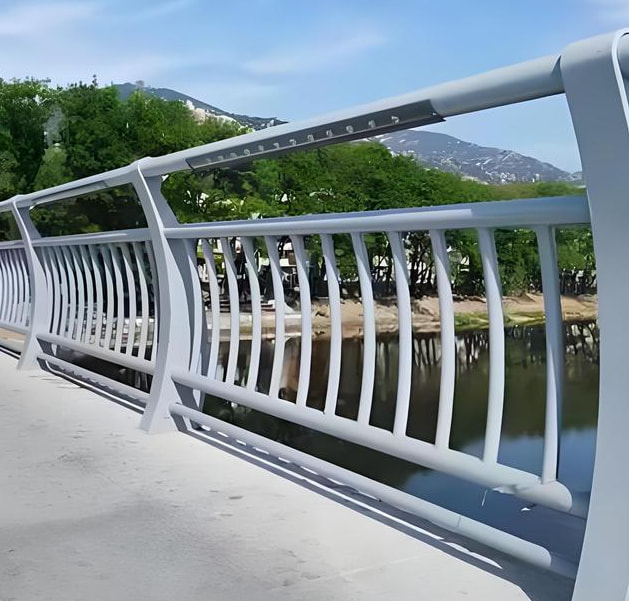
Bridge guardrails, also known as bridge anti-collision guardrails and bridge protective railings, are important traffic safety facilities installed on both sides of bridges, central dividers, and the edge of pedestrian passages. They are permanent security components in municipal and highway projects. Many people mistakenly think that guardrails are just simple protective railings. In fact, bridge guardrails undertake multiple safety missions and are an indispensable part of bridge projects.
The first is the anti-collision protection function. When a vehicle accidentally deviates from the lane, the guardrail can block the vehicle from the bridge deck, buffer the impact energy, reduce the risk of vehicle falling off the bridge, and protect the lives of drivers and passengers. Secondly, the isolation function, the central separation guardrail of the bridge can separate the opposite traffic flow to avoid vehicles crossing the line and colliding, and the sidewalk guardrail can realize the diversion of people and vehicles to ensure the safety of pedestrian passage. In addition, the bridge guardrail also has the functions of warning guidance and landscaping. The regular guardrail lines can guide the driver's line of sight, and at the same time match the overall shape of the bridge to improve the road landscape effect.
Unlike ordinary road guardrails, bridge guardrails are installed in a special location. They are in an open-air environment for a long time and must withstand wind and sun, rain and snow erosion, vehicle impact, and temperature thermal expansion and contraction. The requirements for strength, corrosion resistance and stability are much higher than those of ordinary guardrails. The design, production and installation of bridge guardrails must follow the relevant specifications of national highways and municipal bridges, and cannot be made according to the standards of ordinary courtyard guardrails. This paper systematically explains the professional knowledge of bridge guardrails from the aspects of classification, material, national standard parameters, production process, construction points, acceptance standards, selection and pit avoidance, etc., which is convenient for engineering procurement, construction units, and Party A.
Mainstream classification of bridge guardrails, different styles are selected for different scenarios
Bridge guardrail style comparison chart
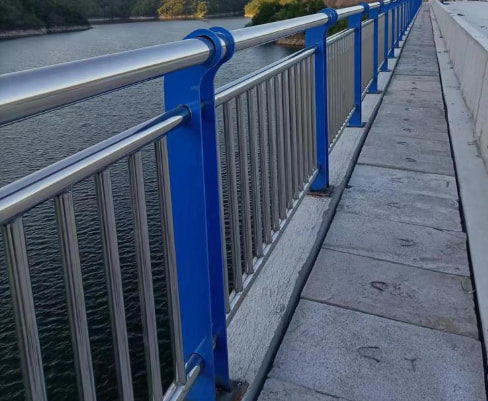
According to the location of use, anti-collision grade, and structural form, bridge guardrails can be divided into three categories, each of which has very different application scenarios and performance indicators, and is the basis for engineering selection.
The first category: bridge anti-collision guardrail (motor vehicle road guardrail), that is, motor vehicle side guardrail, central partition guardrail, the core goal is vehicle anti-collision, focusing on the assessment of anti-collision grade. Common forms are reinforced concrete anti-collision guardrail, metal beam-column anti-collision guardrail. Concrete anti-collision guardrail has strong integrity, high rigidity and strong impact resistance, and is mostly used for high-speed and heavy-load highway bridges; metal beam-column guardrail has better aesthetics and convenient maintenance in the later stage. Municipal bridges and urban landscape bridges are mostly used.
The second category: bridge sidewalk guardrails, mainly located on the outside of the sidewalk, mainly for pedestrians and non-motor vehicles, with low anti-collision loads, more emphasis on stable structure, comfortable feel, and beautiful appearance. Common stainless steel composite pipe guardrails and aluminum alloy guardrails.
The third category: bridge landscape guardrails, mostly used for urban inland river bridges, landscape pedestrian bridges, cultural tourism and sightseeing bridges, taking into account protection safety and landscape effects. The modelling style is rich, and carvings, arcs, and special-shaped customizations are mostly used. Safety indicators must still meet the standard bottom line, and protection standards cannot be lowered for good looks.
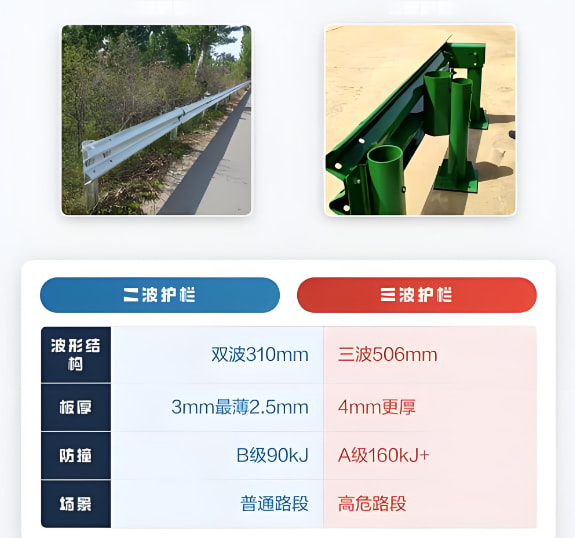
According to the classification of anti-collision, highway bridge guardrails are divided into C, B, A, SB, SA, SS and other grades. The higher the grade, the greater the tonnage and speed of the vehicle that can withstand the impact. High-speed main road bridges generally choose SB and SA grades, and urban secondary roads and small bridges can choose B and A. The first step in selection is to determine the road grade of the project, and then match the corresponding anti-collision grade, rather than simply looking at the price.
Third, compare the commonly used materials of bridge guardrails, and understand the advantages and disadvantages of materials
Guardrail material sample details
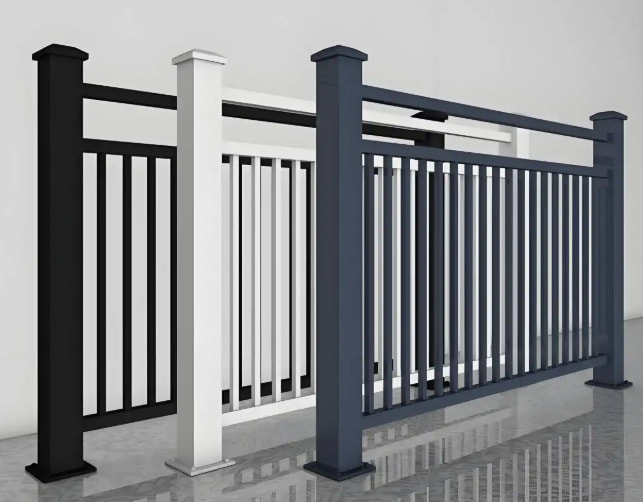
The mainstream materials of bridge guardrails on the market are divided into four categories: reinforced concrete, stainless steel composite pipes, aluminum alloy, and carbon steel paint. Different materials have obvious differences in cost, corrosion protection, service life, and maintenance difficulty.
Reinforced concrete guardrail: The raw material is reinforced concrete, which has the advantages of low cost, strong rigidity, impact resistance, and almost no need for post-maintenance. The disadvantage is that it has a large weight, increases the load of the bridge, and has a single shape, poor aesthetics, making it impossible to make complex shapes. It is mostly used for high-speed and heavy-duty trunk bridges.
Stainless steel composite pipe guardrail: It is the most commonly used material for municipal bridges at present. The outer layer is 304 stainless steel and the inner layer is carbon steel pipe. The outer layer of stainless steel is rust-resistant and corrosion-resistant. The inner layer of carbon steel ensures the structural strength, taking into account strength and rust-proof. The price is moderate, the surface is bright, and it can be used in a variety of shapes. Suitable for urban municipal bridges and footbridges; the disadvantage is that the seaside high salt spray environment requires upgrading 316 stainless steel, otherwise rust points are prone to occur.
Aluminum alloy bridge guardrail: The whole aluminum alloy is integrally extruded, light weight, natural rust resistance, no need to spray paint for anti-corrosion, the surface can be sprayed with fluorocarbon, rich in color and exquisite in shape. The advantage is that it has strong anti-corrosion ability and almost no maintenance in the later stage; the short board is the material cost is high, the impact resistance is weaker than carbon steel, and it is mostly used in landscape pedestrian bridges and non-motor vehicle bridges.
Carbon steel (Q235/Q355) bridge guardrail: welded with carbon steel profiles, with high overall strength and good anti-collision performance, suitable for high-grade anti-collision guardrails; hot-dip galvanizing + spraying double-layer anti-corrosion treatment must be done. If the anti-corrosion process cuts corners, it will rust in 1-2 years, and the later maintenance cost will be high.
There is no absolute best material, only materials suitable for the project environment: stainless steel composite pipes are preferred for municipal projects in inland cities; 316 stainless steel or aluminum alloy is preferred for coastal salt spray environments; concrete guardrails or Q355 carbon steel crash barriers are preferred for high-speed and heavy-duty bridges.
IV. Bridge guardrail core national standards and technical parameters
Bridge guardrail national standard parameter table
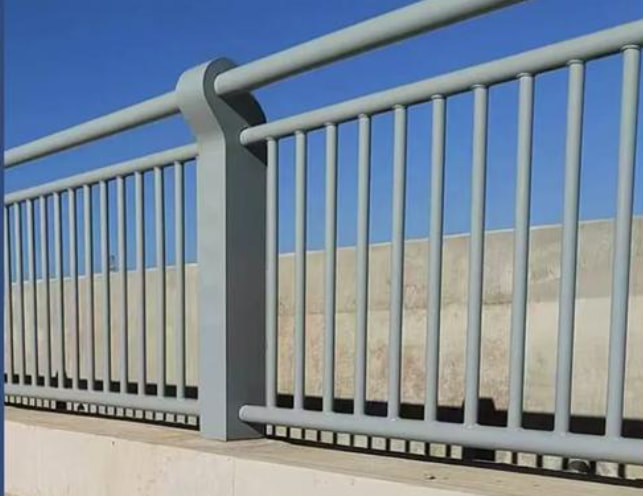
Bridge guardrails are traffic safety facilities, and the design and production must follow the "Highway Traffic Safety Facilities Design Specifications" JTG D81 and "Highway Traffic Safety Facilities Construction Technical Specifications" JTG/T 3671. Municipal projects refer to the relevant specifications of urban bridges, and many low-cost projects are prone to ignore the specifications, leaving safety hazards.
Key indicators include: anti-collision grade, component section size, welding process, anti-corrosion standards, height, column spacing, and number of cross bar layers. The height of conventional sidewalk guardrails is not less than 1.1m, and the height of motor vehicle crash guardrails is determined according to the anti-collision grade; the column spacing is generally 1m, 1.5m, 2m. The larger the spacing, the higher the requirements for pipe wall thickness and structural strength.
Anti-corrosion is the top priority. The standard anti-corrosion process of carbon steel guardrail: hot-dip galvanizing first, then electrostatic spraying. The thickness of the galvanized layer and the thickness of the plastic layer all have national standard requirements. Only spray painting and no hot-dip galvanizing are unqualified products. Stainless steel pipes need to be checked for wall thickness. Many merchants falsely label the wall thickness. For example, the standard 1.2mm is actually only 0.7mm. It is very easy to deform and break when hit.
In addition, the connecting nodes and embedded parts of the guardrail are the key to the force. The embedded parts need to be welded and poured with the steel bars on the bridge deck, and cannot be simply fixed with expansion screws. The guardrail fixed with expansion screws is only suitable for light pedestrian landscape guardrails, and must not be used for motor vehicle collision guardrails. It will fall off directly after impact, causing major safety accidents.
5. Key points of bridge guardrail production process to distinguish between good and bad products
Guardrail production welding, grinding workshop real pictures
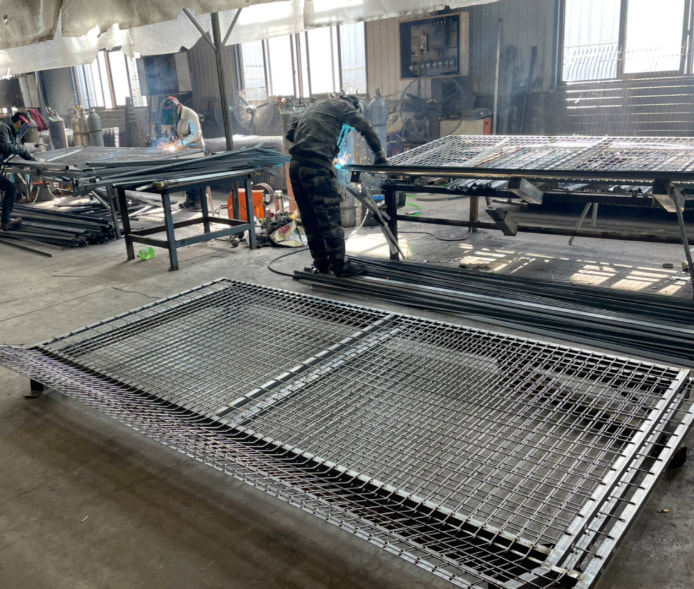
Qualified bridge guardrails are not simply pipe cutting and welding. The entire production process involves rigorous procedures, including cutting, bending, welding, grinding, anti-corrosion, and assembly. Each step will affect the service life and safety performance.
The first step is cutting, the pipe cutting end face is flat, no burrs, and the dimensional tolerance is controlled within the specification range; the second step is welding, full welding is the main one, important stress nodes must be fully welded, and the weld is full without pores, virtual welding, virtual welding is the most common reason for guardrail fracture; the third step is grinding and polishing, and the weld is smooth to avoid sharp edges and corners scratching pedestrians; the fourth step is anti-corrosion treatment, carbon steel hot-dip galvanizing, stainless steel polishing or wire drawing, aluminum alloy fluorocarbon spraying; the fifth step is trial installation, factory pre-assembly to ensure that the size of the on-site installation matches and reduce on-site modification.
Common problems of inferior products: thin pipe, spot welding instead of full welding, omitting hot-dip galvanizing and only painting, no polishing of welds, and large size errors. This kind of guardrail looks fine in the short term. After four seasons of temperature difference and rain erosion, the weld position is the first to rust and crack, and the safety risk is extremely high. When purchasing projects, be sure to require the manufacturer to provide test reports and material sheets, and if necessary, can be sampled and sent for inspection on site.
Construction specification for on-site installation of bridge guardrails
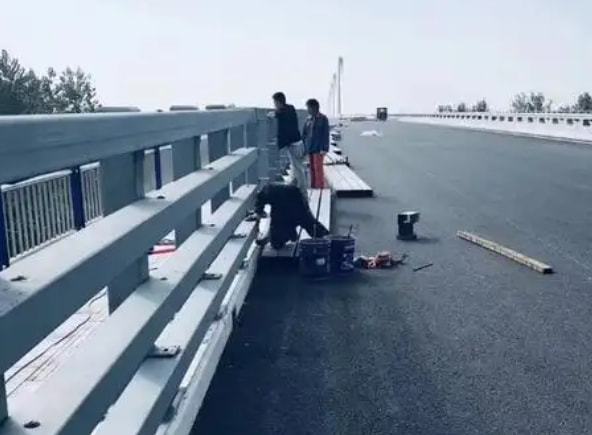
Guardrail site construction map
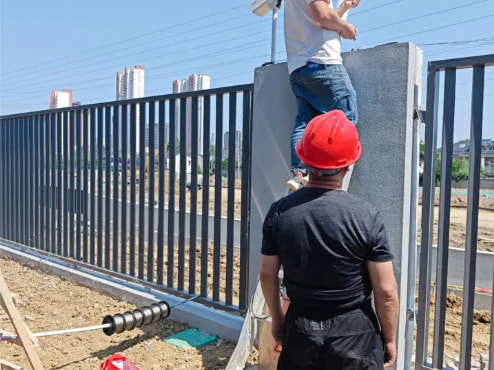
The quality of bridge guardrails requires three points of product and seven points of installation. No matter how good the guardrail is, it will not achieve the protective effect if it is not installed properly.
Before construction, check the position of the embedded steel plate on the bridge deck, check the elevation and line type. The bridge is an arc-shaped and variable-width section, and the guardrail should transition smoothly with the bridge line type, without blunt and hard broken lines. If there is no pre-embedded steel plate in the early stage, the motor vehicle collision guardrail does not allow rear expansion bolts. Chemical anchors and pull tests are required to meet the bearing capacity requirements.
The column and the embedded steel plate are fastened by welding or bolts, and the anti-corrosion paint is done at the welding position. If the cut anti-corrosion layer is not replenished, it will quickly rust from the solder joint position. The connectors between the crossbar and the column should be tightened in place, and all bolts should be made of stainless steel anti-theft bolts to prevent man-made disassembly and damage.
After the installation is completed, the overall straightness and elevation should be uniform, the alignment should be smooth; the gap should be uniform, and there should be no loose shaking. After the installation is completed, clean up the welding waste residue, repair the damaged coating, and protect the finished product to avoid subsequent bridge deck construction bumping and scratching the surface of the guardrail.
VII. Post-maintenance plan for bridge guardrails
Guardrail maintenance and repair actual pictures
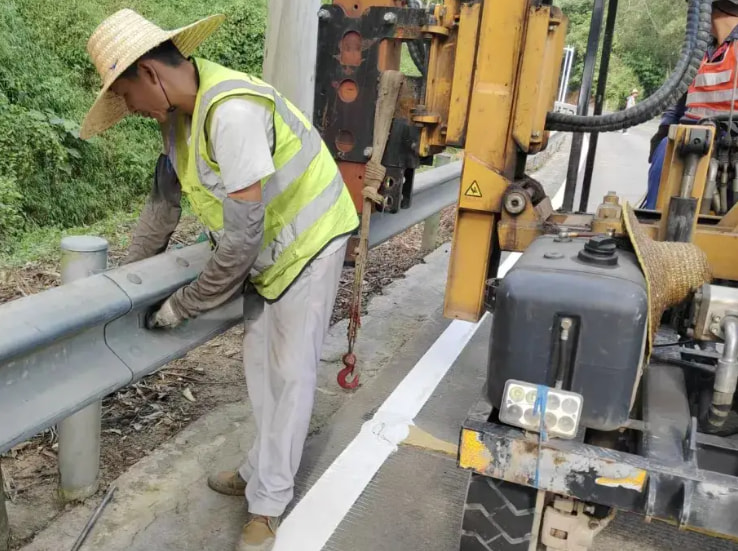
Bridge guardrails are exposed outdoors for a long time, and regular maintenance can prolong their service life and eliminate potential safety hazards in a timely manner.
Stainless steel composite pipe guardrail: Inland cities are generally inspected once a year to clean up surface dust stains, find surface scratches, local rust spots and polish them in time; coastal areas are recommended to inspect for half a year, and salt spray is more likely to erode pipe joints.
Carbon steel spray guardrail: focus on checking whether the plastic layer is cracked or falling off. Once the galvanized layer is exposed, it will rust quickly. After local grinding and rust removal, it will be re-sprayed.
Concrete guardrail: check the surface for cracks, missing corners, and exposed steel bars, and repair them in time.
Key inspection points: the bottom of the column, the position of the weld, the embedded parts, and the connecting bolts. These are the weak points of the force. If a loose, deformed, or seriously rusted guardrail is found, it should be reinforced or replaced in time, and it cannot be used with disease.
Eight, bridge guardrail procurement selection pit avoidance summary
Purchasing pit avoidance mind map
Many engineering parties purchase bridge guardrails easy to step on the pit, low prices won the bidding after the emergence of security risks, summed up several core pit avoidance points.
First, don't just compare prices, first confirm the anti-collision level and execution standards, motor vehicle anti-collision guardrails and sidewalk guardrails cannot be mixed;
Second, verify the wall thickness and material grade of the pipe. Stainless steel is classified as 201, 304, 316, and 201 stainless steel that will rust outdoors in half a year. It is strictly forbidden to use it for bridge guardrails.
Third, confirm the anti-corrosion process, carbon steel guardrail must be hot-dip galvanized + sprayed, and refuse to paint directly;
Fourth, confirm the embedded parts plan, and the motor vehicle crash guardrail prohibits simple expansion screw fixation.
Fifth, give priority to regular manufacturers that have engineering cases and can provide test reports, rather than simple welding products in small workshops.
Bridge guardrails are facilities that safeguard road safety, and safety always comes first. Only by considering the comprehensive selection of beauty, anti-corrosion, and cost can we meet the long-term use needs of the project.