

Waveform guardrail
Waveform guardrail plate comprehensive popular science | Specifications, protection principles, construction standards, selection Daquan
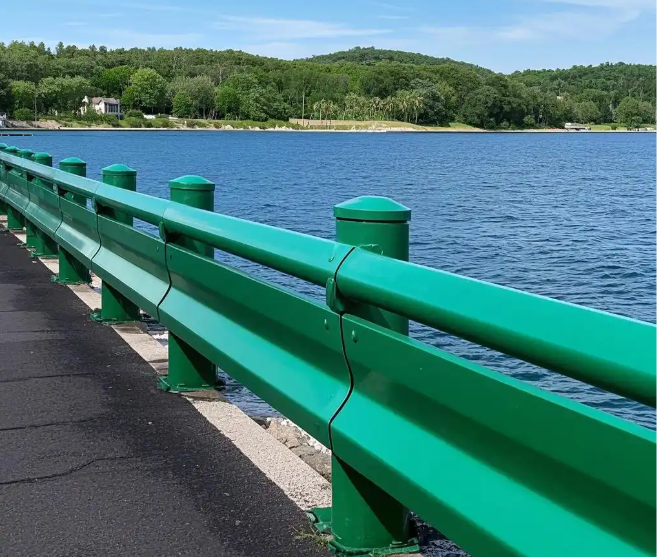
National highway standard waveform guardrail overall real picture, linear and straight, regular installation
Product definition and industry value of corrugated guardrail
The corrugated guardrail plate (corrugated beam steel guardrail) is the most important semi-rigid anti-collision protection facility for road traffic. It is produced in accordance with the national "GB/T 31439-2015" highway guardrail special standard. Mainly used in highways, national and provincial roads, county and township roads, rural roads, municipal roads, scenic roads, factory roads, bridge sections and other scenes.
The waveform guardrail is different from the rigid concrete guardrail and the flexible rope guardrail. Relying on the flexible deformation and energy absorption characteristics of steel, when the vehicle is out of control and impacted, the guardrail plate, column and soil jointly buffer the impact force, effectively correcting the driving trajectory and reducing the accident mortality rate. Because of its high cost performance, stable protection, convenient maintenance and long service life, it has become the most widely used and widely used safety protection product for road security projects in China, and it is also the core item that must be checked for road acceptance.
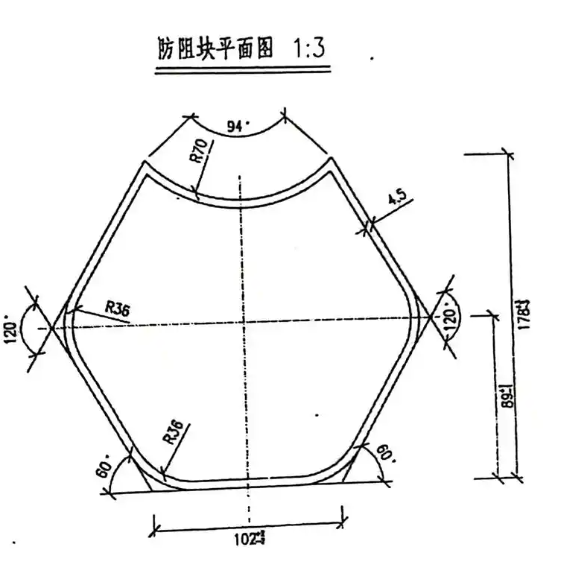
Schematic diagram of the structure principle of the corrugated guardrail plate, showing the energy absorption process of buffer deformation
Second, the core protection principle of the waveform guardrail plate (professional analysis)
Many users think that the guardrail is just a "blocking rail", but in fact the waveform guardrail has strict mechanical protection logic. The waveform guardrail belongs to a semi-rigid protection system, and the anti-collision process is divided into three stages: the first stage is when the vehicle contacts the waveform plate surface, and the corrugated structure instantly disperses the local impact force; the second stage is when the guardrail plate is stretched and deformed, and the bracket/anti-resistance block buffers the unloading force; the third stage is when the column squeezes the roadbed soil to further absorb the remaining kinetic energy.
The whole protection system will not be hard-on, but will be exchanged for safety by deformation, minimizing vehicle damage and personal injury. Due to the scientific mechanical structure, the waveform guardrail can be adapted to different vehicle speed sections from 60km/h to 120km/h. According to the version, thickness and configuration, it can distinguish multi-level anti-collision grades, fully meeting various road safety design standards.
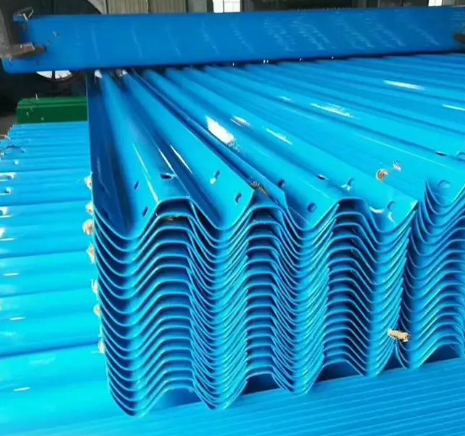
The two-wave and three-wave guardrail panels compare the real photos, clearly showing the difference in version width
III. Classification of corrugated guardrails and national standard specifications
Regular waveform guardrails on the market are mainly divided into two-wave waveform guardrails and three-wave waveform guardrails. The specifications are strictly distinguished and cannot be mixed.
Two-wave wave guardrail: width 432mm, wave height 85mm, conventional thickness 2.5mm, 2.75mm, 3.0mm, standard length 4.32 meters, suitable for county roads, township roads, municipal roads, park roads, belonging to B-class, C-class protection.
Three-wave wave guardrail: width 506mm, wave height 85mm, thickness 3.0mm, 4.0mm, the overall cross-section is larger, impact resistance is stronger, belongs to the A-class, SB-class high protection level, mostly used for highways, first-class highways, cliffs, high fill, long downhill high-risk sections.
The most crucial thing in engineering procurement is to meet the standards of solid thickness. Although the unit price of non-standard negative difference plates in the market is low, their anti-collision performance has shrunk significantly, and they cannot pass the acceptance of traffic supervision.
Comparison details of anti-corrosion process of hot-dip galvanized and galvanized spray guardrail sheet
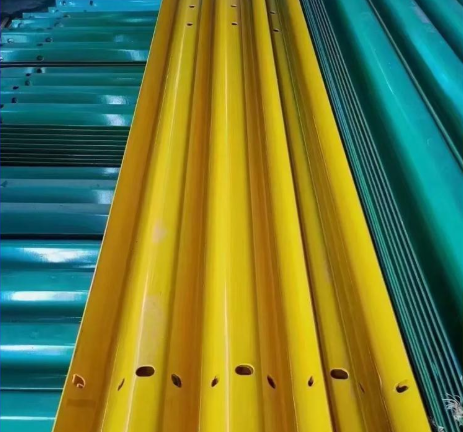
Fourth, the material and anti-corrosion process of the corrugated guardrail, and the detailed explanation of the service life
The regular waveform guardrail base material is all made of Q235 low-carbon hot-rolled steel plate, which has high toughness and is not easy to break. It is the basic raw material for anti-collision safety.
At present, there are two mainstream anti-corrosion processes:
1. Hot-dip galvanized guardrail: The national standard galvanized layer is 60μm-85μm, which is anti-corrosive and durable, not easy to rust, and has a normal outdoor service life of 10-15 years. It is a standard process for highway engineering.
2. Galvanized spray guardrail: hot-dip galvanized base + outdoor polyester powder spraying, beautiful color, stronger corrosion resistance, suitable for landscape highways, tourist roads, and municipal beautification sections.
The industry strictly prohibits the use of cold galvanizing (electrogalvanizing) inferior process. The cold galvanizing zinc layer is extremely thin, and it will rust and peel in a large area in 1-2 years, which completely fails to meet road security standards. Coastal, mining areas, and corroded road sections must be thickened with galvanizing to improve corrosion resistance.
Waveform guardrail full set of accessories combination real shot (column, anti-resistance block, bracket, bolt, end)
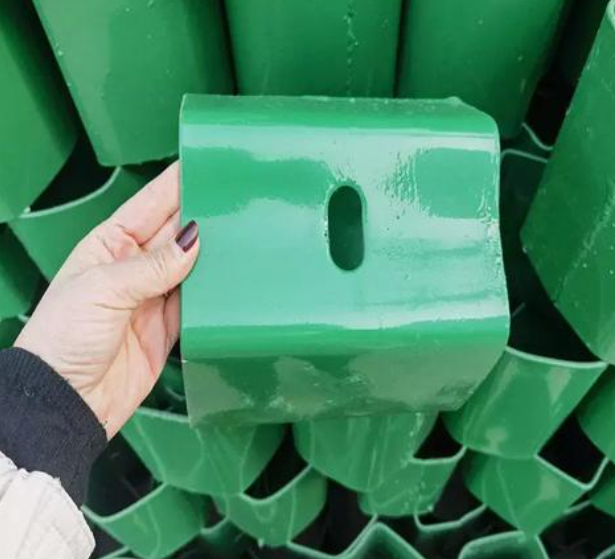
Fifth, the function and matching specification of the whole system accessories of the waveform guardrail
The waveform guardrail is a complete system engineering, not a single steel plate. The matching of accessories directly determines the anti-collision level.
Two-wave guardrail standard: bracket, round column, ordinary anti-theft bolt, round end;
Three-wave guardrail standard: anti-resistance block, thickened column, high-strength bolt, transition section end.
The anti-blocking block is the core accessory of the high-speed guardrail, which can be cushioned twice during impact to prevent the tire from sticking to the column and prevent the vehicle from overturning and rollover accidents. The column is usually made of 114mm and 140mm round tubes with thicknesses of 4.0mm and 4.5mm. The end is used for the starting and ending positions of the guardrail to avoid sharp incisions scratching the body and preventing secondary accidents.
Many low-cost projects replace parts, reduce resistance blocks, and use thin-walled columns, resulting in the same appearance and substandard protection, which are serious engineering hazards.
Subgrade piling standardization construction site real shot
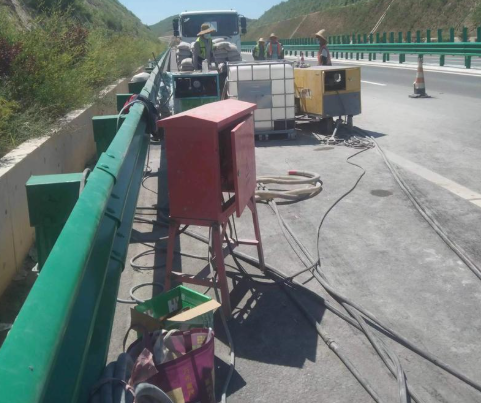
Six, waveform guardrail three installation methods and applicable subgrade conditions
The installation of corrugated guardrails is divided into three construction processes: push-in, pre-embedded, and flange fixed, which are selected according to the geological conditions of the road.
1. Driving-in: suitable for ordinary soil roadbeds, the pile driver directly presses the pile, and the construction is fast and the stability is high. 90% of rural roads and national roads use this process;
2. Pre-embedding casting type: suitable for rock subgrade, hard soil subgrade, digging and pouring concrete fixed columns;
3. Flange fixed type: suitable for cement pavement, bridge deck, parking lot, bottom flange expansion screw fixing.
Industry standard spacing: 4 meters standard section, 2 meters encrypted reinforced section. Curves, downhill, bridge heads, intersections, and high-risk sections on cliffs must use 2 meters encrypted columns to improve the overall anti-collision stability. Standard buried depth 120cm, high-risk sections buried depth more than 140cm.
Standardized installation of guardrails on road curves and straight sections
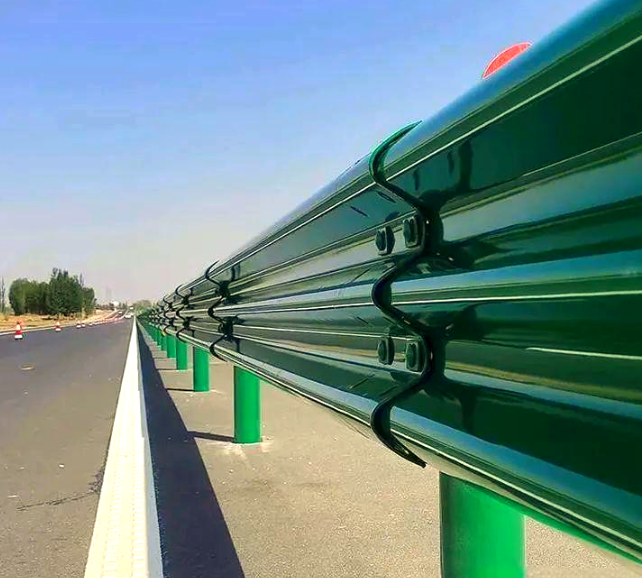
Seven, waveform guardrail standardization construction process and core technical points
Professional guardrail construction pays attention to "linear and straight, unified elevation, and balanced force". Standard construction process: measurement, lofting, fixed-point piling, correction, column installation bracket/anti-resistance block, fine-tuning, unified fastening, bolt installation end, and overall leveling.
Key construction specifications:
1. The splicing direction of the guardrail plate must be overlapped in the direction of the vehicle to prevent the vehicle hanging plate;
2. The bend must be pre-bent and adapted, and it is forbidden to forcibly pull and assemble;
3. The bolts need to be tightened twice, first fine-tune the alignment and then lock them;
4. The overall height of the guardrail is uniform at 55cm (two waves) and 60cm (three waves).
5. Bridges and culverts must be equipped with transition section guardrails to eliminate protective faults.
Three parts of the product are installed in seven parts, and the construction is not standard. No matter how good the plate is, it will also have problems of loosening, water seepage, deformation, and anti-collision failure.
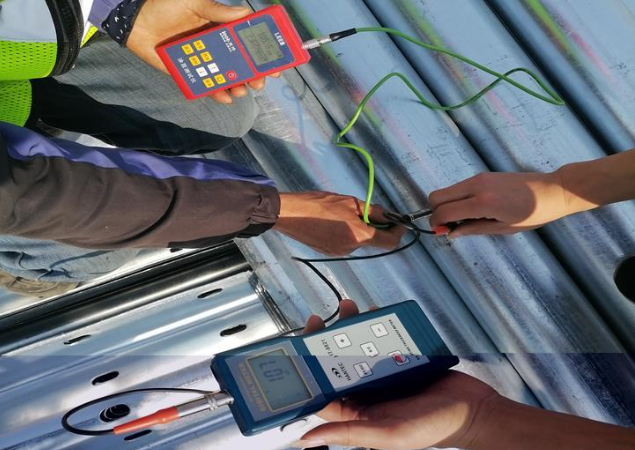
Supervision on-site inspection of thickness, galvanized layer, verticality acceptance
VIII. Waveform guardrail engineering acceptance standards and testing priorities
The corrugated guardrail belongs to the key acceptance items of traffic. The inspection must include: plate thickness, column wall thickness, galvanized layer thickness, column burial depth, verticality, linear appearance, bolt tightening, and end integrity.
Qualification standards: no distortion, no leakage plating peeling, column vertical deviation ≤10mm, smooth plate without ups and downs, all accessories are fully matched.
Project acceptance must provide: material report, galvanizing test report, factory certificate, construction acceptance records, incomplete information, unqualified sampling inspection will be reworked and rectified. Regular projects will never allow non-standard plates, negative plates, and inferior anti-corrosion products to enter the site for construction.
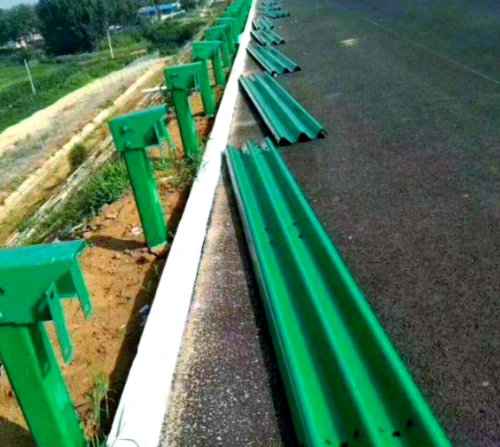
Comparison chart of guardrail application in different scenes of expressway, county road and scenic road
Nine, waveform guardrail accurate selection skills and industry pit avoidance guide
Combining years of road engineering experience, we summarize the accurate selection plan:
1. Expressway, first-class highway, cliff-high fill, three-wave 3.0/4. 0mm, SB-level protection, 2-meter encryption section;
2. County roads, township roads, and ordinary highways, with two waves of 2.75mm/3.0mm standard guardrails;
3. Municipal, scenic spots, landscape roads, galvanized spray color guardrails;
4. Bridge deck, cement pavement, parking lot, flange fixed guardrail.
Key points for purchasing pit avoidance: not only the unit price, but also the solid thickness, coating, accessories, and national standard grade. Many low-priced guardrails on the market have false standard thickness, galvanized layers do not meet standards, and accessories are reduced, which seem to save money. Later acceptance fails, rust is replaced, and the cost is higher.
summarize
The corrugated guardrail board seems to have a simple structure, but it is actually a rigorous, professional and systematic road safety protection project. From the material of the board, the anti-corrosion process, the version specifications, the matching of accessories, to the construction standards and acceptance specifications, every detail is related to road safety. Whether it is new road security, road renovation and upgrading, or replacement of damaged guardrails, it is necessary to strictly select and standardize the construction according to the national standard parameters in order to truly play the core role of the corrugated guardrail's anti-collision buffer and safeguard travel safety.