

Prison fence
Prison guardrail, detention center guardrail, prison area isolation guardrail, anti-climbing guardrail, blade gill net guardrail, high security isolation net, drug rehabilitation center guardrail, supervision area protective fence, prison steel mesh wall
[The overall completion of the prison guardrail | Panorama of the steel mesh guardrail on the periphery of the prison area]
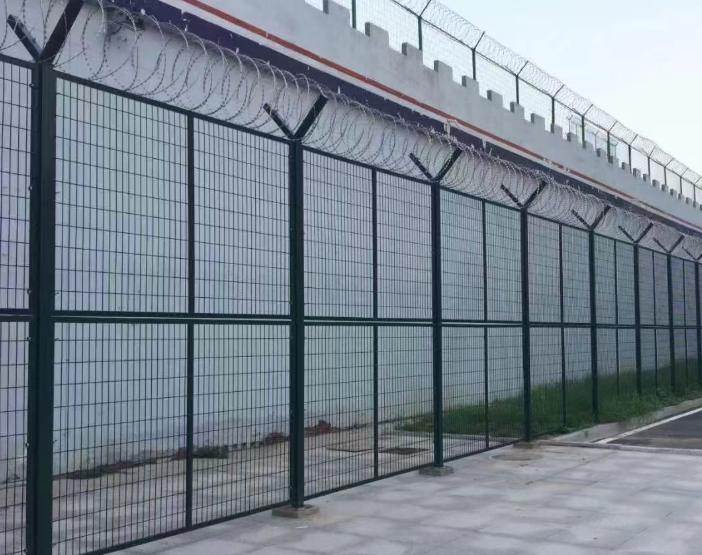
Prison guardrails are also often referred to as supervision steel mesh walls, detention center isolation guardrails, and prison perimeter protective fences in the industry. They are special high-security isolation protection products, distinguishing ordinary municipal guardrails, factory fences, and courtyard guardrails. It is mainly used in prisons, detention centers, compulsory drug rehabilitation centers, detention centers, juvenile correctional centers, armed police duty camps, combat readiness depots and other key regulatory sites. The core design goals are anti-climbing, anti-climbing, anti-damage, anti-shearing, and anti-impact. It is the first core line of defense for physical barriers in the perimeter security system of regulatory sites.
Supervision sites have strict and rigid standards for the safety level, structural strength, damage resistance, anti-escape performance, and acceptance specifications of guardrails, which cannot be replaced by conventional fence products. Ordinary guardrails only play a simple role in area division and warning isolation; while prison guardrails, as perimeter physical barriers, need to be linked with security alarm systems such as blade barbed ropes, pulse electronic fences, video surveillance, and infrared radiation to form an integrated perimeter security solution of "physical blocking + detection and early warning + video review", which is also the core design logic of prison guardrails.
First, prison guardrail design principles and industry norms
The perimeter protection of the supervision site has clear security design requirements. The research and development, production and installation of the prison guardrail need to follow the relevant specifications of the security engineering of the supervision site, and the structure, material, accessories and installation methods are all designed around the delayed intrusion time. The security industry has a core indicator: anti-damage delay, that is, the time it takes for an intruder to cut, pry, and climb over the guardrail with ordinary tools. This indicator directly determines the security level of the guardrail.
Conventional factory fences have a very short anti-vandalism time, and can be destroyed and crossed in a short time with wire pliers and crowbars; qualified prison guardrails must greatly increase the difficulty of destruction, prolong the intrusion time, and strive for response time for on-duty security personnel and armed police.
The overall design follows five principles:
Anti-climbing priority: eliminate all fulcrum points that can be stepped on, grasped, and leveraged, and eliminate climbing focus points;
Strong shear resistance: the mesh wire is thickened and welded firmly, and with high-hardness pipes, ordinary manual tools are difficult to cut quickly;
Structural impact resistance: columns, horizontal pipes, and embedded parts have sufficient strength to resist human impact and impact damage, and are not easy to lodge;
Anti-disassembly design: anti-theft and anti-disassembly bolts are adopted, the outside cannot be disassembled by hand, and the screws are anti-loss and anti-prying;
Weatherproof, stable and maintenance-free: year-round outdoor use, anti-acid rain, salt spray, ultraviolet aging, not easy to rust and collapse, reducing the later maintenance pressure in the regulatory area.
[Close-up of the mesh structure of the prison guardrail profile | Details of mesh, wire diameter, and welding joints]
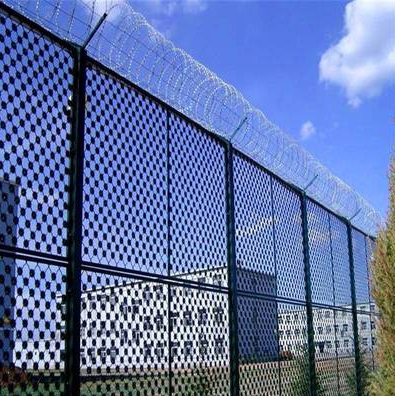
Classification and technical parameters of the mainstream structure of prison guardrails
At present, the most widely used prison guardrails for domestic supervision projects are mainly divided into two categories: Y-column blade gillnet guardrails (Y-type security fences) and frame-type steel mesh walls (prison frame guardrails). The two solutions are applicable to different locations. Many large prison projects use Y-blade gillnet guardrails on the periphery of the main perimeter, and frame-type prison guardrails are used for internal separation passages, isolation courtyards, and functional partitions.
1. Y-column blade gillnet prison guardrail (preferred for peripheral main perimeter)
The Y-column guardrail column adopts a Y-shaped structure with two forks at the top of the column, which is used to set up blade barbed rope (blade barbed net). It is the most commonly used style for the perimeter of the first wall around prisons and detention centers.
Column material: Q235 low carbon steel square tube/round tube, conventional specifications 8080mm, 100100mm, wall thickness 2.5-3.0mm;
Mesh: usually use bilateral wire protective mesh or welded square mesh, wire diameter ≥5.0mm, mesh 75150mm or 50100mm;
Top security configuration: V-shaped bracket, with spiral blade barbed rope (BTO-22 standard blade barbed net), the barbed rope is tightly arranged, sharp and anti-grasping, which greatly increases the risk of jumping over;
Fixed accessories: all use anti-theft bolts and anti-removal nuts, and ordinary wrenches cannot be directly removed;
Height: The general total height of the main perimeter of the periphery is 2.5m, 3.0m, and 3.5m, which can be customized according to the security level.
Anti-corrosion process: hot-dip galvanizing primer + electrostatic spraying double-layer anti-corrosion, the thickness of zinc layer and plastic layer meet the outdoor long-term anti-corrosion standard.
Advantages of Y-column guardrail: The top blade barbed rope has strong deterrence, is extremely difficult to climb over, is transparent as a whole, does not block the field of view of the surveillance camera, and has no blind spots for monitoring. It is very suitable for continuous laying of large-scale perimeters around the periphery. The disadvantage is that the cost is higher than that of ordinary frame guardrails, which is suitable for the peripheral boundary of the first-level security level.
2. Frame-type prison steel mesh guardrail (internal division of the prison area)
The frame guardrail is welded and formed by the outer frame square tube + internal welded mesh as a whole, which has stronger integrity, better rigidity and is not easy to deform. It is mostly used for isolation between cells, channel isolation, ventilation area isolation, and infield partition. Generally, the top can be equipped with blade barbed rope or no barbed rope, which can be adjusted according to the security level of the inner area.
Frame: 3050mm, 4060mm rectangular square tube, wall thickness 2.0mm or more;
Internal net: 5mm-6mm thick wire welded net, the mesh is encrypted to prevent fingers from reaching into the grip and borrowing force;
Welding process: full welding welding, the solder joint is firm and does not deweld, and the burrs are polished after welding to avoid management hidden dangers caused by sharp burrs;
Installation form: embedded fixing or flange expansion bolt fixing, ground hardening cement foundation supporting construction;
The frame-type guardrail has strong integrity, thick structure, outstanding impact resistance, regular zoning, and neat appearance. It is suitable for fine isolation in the prison area and use in close-range activities of personnel.
Supplement: A few high-level control projects will use steel mesh prison guardrails, anti-rush card reinforced mesh walls, which have stronger impact resistance and are mostly used in dangerous goods storage areas and key confinement areas.
[Installation details of the blade barbed rope at the top of the Y-column prison guardrail]
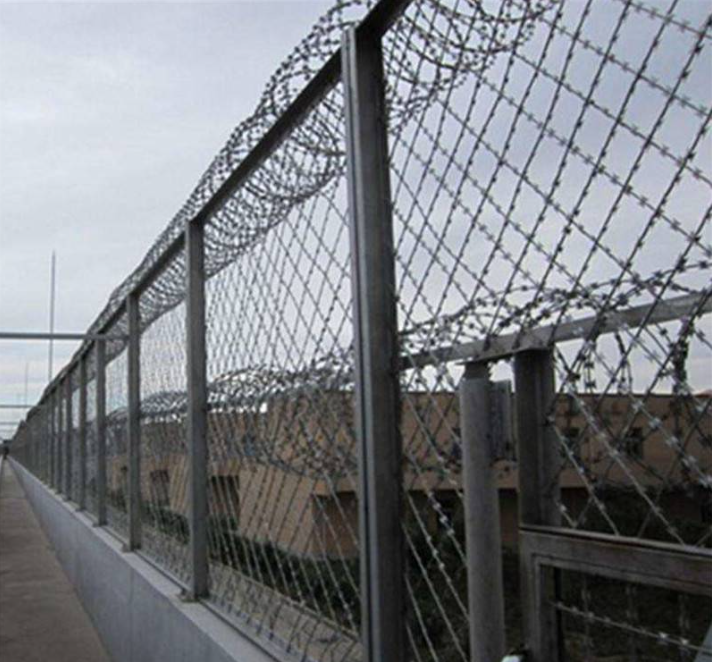
III. Detailed explanation of the anti-corrosion process, why double-layer anti-corrosion is necessary in supervision scenarios
Prison guardrails are open-air all year round, and many detention centers are located in humid, coastal areas along the river, with high air humidity and high salt content. If the anti-corrosion process is not up to standard, rust, solder joint rust, pipe rust and thinning will occur in just two or three years, and the security performance will directly fail, which will bring huge regulatory safety hazards. Later replacement construction is difficult and the approval process is complicated, so anti-corrosion is a hard indicator of prison guardrails.
Standard prison fence embalming process:
The first step: substrate pickling and rust removal to remove rust and oil stains on the surface of the pipe;
The second step: high-temperature hot-dip galvanizing to form a zinc alloy protective layer to isolate the contact between steel and air moisture;
Step 3: Electrostatic powder spraying (plastic spraying) on the surface, using outdoor weather-resistant polyester powder, the colors are commonly used grass green, dark green, gray, and the color is uniform;
With double-layer process stacking, the normal outdoor service life can reach 15-20 years. In non-coastal inland areas, the maintenance workload is extremely low.
The low-cost and inferior products in the market are only simply painted or sprayed with a single layer. There is no hot-dip galvanized bottom layer. They look good in the short term and return to rust in a large area in 1-2 years. Regulatory projects are strictly prohibited from using such simple anti-corrosion guardrails.
IV. Supporting security accessories and linkage solutions (professional focus)
Prison guardrails are not isolated physical fences used alone. They are mature supervision perimeter systems. Guardrails are carriers and need to be combined with other security equipment.
Blade barbed rope: BTO-22 is a general model in supervised places, divided into spiral cross type and flat type. The sharp blade forms a barrier and is the core accessory of anti-overturning;
Anti-dismantling and anti-theft fasteners: plum blossom anti-theft bolts, pentagonal anti-dismantling screws, which require special tools to disassemble, and prevent private disassembly of guardrails in the supervision area;
Perimeter alarm equipment: pulse electronic fence detector, tension mesh, vibration fiber, installed on the fence mesh or bracket, once someone climbs, prys, cuts, immediately triggers the alarm signal, the duty room sound and light alarm, synchronous linkage camera automatically capture video;
Grounding lightning protection accessories: The perimeter fence is a continuous metal conductor, and the long-distance fence must be grounded for lightning protection to avoid damage to the back-end alarm equipment due to lightning strikes;
Security warning signs: Security warning signs and warning signs are arranged at regular intervals to serve as a warning and deterrent.
[Real scene of partition isolation of frame prison guardrail in the prison area]
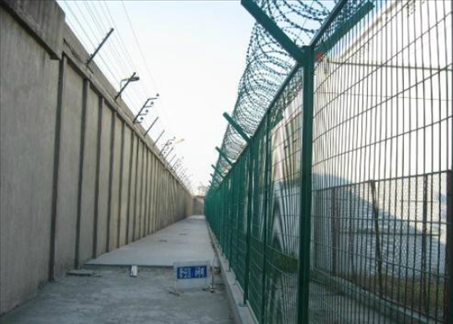
V. Foundation installation construction plan, foundation and fixing method
The installation foundation of the prison guardrail also affects the overall security effect. There are mainly two fixed methods:
Embedded installation: excavate the foundation pit and bury the bottom of the column into the concrete for pouring and fixing. This method has the strongest resistance to uplift and impact. It is the first choice for the main perimeter of the periphery. It is suitable for new sites. The foundation is firm and difficult to be knocked down by external forces;
Flange expansion bolt fixing: The ground has been hardened cement floor, the bottom of the column is welded flange baseplate, and high-strength expansion screws are used to fix it on the ground. The advantages are fast construction and suitable for completed renovation projects. Most of the inland areas use this scheme.
Key construction control requirements: the vertical deviation of the column is strictly controlled, and the guardrail of the whole line is kept in a straight line; the mesh splicing gap is controlled in a very small range, without leaving too large a gap to prevent personnel from passing through; all solder joints, cutting incision positions, plastic layer must be completely covered, and the incision position is sprayed with anti-corrosion to prevent rust from the incision position; the blade barbed rope is tightened and fixed, and it cannot be loose. The anti-overturning effect of the loose barbed rope is greatly reduced.
After the project is completed, the construction party needs to cooperate with Party A, supervision, and security acceptance units to conduct damage testing, tensile testing, and appearance acceptance, and provide material inspection reports and galvanized plastic layer inspection materials to complete the security completion acceptance.
Sixth, the core difference between prison guardrails and ordinary guardrails (purchase pit avoidance)
Many customers are prone to confuse prison guardrails, factory guardrails, and airport guardrails, but the security level gap is huge:
The design goals are different: ordinary guardrail is used to divide the area; the core target of prison guardrail delays invasion and prevents escape;
The thickness of the wire diameter pipe is higher: the wall thickness of the prison guardrail pipe, the mesh wire is thicker, and the welding strength is higher;
Anti-dismantling structure: all anti-theft screws, ordinary guardrails use ordinary bolts, which can be disassembled at will;
Top configuration: Most of the supervision guardrails are equipped with blade barbed ropes, and ordinary fences generally have no barbed nets;
The acceptance standards are strict: the supervision project is a special security project, and the acceptance process and data requirements are much higher than those of ordinary municipal and factory fences.
Do not have too many trampling fulcrums: ordinary guardrails have many crossbars, which is convenient for climbing. The prison guardrail structure minimizes lateral trampling points.
Scope of application
Prison guardrails are high-security special fences, suitable for use in prisons, detention centers, detention centers, compulsory isolation drug rehabilitation centers, juvenile correctional centers, armed police duty camps, ordnance material storage warehouses, important classified storage areas, and border checkpoint control areas.
The security level of different areas is different: the first perimeter of the periphery has the highest security level, and the raised Y-shaped column + encrypted blade barbed rope is selected; the prison's ventilation field and internal passage are isolated, and the frame-type encrypted steel mesh guardrail is used to simplify the barbed rope configuration as appropriate, taking into account safety and management personnel's observation line of sight.
Eight, the manufacturer's supporting service description
Prison guardrail projects are different from ordinary retail orders. Most of them are bidding and bidding security projects. They have a complete set of requirements for qualifications, samples, test reports, on-site surveys, deepening drawings, production schedules, on-site installation, and after-sales quality assurance. Regular manufacturers can deepen the plan according to the drawings of regulatory units or on-site survey results, adjust the height, mesh, and barbed rope layout, and provide samples, test certificates, and qualification documents in cooperation with bidding. At the same time, they have a professional security construction team, familiar with the construction management regulations of supervised sites, abide by the entry management requirements of the prison area, complete and cooperate with security acceptance, and provide long-term quality assurance and maintenance services.
Summary
The prison guardrail is an indispensable physical barrier for the perimeter security system of the supervision site. It relies on a high-strength steel structure, a double-layer long-term anti-corrosion, anti-dismantling and anti-climbing structure, and a blade barbed rope and perimeter alarm system to form a multi-layer security line, blocking the escape behavior from the physical level and gaining valuable response time for security disposal.
In the project selection, we must not only look at the price, but also give priority to checking the wire diameter, pipe wall thickness, anti-corrosion process, anti-theft accessories, and anti-damage indicators. In combination with the project security grade, we must reasonably choose the Y-shaped column or frame-type guardrail scheme, and strictly follow the security specifications for construction and acceptance in order to stably meet the long-term and highly reliable security protection needs of key supervision places such as prisons and detention centers.