

Municipal guardrail
As an important part of urban road traffic infrastructure, municipal guardrails are widely used in urban main roads, non-motorized roads, sidewalks, central isolation belts, municipal bridges, park riversides, road intersections and other scenes. Many people's cognition of municipal guardrails only stays at "road isolation railings". In fact, municipal guardrails are a system engineering that takes into account traffic safety, mechanical structure, weather resistance and anti-corrosion, landscape aesthetics, and standardized operation and maintenance. From program selection, raw material control, production and processing to on-site installation, and completion acceptance, there are corresponding national and industry norms. High-quality municipal guardrails can guide the orderly flow of traffic, avoid traffic accidents, protect pedestrian safety, and beautify the urban environment; while inferior guardrails not only have insufficient protective performance, but also are prone to rust and fracture, burying long-term road safety hazards. This paper combines the requirements of national standards such as "Highway Guardrail Safety Performance Evaluation Standards" and "Urban Road Traffic Facilities Design Specifications" to systematically explain the professional knowledge of municipal guardrails.
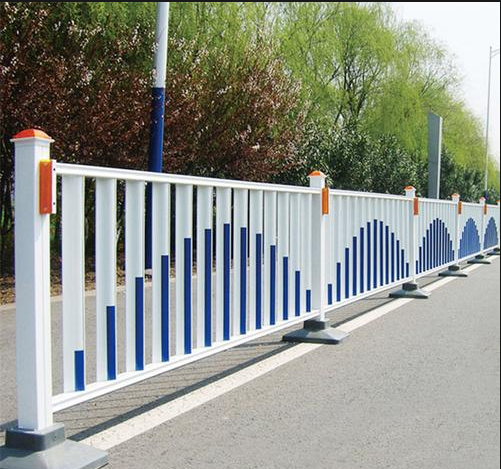
[Overall real picture of the central municipal guardrail on urban roads | Main road isolation guardrail, panoramic shooting during the day]
First, the functional positioning of municipal guardrails and relevant national standards
Municipal guardrails are different from temporary guardrails on construction sites and guardrails in residential courtyards. They are permanent urban traffic security facilities with five core functions: people and vehicles diversion, lane isolation, anti-collision protection, warning guidance, and urban landscaping. It is not a simple decorative railing, but a passive safety protection part of the urban traffic control system.
The main reference specifications for the design, production and acceptance of domestic municipal guardrails: GB 51038 "Code for Design of Urban Road Traffic Facilities", JTG B05-01 "Evaluation Criteria for Safety Performance of Highway Guardrails", GB/T 30094 "Composite Guardrails for Highways", GB/T 18250 "Highway Waveform Beam Steel Guardrail". The specification provides rigid indicators for the height of the guardrail, the spacing of the columns, the wall thickness of the crossbar, the resistance to horizontal loads, the anti-corrosion period, the setting of reflective signs, and the anti-collision grade.
Many purchasers and project party A are easy to step on the pit: replace the municipal standard with the ordinary courtyard guardrail standard. The courtyard guardrail focuses on aesthetics, and the load and impact resistance indicators are low; the municipal guardrail needs to withstand vehicle scratches, strong wind impact, rain and snow corrosion, acid and alkali dust for a long time, and the mechanical load indicators are higher. The central isolation guardrail of conventional urban roads requires that it can withstand a certain level of thrust. When the small vehicle is slightly hit, it can buffer the unloading force, and there will be no brittle fracture and debris splashing, so as to avoid secondary injury.
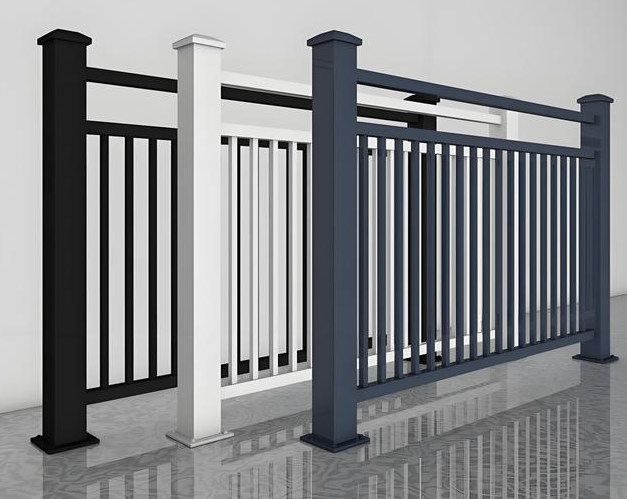
According to the use scenario, the municipal guardrail is divided into: road central separation guardrail, machine non-isolation guardrail, sidewalk anti-collision guardrail, bridge municipal guardrail, riverside landscape guardrail, intersection anti-pedestrian crossing guardrail, and fence-type municipal isolation guardrail. The anti-collision grades, heights, and structural forms corresponding to different scenarios are completely different, and cannot be selected universally.
[Schematic diagram of municipal guardrail classification | Comparison chart of styles of machine non-guardrail, central isolation guardrail, and bridge guardrail]
Second, the comparison of mainstream materials of municipal guardrails, the technical characteristics of each material, and the analysis of applicable scenarios
At present, among the invited tenders of municipal engineering, the mainstream materials are divided into four categories: zinc steel (hot-dip galvanized steel pipe) municipal guardrail, aluminum alloy municipal guardrail, stainless steel guardrail, and composite resin/fiberglass reinforced plastic guardrail. Among them, hot-dip galvanized zinc steel guardrail is the category with the largest amount of municipal projects. The anti-corrosion principle, mechanical properties, cost and maintenance cycle of each material vary greatly, and it is also the core knowledge point of industry selection.
1. Hot-dip galvanized steel pipe (zinc steel) municipal guardrail (municipal preferred mainstream)
The substrate is made of Q235 low-carbon steel pipe, and the whole anti-corrosion process is: hot-dip galvanized shot blasting and rust removal electrostatic powder spraying, which is often referred to as "hot-dip galvanized + plastic spraying" double-layer anti-corrosion system in the industry. This is the core to distinguish between genuine municipal zinc steel guardrails and simple painted iron railings.
Hot-dip galvanizing is to immerse the steel pipe in the molten zinc liquid at about 450 ° C. The zinc layer and the steel substrate are metallurgically bonded. The thickness of the zinc layer is generally ≥85 μm to form cathodic protection. Even if the surface spray layer is scratched, the zinc layer can still sacrifice the anode and protect the steel from rust; subsequent outdoor polyester powder electrostatic spraying, the thickness of the plastic layer is 60-80 μm, anti-ultraviolet, salt spray resistance. Qualified hot-dip galvanizing spray municipal guardrail, in the ordinary urban atmospheric environment, the anti-corrosion quality assurance can reach 10-15 years; in the coastal salt spray area, a thickened zinc layer + fluorocarbon spraying upgrade plan can be added.
Mechanical advantages: Q235 steel has stable yield strength, can be used for complex frame structures, and has good welding performance, which can meet the requirements of road guardrails against horizontal loads. The disadvantage is that if the cutting section and welding position are not treated with zinc and plastic, it is easy to rust first from the solder joint position.
Applicable scenarios: central isolation and non-isolation guardrails on urban main roads are also the most commonly used solutions for municipal bidding in China.
2. Aluminum alloy municipal guardrail
The base material is 6063-T5 aluminum alloy profile, no galvanizing is required, and the surface process is divided into electrostatic powder spraying and fluorocarbon spraying. Aluminum alloy itself is naturally rust-proof, and there is no problem of rust and corrosion. The difficulty of solder joint treatment is lower than that of zinc steel, and there is almost no risk of rust in the later stage.
Advantages: light weight, strong plasticity, can be streamlined, landscape shape, long-lasting color, suitable for riverfront, parks, urban demonstration areas, and bridge decoration guardrails with high landscape requirements; short board: aluminum alloy material has good toughness but weak rigidity, and its anti-collision buffering capacity is weaker than that of steel pipe zinc steel guardrail of the same specification. The cost is relatively high, and it is generally not used for central isolation of main roads with large traffic flow and frequent vehicle scratches.
304/316 stainless steel municipal guardrail
304 stainless steel is suitable for inland cities, 316 stainless steel is specially used in coastal and riverside high salt spray areas. The surface of stainless steel guardrail is divided into brushed, mirror, and can also be used as color fluorocarbon paint.
Advantages: excellent anti-rust ability and high strength; short board: high price of raw materials, ordinary brushed stainless steel is easy to leave fingerprints and scratches, and the surface appearance is average after long-term outdoor exposure; if the welding seam is not properly treated, intergranular corrosion will occur, and the weld position will rust. Many old urban renovation projects will be selected, and large-scale purchases of new main roads will be used less.
4. FRP composite municipal guardrail
It belongs to non-metallic guardrail, insulating, non-rusting, extremely light weight, acid and alkali corrosion resistance. However, it is a brittle material with poor impact resistance, direct fragmentation after vehicle impact, and low safety redundancy. Currently only used in substations, special chemical parks, and special sections with hard requirements for insulation. Ordinary urban roads are basically not recommended.
[Close-up of the raw material process of municipal guardrail | Details of anti-corrosion treatment of hot-dip galvanized pipes, sprayed surfaces, and welded joints]
Key points of municipal guardrail structure design: height, column, crossbar, anti-crossing, reflective design
Municipal guardrails are not simply a few pipes spliced together, and the structural parameters are all derived from standardized calculations. The common problem of many low-cost small factory products is to reduce the height, thin the wall thickness, and reduce the section of the column without permission, resulting in protection failure.
1. Guardrail height specification
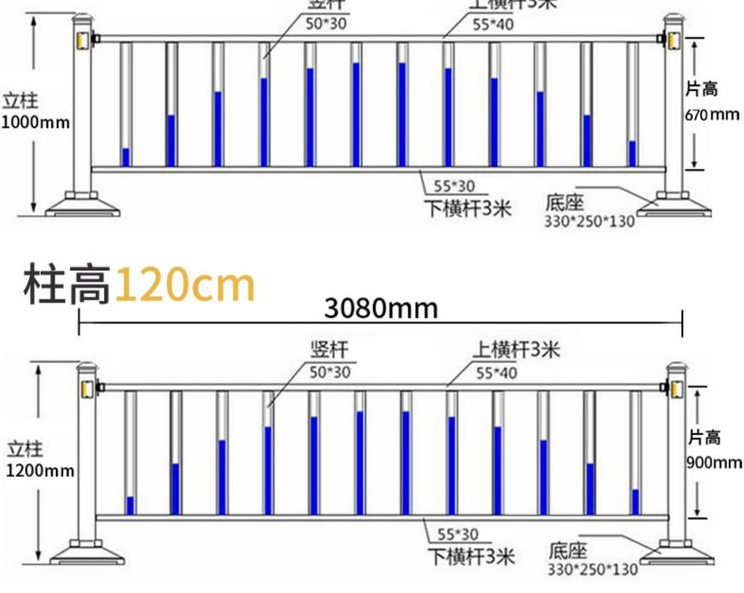
The conventional height of the central isolation guardrail on urban roads: 0.8m - 1.2m; the common height of the non-mechanical isolation guardrail is 1.0m - 1.2m; the height of the pedestrian road anti-collision guardrail and bridge guardrail is more demanding. According to the calculation of the airborne drop, the airborne height is greater than 3 meters, and the net height of the guardrail is not less than 1.1m. The waterfront guardrail has a net height of ≥1.2m to prevent climbing and falling. The height cannot be reduced at will. If the height is insufficient, it is easy for pedestrians to climb over, which will cause a cross-road accident.
2. Column and span design
The column is the load-bearing core of the entire guardrail, and the column is buried in the ground or the flange is fixed to the road foundation. The standard span of the conventional municipal guardrail is 3.0m, which is a span of 3 meters; the road section with large traffic flow and many heavy vehicles will reduce the span and improve the overall stiffness. There are two fixing methods at the bottom of the column: pre-embedded type (pre-embedded when the road surface is poured, the stability is the strongest, and it is suitable for new roads), flange expansion screw fixing (post-installed to transform the road, the construction is fast, and it is suitable for the renovation of old roads). There are requirements for expansion screw specifications and burial depth. Many low-cost projects only use small-sized expansion bolts, which are directly loosened by strong wind and slight impact
3. Anti-overturning design of crossbars and vertical bars
The net spacing of the vertical bars is a mandatory rule: the gap of the vertical bars is ≤11cm to prevent children's heads from getting stuck. This is a mandatory safety clause. At the same time, many municipal guardrails have added anti-climbing elbows, anti-climbing thorns, and bending shapes to the upper bar to improve the difficulty of climbing and reduce pedestrian crossing.
4. Reflective warning system
According to the specification, municipal isolation guardrails must be equipped with reflective signs. The reflective film is made of national standard IV high-strength reflective film, which is installed on the upper edge of the guardrail. It is clearly reflective under the illumination of the lights at night to give the driver a clear road boundary prompt. Many low-cost projects omit reflective labels, or use inferior reflective films. After a few months, the reflection fails, and the night recognition is poor, which increases the risk of accidents.
In addition, at the end of the intersection, the guardrail must be gradually changed and designed to prohibit the sharp end from facing the traffic flow. Once the vehicle hits the sharp end, it is easy to pierce the car body and cause serious casualties. This is the most easily overlooked safety detail in many small workshops.
IV. Municipal guardrail production process and quality control points
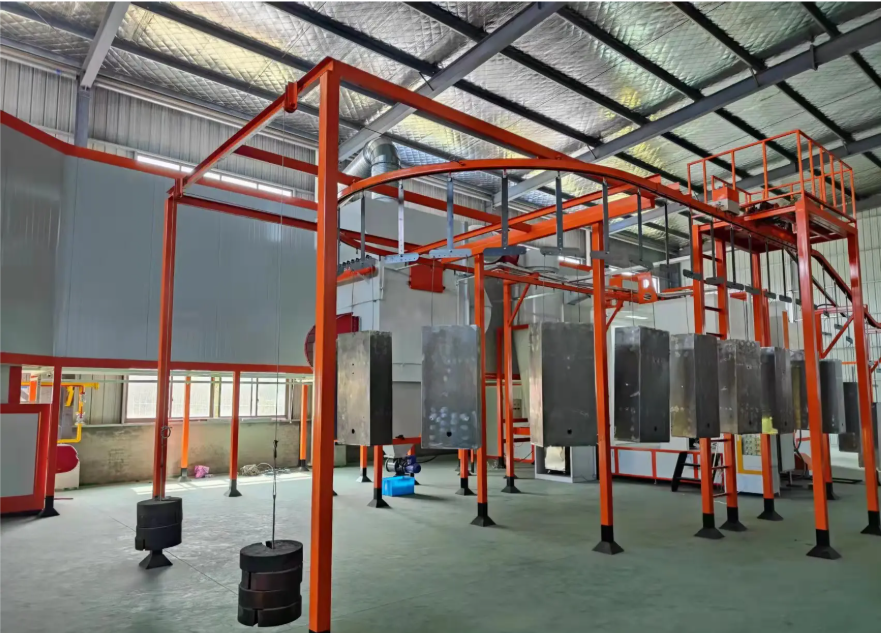
Regular municipal guardrail factory production process: drawings deepen cutting, pipe cutting, punching, pipe bending, forming, welding and grinding, pre-treatment, degreasing, rust removal, hot-dip galvanizing (zinc steel) electrostatic spraying, curing, quality inspection, trial packaging and transportation.
In the welding process, municipal guardrails are preferentially welded rather than spot welded. The weld seam is very easy to crack after the spot welding guardrail is stressed; after the welding is completed, the welding slag is polished flat, and the welding joint position must be closed with zinc and plastic to block the corrosion channel.
In the spraying process, outdoor polyester powder is a hard requirement, and indoor powder cannot be used. Indoor powder has poor UV resistance, and it will fade and pulverize and peel outdoors for half a year to a year. The factory must be equipped with a salt spray test box, and each batch of samples must be sampled for salt spray aging test. Salt spray test in inland cities is ≥500 hours, and coastal projects are ≥1000 hours.
Before leaving the factory, it must be pre-assembled, tried out across the whole span, checked for dimensional tolerances and splicing gaps, to avoid the wrong size on the site, forced cutting and modification, and damage to the anti-corrosion layer.
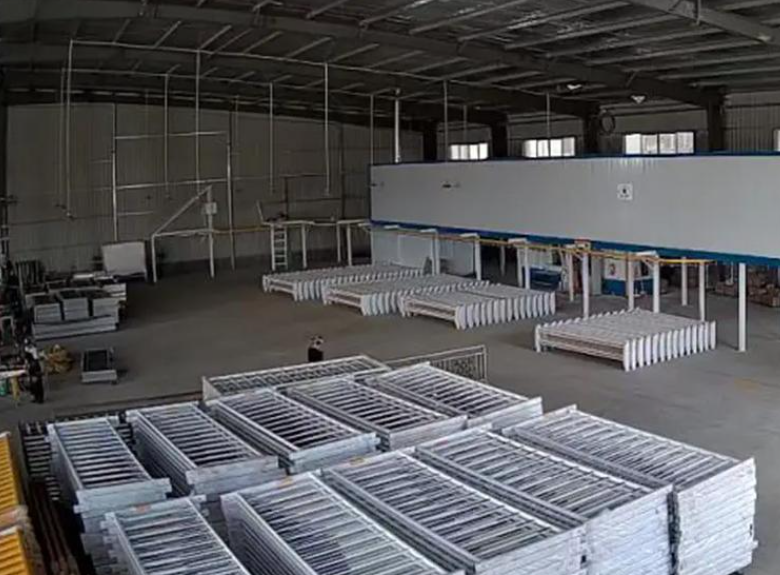
[Real pictures of municipal guardrail factory trial installation, salt spray testing, spray production line]
V. Municipal guardrail site construction, installation specifications and acceptance standards
Industry old saying: three products are installed in seven, and the installation foundation of municipal guardrails determines the overall stability.
1. Basic re-testing lofting: lay out the line according to the construction drawings, check the road center line and elevation, ensure that the guardrail is straight, and the line shape follows the road curve smoothly;
2. Foundation construction: flange installation section, foundation concrete strength above C25, expansion bolt implantation depth up to standard; pre-embedded models are synchronized and road subgrade construction;
3. Guardrail hoisting and splicing: the whole span splicing gap is uniform, the height is aligned, the straightness error of the whole guardrail is controlled within 3mm/10m, and the appearance is straight and beautiful;
4. Grounding and matching: metal municipal guardrails installed on bridges, some items have lightning protection grounding requirements, and need to be connected to the bridge lightning protection system.
5. Completion acceptance items: appearance inspection, wall thickness sampling inspection, galvanized plastic layer thickness inspection, horizontal load sampling inspection, reflective logo inspection, stability shaking test. During acceptance, the supervisor will randomly sample inspection, use a thickness gauge to detect the thickness of zinc layer and plastic layer, and load test to randomly check the horizontal thrust resistance of the guardrail. Once the index does not meet the standard, the whole batch will be rejected for rework.
In many road renovation projects, the construction team is in a hurry, the foundation is not leveled, the expansion bolt is short, and after completion, the guardrail is crooked, the wind blows and shakes, and the short-term loosening and tilting, and the later maintenance cost is extremely high.
Municipal guardrail operation and maintenance, disease investigation and service life reference
Municipal guardrails are long-term outdoor facilities, and municipal maintenance units will inspect them regularly. Common diseases: aging and falling off of the reflective film, bumping and scratching of the plastic layer, loose settlement of the column foundation, corrosion of solder joints, and deformation of vehicles.
Zinc steel hot-dip galvanized spray guardrail: normal inland environment, designed service life of 10-15 years; coastal salt spray environment 7-10 years;
Aluminum alloy, 316 stainless steel guardrail: normal use for more than 15 to 20 years;
Maintenance suggestions: bump the plastic position, polish and spray the special outdoor refinish paint in time to cut off the starting point of rust; check the loose column and replace the failed reflective sign once a year; clean the dust and oil on the surface of the guardrail in time to reduce the long-term adhesion of corrosive media.
7. Guide for the procurement and selection of municipal guardrails to avoid pits (key reference for Party A and engineering contractors)
1. Only look at the unit price, not the wall thickness: the core of the quotation gap lies in the pipe wall thickness. The contract must specify the pipe wall thickness, zinc layer thickness, and powder type. A third-party inspection is agreed upon. Many merchants standard the thickness of the virtual, but the actual difference is serious.
2. Confuse "cold galvanizing" and "hot-dip galvanizing": The zinc layer of cold galvanizing (electrogalvanizing) is extremely thin, rusts for a few months, and the cost is very low. It cannot be used for municipal permanent guardrails. Many bad merchants steal the concept;
3. Omit the salt spray test report and type test report: for regular municipal bidding projects, the supplier must provide the test report of the guardrail.
4. The end of the intersection is simplified and the end is directly closed, which poses a great traffic safety hazard.
5. Choose indoor plastic powder instead of outdoor weather-resistant polyester powder, which is beautiful in the short term and fades quickly.
VIII. Summary of municipal guardrails
Municipal guardrail seems simple, behind it is a multi-disciplinary combination of mechanics, material anti-corrosion, traffic safety, landscape design municipal special project products. It carries not only isolation and diversion, but also a passive safety line for urban roads. In urban renewal and road renovation projects, from the initial plan selection, material matching, structural design, to factory production quality control, on-site standardized installation, and post-normal operation and maintenance, each link is supported by corresponding industry norms.
For Party A and purchasers of the project, the choice of municipal guardrail cannot be simply price comparison. It should be combined with the comprehensive selection of project area (inland/coastal salt fog), road traffic grade, anti-collision needs, and budget cycle, and priority should be given to meeting safety indicators and anti-corrosion indicators, and then taking into account the landscape effect. For the construction unit, strictly follow the national standard construction, and control the safety design of foundation, fixed nodes, and ends in order to deliver a set of stable, durable, and safety-compliant municipal guardrail projects. A set of qualified municipal guardrails can protect the traffic order of people and vehicles for a long time, and is also a visual manifestation of the refined construction of modern urban infrastructure.