

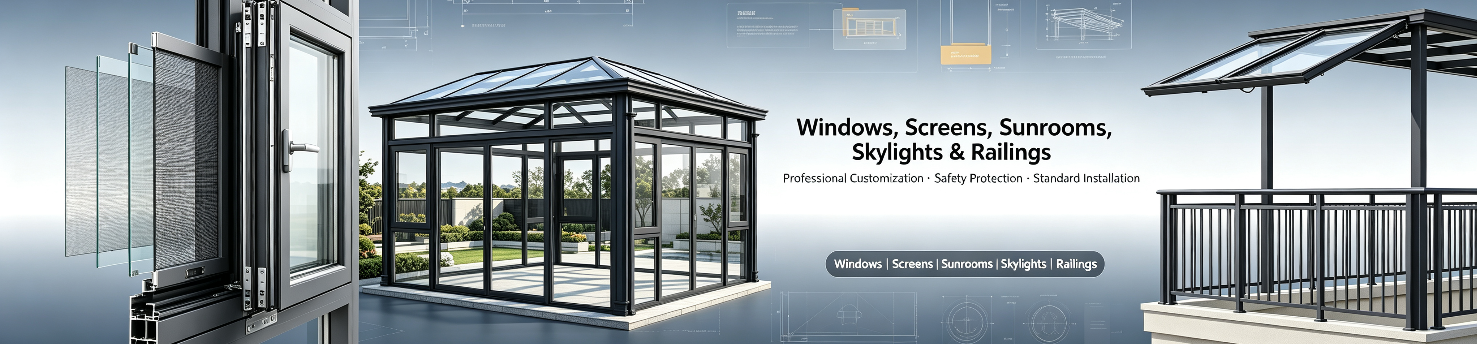
Broken bridge doors and windows
Professional in-depth analysis of broken bridge doors and windows | Profile, glass, hardware, sealing, purchase guide
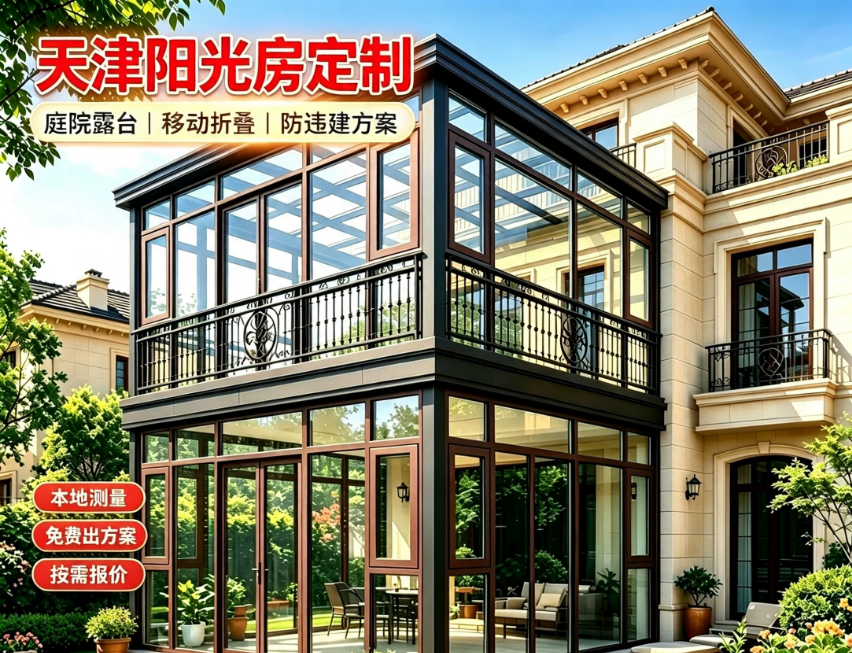
Floor panorama of broken bridge doors and windows, overall renderings of villa balcony broken bridge casement windows
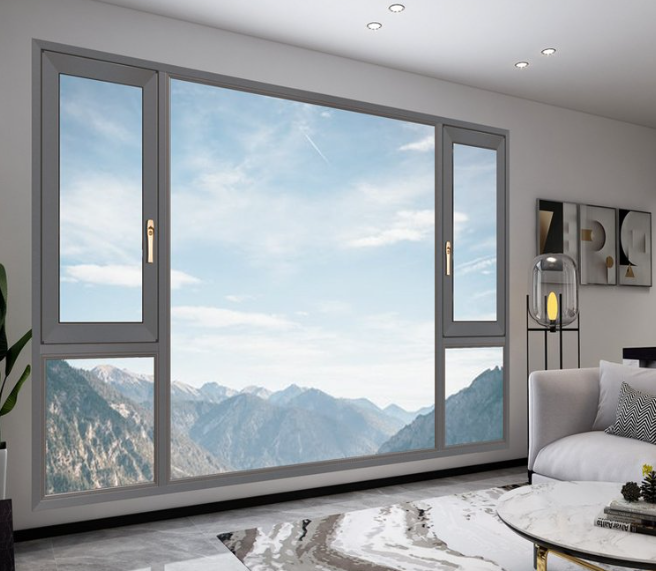
First, the basic definition of broken bridge doors and windows: what is broken bridge aluminum doors and windows
Many owners will hear "broken bridge doors and windows" when decorating and choosing doors and windows, but most people only know that broken bridge doors and windows have good sound insulation and heat insulation, and do not know its underlying principle. Broken bridge doors and windows are full of broken bridge aluminum alloy doors and windows. The core is to add heat insulation strips in the middle of aluminum alloy profiles to disconnect the original integrated aluminum profiles and block heat conduction, which is what the industry calls "broken bridge".
Ordinary aluminum alloy is a metal heat conductor. In summer, outdoor heat is quickly transferred to the room. In winter, indoor heat is lost along the aluminum material, which is prone to condensation by the window and large heat and cold loss. The broken bridge structure divides the aluminum profile into indoor side aluminum and outdoor side aluminum, and the middle is separated by heat insulation strips, breaking the hot and cold bridge to achieve heat insulation.
Broken bridge doors and windows belong to the category of system doors and windows, not just simple profile splicing, but also a complete system composed of profiles, thermal insulation strips, glass, rubber strips, hardware, and drainage structures. They are widely used in home improvement balconies, bedrooms, kitchens, sun rooms, villas, and tooling projects. They are also the mainstream choice for home improvement doors and windows today.
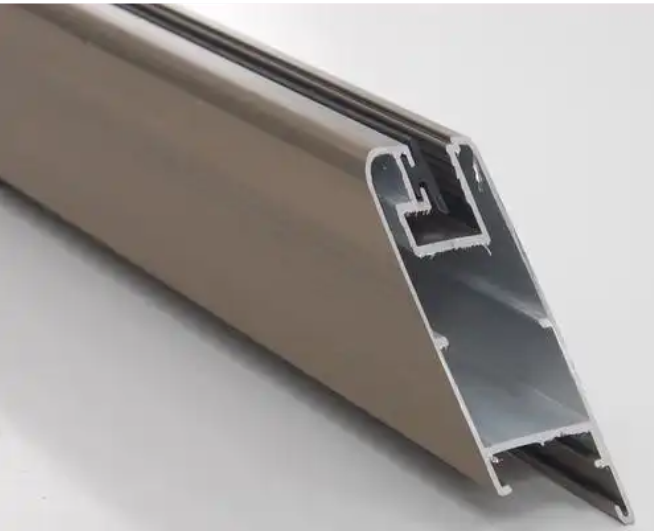
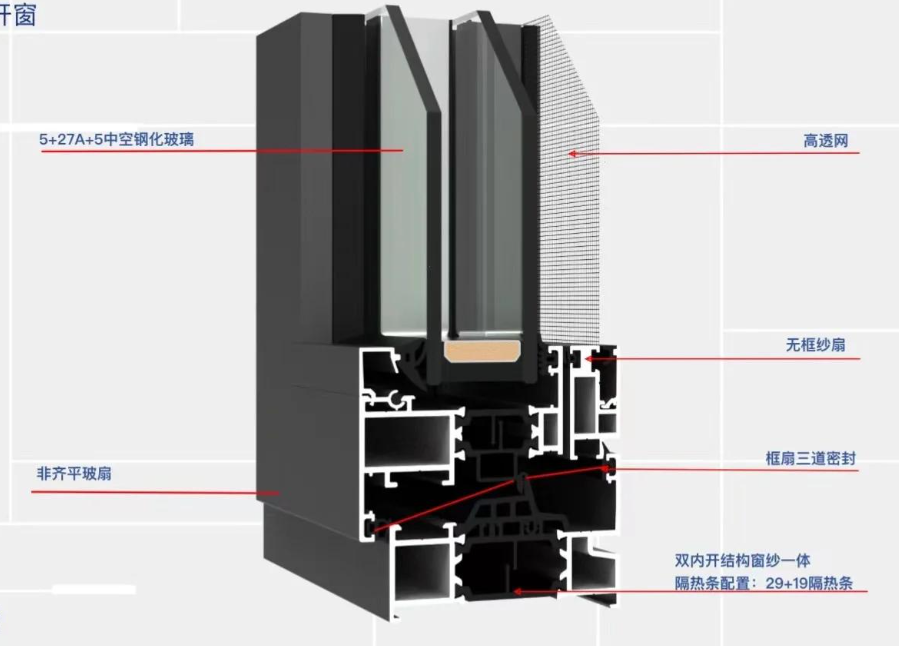
Schematic diagram of the section of the broken bridge profile, marking the position of the aluminum profile and heat insulation strip
Second, the core profile specifications and national standard requirements for broken bridge doors and windows
The basic skeleton of broken bridge doors and windows is aluminum alloy profiles. Regular products use national standard 6063-T5 primary aluminum, which has stable toughness, hardness and wind pressure resistance. It is different from recycled aluminum. Common series on the market include 60, 70, 75, 80, 85, 90, 108, 120, etc. The number represents the cross-sectional width (mm) of the profile frame.
The larger the series number, the wider the profile cavity, the more complex the cavity structure, and the stronger the sound insulation and wind pressure resistance. For example, 70 broken bridges are suitable for ordinary high-rise home improvement, 85 and 90 series are suitable for street noise and large hole floor-to-ceiling windows, and 120 series are mostly used for sun room matching doors and windows.
National norms have mandatory requirements for the wall thickness of home improvement doors and windows: the wall thickness of outer window profiles is ≥1.4mm, and the wall thickness of balcony heavy-duty doors is ≥2.0mm. Many low-cost broken bridge doors and windows steal the wall thickness and make it 1.2mm or even thinner. The wind pressure resistance is insufficient. It is easy to deform and shake when used in high-rise buildings, and there are potential safety hazards. High-quality profiles use a multi-cavity structure, which is divided into heat insulation chambers, drainage chambers, and strengthening chambers. Each performs its own duties to improve structural stability.
60/70/85/108 Series Broken Bridge Profile Section Comparison Close-up
III. Insulation strips: the soul of broken bridge doors and windows, the key to distinguishing between true and false broken bridges
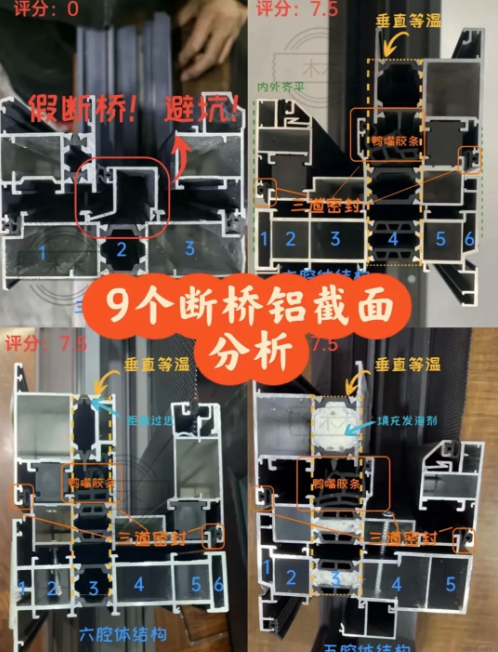
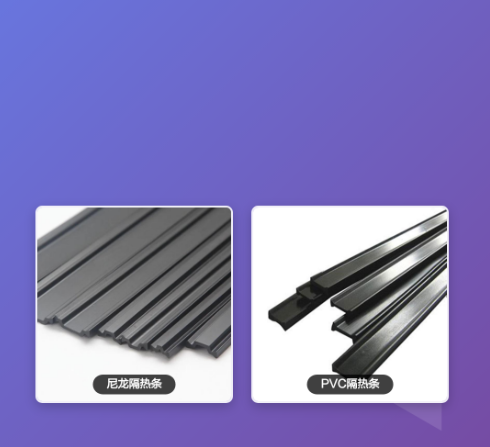
The thermal insulation strip is the core component of the broken bridge structure, and it is also the most important watershed for true and false broken bridges and high and low quality broken bridges. The national standard broken bridge doors and windows must use PA66 nylon thermal insulation strips with 25% glass fiber added, which is resistant to high temperature, low shrinkage, high strength, high and low temperature aging, and will not deform, soften or crack after long-term exposure to the sun.
The low-priced products in the market use a large number of PVC plastic insulation strips, which are similar in appearance to PA66, but have poor high temperature resistance and are prone to softening and shrinking when exposed to the sun in summer. The gap between the aluminum and the insulation strips directly loses the insulation ability and will fall off over time, which belongs to the industry's recognized reduction routine.
Identification tips: PA66 heat insulation strip has a matte surface with fine lines, and the PA66 logo will be printed on it; PVC heat insulation strip has a bright and smooth surface without a logo, and will emit a pungent smell when ignited with fire. Once the material of the heat insulation strip is changed, no matter how thick the profile is, it will lose the meaning of breaking the bridge.
Physical comparison chart of PA66 nylon thermal insulation strip and PVC thermal insulation strip
Fourth, the broken bridge door and window glass configuration: the core of sound insulation, heat insulation and lighting
About 70% of the area of broken bridge doors and windows is glass. The sound insulation and heat insulation effect of doors and windows is largely determined by glass, not necessarily sound insulation if the broken bridge profile is selected. The mainstream standard of home improvement is 5 + 12A + 5 hollow tempered glass, 5 represents the thickness of glass, and 12A represents the thickness of the intermediate air layer.
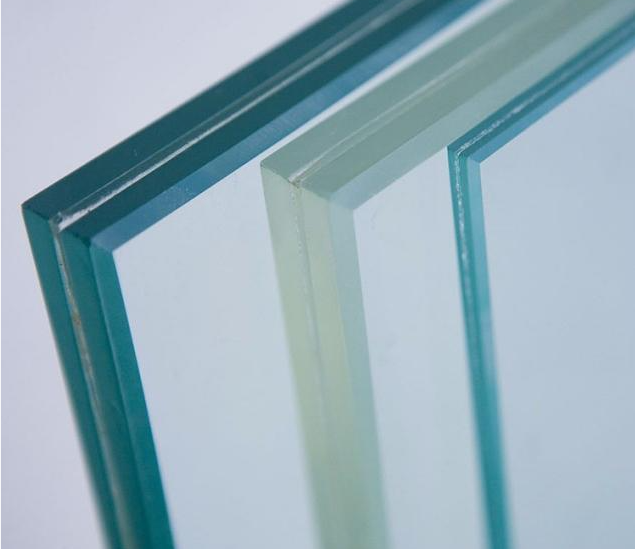
The insulating glass has a dry air layer in the middle to reduce heat conduction and improve heat preservation. If it is facing the street, close to the main road, or elevated, and the noise is high, it is necessary to upgrade the laminated insulating glass (5 + 0.76PVB + 5 + 12A + 5). The PVB adhesive layer can block the noise of medium and low frequency traffic, and the sound insulation effect is far better than that of ordinary insulating glass.
In pursuit of sun protection, UV protection, and temperature control, Low-E low-radiation glass can be selected, which is divided into high-transparency Low-E and offline Low-E, blocking infrared heat radiation, blocking outdoor heat in summer, and locking indoor heating in winter to reduce air conditioning and floor heating energy consumption. All home improvement exterior window glass must be marked with 3C toughening. After the tempered glass is broken, it is granular, reducing the risk of injury.
Structure analysis diagram of insulating glass, laminated glass and Low-E glass
Fifth, the broken bridge door and window sealing system: rubber strip, sealing structure, drainage design
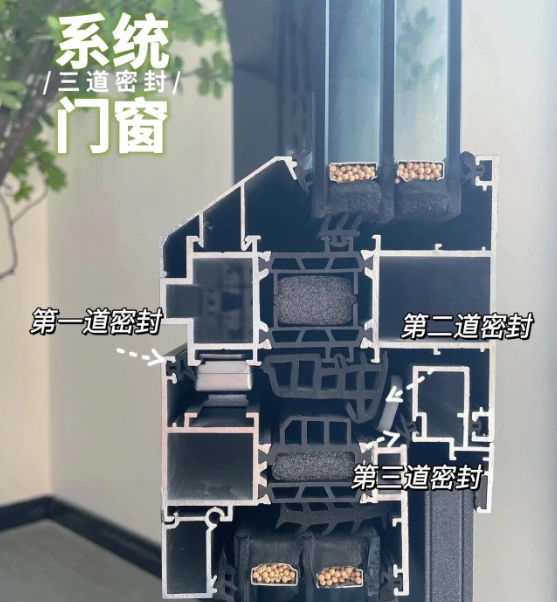
Broken bridge doors and windows leak air, water seepage, dust, mostly because the sealing and drainage system design is not in place. High-quality broken bridge doors and windows adopt a multi-channel isobaric sealing structure, with three mainstream seals, and some high-end system windows achieve four seals. EPDM EPDM EPDM rubber strips are preferred for sealing strips, which are resistant to aging, high and low temperatures, and have long-lasting elasticity. The service life can reach more than 15 years, which is better than ordinary rubber strips.
The principle of the isobaric chamber is to make the internal pressure of the frame fan equal to the outdoor air pressure, and the rainwater is not easy to be pressed into the gap by the air pressure, which is the core logic of the waterproofing of high-end broken bridge windows. At the same time, it is equipped with hidden drainage, which distinguishes the old-fashioned straight drainage holes, and hides the drainage with a water retaining cover to prevent rainwater backflow, wind sand, and mosquitoes from entering. The advantages of typhoon-prone rainy areas are obvious.
Many low-cost broken bridges only have single sealing and open drainage. It is easy to seep water into the home in heavy rain and windy weather. Post-maintenance treatment is very troublesome. Sealing and drainage are important parts of doors and windows that are easily ignored but determine long-term use experience.
Schematic diagram of three sealing structures and details of hidden drains
Sixth, broken bridge door and window hardware accessories: determine the opening and closing feel and service life
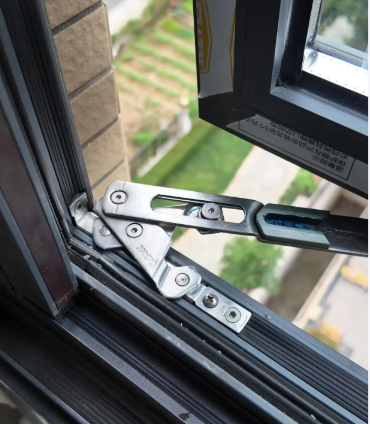
Hardware is the joint of broken bridge doors and windows. Whether a set of doors and windows can be smoothly switched on and off, locked tightly, and not falling for a long time depends entirely on hardware. Hardware includes hinges (hinges), actuators, lock points, lock seats, handles, and pulleys (push-pull models).
First-line brand hardware has better load-bearing, rust-proof and wear-resistant performance. Load-bearing hinges will be marked with load-bearing parameters. High-rise large windows must be selected with high-bearing hinges to prevent the window sash from falling, rubbing against the frame, and not closing tightly for a long time. Multi-point locking system, after closing, multiple lock points are synchronously engaged, and the frame fan is pressed tightly to improve air tightness and anti-theft.
Hardware is also the main reduction point for merchants. With miscellaneous thin iron sheet hardware, the handle will be loose, the lock point will fail, and the window sash will sag after 1-2 years of use. It is recommended to choose 304 stainless steel hardware or brand aluminum alloy hardware for broken bridge windows, and hardware with higher anti-corrosion level is preferred in coastal humid areas.
Broken bridge window multi-point lock, load-bearing hinge, handle hardware close-up
Seven, the mainstream opening method of broken bridge doors and windows, how to choose different scenarios
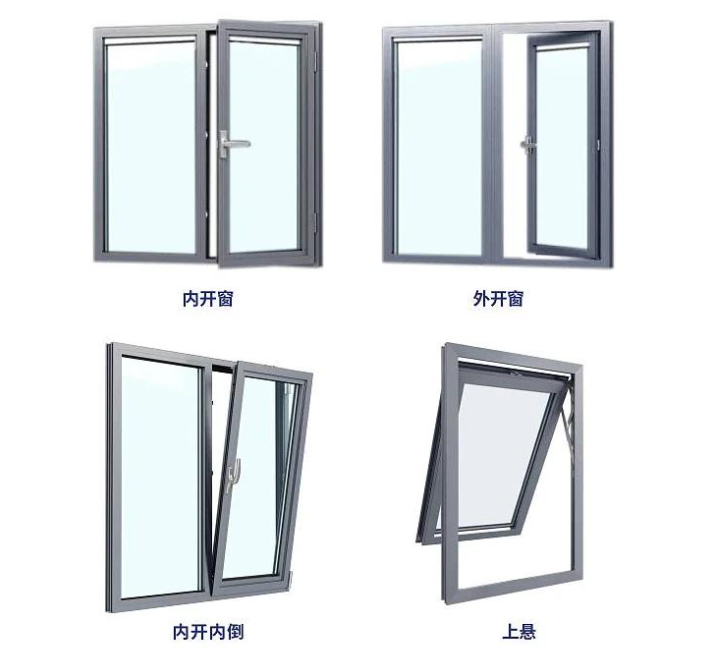
Broken bridge doors and windows come in a variety of opening styles, suitable for different apartment types, floors, and needs. There is no absolute best, only the most suitable.
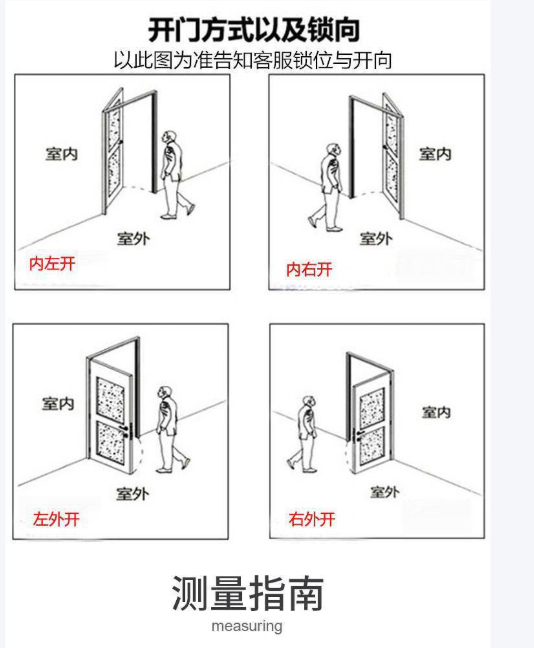
1. Inner opening and inner inverted window: The most popular high-rise home decoration, open inward, can also be suspended for micro-ventilation, slightly open state anti-theft, rain-proof, avoid direct wind blowing, high-rise fans are not easy to fall, high safety; the disadvantage is that opening will occupy indoor space, easy to conflict with curtains.
2. External window opening: Open outward, does not occupy indoor space, and has a large opening area; many high-rise residential properties prohibit external window opening, and there is a risk of fan falling. Priority is given to low-rise use.
3. Swing door: balcony, kitchen partition, good sealing, strong sound insulation and heat insulation;
4. Push-pull broken bridge windows: push-pull left and right, do not take up space, and are cost-effective; the short board is less airtight and water-tight than casement windows.
The purchase should be based on the comprehensive judgment of property regulations, floor height, noise situation, and indoor layout. High-rise people give priority to recommending inner opening and inner inverted bridge windows.
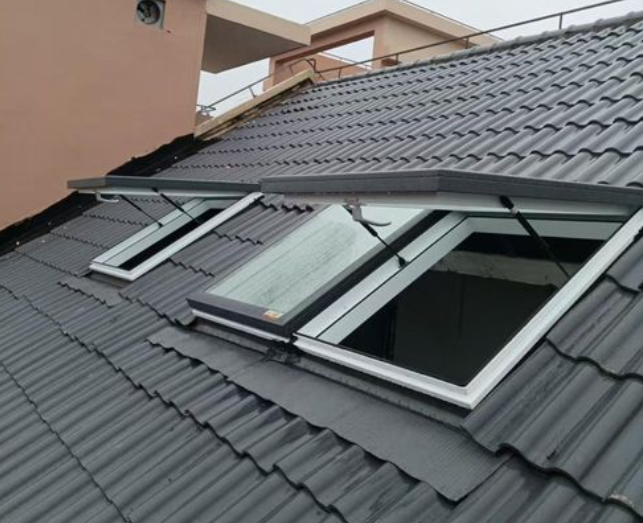
Comparison of opening effects of inner opening, inner inverted, outer opening window and push-pull broken bridge window
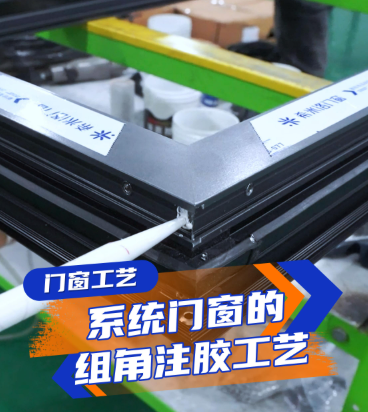
Eighth, the production process of broken bridge doors and windows: group angle glue injection determines the structural stability
Profile cutting and corner forming process determine whether the door and window frame will crack, seep, and deform. Regular broken bridge doors and windows are cut with 45-degree precision numerical control, and the cutting gap is uniform with minimal error; group angle position is injected with group angle glue, and it is reinforced with corner code, which is what the industry calls glue injection group angle process.
The corners of the glue injection group can firmly fix the four corners, the corner seams are sealed, rainwater will not penetrate from the corner seams, the overall frame is rigid, and the corners will not crack or loosen after long-term use. Many low-priced broken bridges on the market do not inject glue, but are simply spliced with corner codes. The corner seams are only blocked by rubber strips. After a long time, water enters the gaps, the profiles are oxidized, and the window seepage is high.
Surface treatment processes are common: electrostatic powder spraying, fluorocarbon spraying, wood grain transfer printing. Fluorocarbon spraying has the strongest weather resistance, is suitable for outdoor exposure environment, and is not easy to fade and lose light; powder spraying is cost-effective and has a wide range of colors; wood grain transfer is suitable for new Chinese style and log style decoration.
Group corner glue injection processing workshop real shot, corner code glue injection details
Nine, broken bridge doors and windows installation specifications: three points of product and seven points of installation
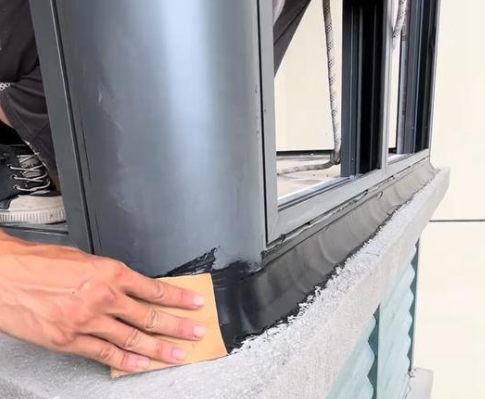
No matter how good the broken bridge doors and windows are, if the installation is not standardized, the performance will be greatly reduced directly. Standard installation process: hole cleaning, window frame in place, adjusting horizontal and vertical foaming, filling the outside, weathering sealant, closing the inside, debugging, hardware cleaning and acceptance.
The gap between the window frame and the wall should be filled with polyurethane foam to fill it fully and serve as a thermal insulation buffer; the outer sealant must be neutral weather-resistant silicone glue, and ordinary glass glue cannot be used. Ordinary glue will crack and degummed for 1-2 years, and rainwater will seep into the wall along the gap.
Installation key points: the horizontal and vertical error of the window frame is strictly controlled, and it is not inclined; the inside and outside of the foam cannot be exposed; the external wall glue is continuous without breakpoints; it is forbidden to directly seal the window frame with cement. The thermal expansion and contraction of cement will squeeze the profile and cause deformation. Many owners' doors and windows leak. The root cause is not the product, but the cracking and filling of the external wall glue.
Broken bridge doors and windows site installation glue, foam filling construction map
10. Broken bridge doors and windows purchase pit avoidance guide to avoid common market routines
1. Only report the series but not the wall thickness: 70 broken bridges have 1.4 thick national standard models, and there are also 1.2 thin material non-standard models, and the quotation gap is large;
2, confuse ordinary hollow and laminated glass, use ordinary hollow as sound insulation laminated glass;
3. The thermal insulation strip PVC pretends to be PA66 nylon thermal insulation strip;
4. Only the price of the bare frame is counted, and the price of glass, hardware, gluing, columns and opening fans will be increased separately in the later stage;
5. Do not use glue injection group corners to simplify the process and reduce costs.
6. Ignore the property requirements, and the high-rise will choose to open the windows without permission. Later, it will be required to be demolished and rectified.
When purchasing, write clearly in the contract: profile wall thickness, thermal insulation strip material, glass specifications, hardware brand, opening method, whether to inject glue group angle, quality assurance period, black and white agreement to reduce disputes.
Eleven, broken bridge doors and windows later maintenance and quality assurance common sense
The broken bridge doors and windows themselves are durable, but simple daily maintenance can prolong the service life. Regularly clean the dust catkins in the drain holes to prevent the drain holes from clogging and accumulating water; the handles and hinges can spray a small amount of special grease for half a year, do not use oil; if the external wall glue is cracked, replenish the glue in time to prevent water seepage.
Regular brand broken bridge doors and windows, profiles are generally quality assurance for 10-20 years, hardware quality assurance for 2-5 years, rubber strips and sealants are consumables. Do not hit the window sash vigorously every day, do not hang heavy objects on the window sash, and avoid overload sagging of load-bearing hinges.
Full text summary
Broken bridge doors and windows are the mainstream solution for home improvement energy-saving doors and windows. The core relies on PA66 thermal insulation strips to disconnect hot and cold bridges, combined with multi-cavity profiles, tempered hollow/laminated glass, EPDM sealing strips, brand hardware, glue injection group angle process, standardized installation, to achieve multiple functions of heat preservation, sound insulation, waterproof, airtight, safety and anti-theft.
When choosing broken bridge doors and windows, you can't just look at the series of numbers and low prices. You must comprehensively check the wall thickness of the profile, the authenticity of the thermal insulation strip, the glass configuration, the hardware grade, the angle forming process, and the installation and construction. For high-rise, street-facing, and villa decoration, broken bridge system windows are the best choice to improve living comfort and reduce energy consumption. Within the budget, priority should be given to complete sound insulation glass, glue injection process, and brand hardware. At the same time, the outer wall should be sealed and installed to give full play to the full performance of broken bridge doors and windows.