

Aluminum alloy doors and windows
Aluminum alloy doors and windows in-depth popular science | Profile structure, sealing system, glass configuration, hardware craftsmanship, selection, installation and maintenance guide
[| Modern residential floor-to-ceiling aluminum alloy system doors and windows real scene, living room large view floor-to-ceiling windows, transparent light, simple and atmospheric appearance]
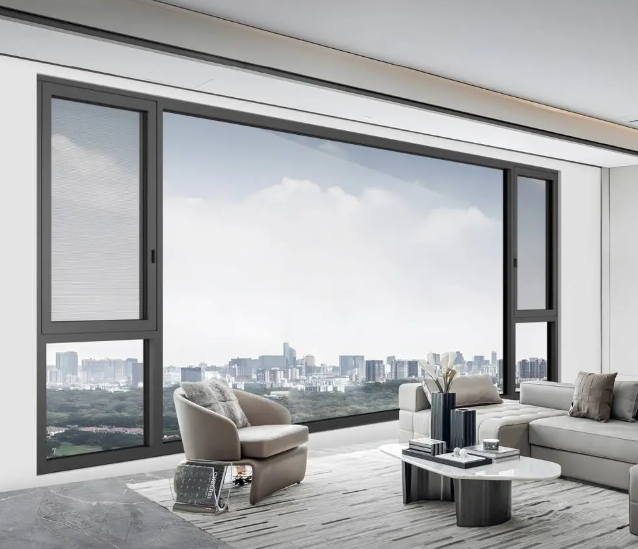
In the decoration of new houses, renovation of old houses, self-construction of villas and engineering projects, aluminum alloy doors and windows have become the mainstream choice in the market. Compared with traditional plastic steel windows, ordinary iron windows, and wooden doors and windows, aluminum alloy doors and windows account for the vast majority of the door and window market due to their advantages of high strength, not easy to deform, waterproof and moisture-proof, rich styles, and long service life. However, when many owners, decoration purchasers, and engineering parties purchase aluminum alloy doors and windows, they can easily fall into the misunderstanding of only looking at the color and price comparison of aluminum, unable to distinguish the difference between ordinary broken bridge aluminum and system windows, and unable to understand the profile cavity structure, heat insulation strip, sealing configuration, glass parameters, and hardware grades. After the installation is completed, a series of problems such as rain leakage, ventilation, noise, poor insulation, switch cards, and profile deformation will occur, and the rework cost will be extremely high.
Aluminum alloy doors and windows seem to be just a simple combination of frame fans, but in fact it is an integrated system product, including seven core plates of profiles, heat insulation, sealing, glass, hardware, drainage, and installation, each of which has corresponding national standards, technical parameters, and process requirements. This article explains the classification of aluminum alloy doors and windows, profile knowledge, thermal insulation structure, sealing principle, glass selection, hardware accessories, surface treatment, installation acceptance, maintenance methods, and common routines in the industry from a professional perspective. It takes into account professional depth and popular readability. It is suitable for decoration owners, decoration companies, engineering procurement, and real estate party A reading reference.
[Cross-sectional anatomy of the profile | Enlarged cross-sectional view of the aluminum profile of the broken bridge, marking the position of the profile cavity, heat insulation strip, sealing tape, and wall thickness]
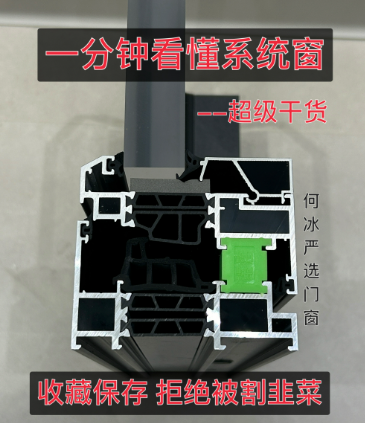
First, the basic classification of aluminum alloy doors and windows: the core difference between non-broken bridge aluminum and broken bridge aluminum system windows
Many people buy doors and windows and hear "broken bridge aluminum", but they don't know what the broken bridge means. Aluminum alloy itself conducts heat very quickly. If it is not heat treated, outdoor heat will be quickly transferred into the room in summer, and indoor heat will be lost outward in winter. Energy consumption is high and condensation is serious. The broken bridge process is to add low-heat conduction heat insulation strips in the middle of aluminum alloy profiles to disconnect the inner and outer layers of aluminum alloy and block the heat transfer channel. This is also the most essential difference between broken bridge aluminum doors and windows and ordinary non-broken bridge aluminum doors and windows.
The first category: non-broken bridge aluminum alloy doors and windows. The profile is an integrated aluminum alloy cavity without thermal insulation strips, the cost is low, and the thermal insulation performance is poor. The K value is generally above 4.0W/(m2 · K). The advantages are cheap and simple structure. Generally, it is only suitable for factories, warehouses, and simple buildings in the south that do not consider thermal insulation. It is not suitable for residential home improvement. It is cold in winter and hot in summer. When the temperature difference is large, the inside of the glass is prone to condensation and running water.
The second category: broken bridge aluminum alloy doors and windows, which is also the mainstream style of home improvement. Through PA66 nylon thermal insulation strips to disconnect the inner and outer aluminum profiles to achieve thermal insulation, and then with multi-channel sealing and insulating glass, the thermal insulation and sound insulation performance is greatly improved. Broken bridge aluminum doors and windows are divided into ordinary assembled broken bridge aluminum and high-performance system broken bridge aluminum. Ordinary broken bridge aluminum is mostly bulk material for profile factories, and stores cut and assemble by themselves. Accessories, sealing, and drainage are matched separately, and the overall coordination is general; system doors and windows are developed and matched by the manufacturer as a whole. The profile cavity, thermal insulation strip, rubber strip, hardware, and drainage structure are uniformly designed. After wind pressure, watertight, and airtight laboratory testing, the performance indicators are stable, and they belong to higher standard products.
The basic requirements of the national standard are popularized here: according to GB/T 8478 "Aluminum Alloy Doors and Windows", the outer window is divided into five basic indicators according to its performance: airtight, watertight, wind pressure resistance, thermal insulation, and sound insulation. High-performance system windows can meet high-level standards. Ordinary broken bridge aluminum can often only meet the basic compliance line.
[Profile wall thickness caliper measurement chart | Vernier caliper to measure the wall thickness of aluminum profiles, mark the requirements of the national standard, and distinguish between non-standard thin materials and national standard materials]
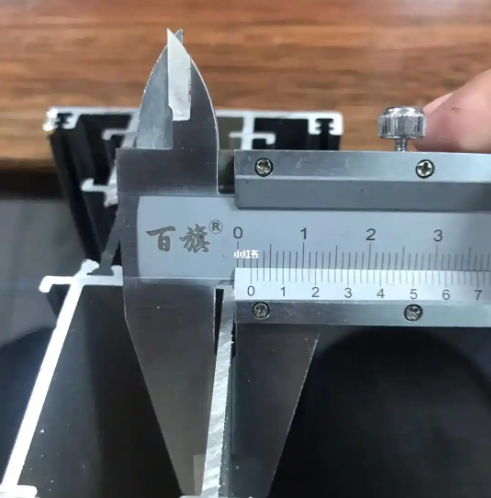
Second, aluminum alloy profile material, wall thickness standards and cavity structure analysis
The mainstream of aluminum alloy door and window substrates is 6063-T5 aluminum alloy, which belongs to aluminum-magnesium-silicon alloy. It has good extrusion molding performance, moderate strength and stable surface coloring. It is a special brand for doors and windows. A few low-priced products in the market use recycled aluminum, which has many impurities and high brittleness. It is easy to distort and deform after stress, and the surface spraying is easy to peel. Regular products prefer primary aluminum 6063-T5.
The wall thickness of profiles is the bottom line of safety, and it is also the hardest hit area for cutting corners. According to the current national norms, the wall thickness of the main profiles of building exterior windows should not be less than 1.4mm. It is recommended to use thickened profiles of 1.6mm and above for high-rise buildings, floor-to-ceiling windows, large fixed glass, and heavy-duty sliding doors. Many low-cost doors and windows are marked with 1.4mm, but the actual actual thickness is only 1.0-1.2mm. This is a non-standard reduction, insufficient wind pressure resistance, and potential safety hazards for high-rise use. The purchase contract must state the actual wall thickness, not the standard thickness.
Broken bridge profile cavity design is the core embodiment of professionalism. Simple single cavity has only one cavity, and the sound insulation, drainage, and torsion resistance are weak; multi-cavity broken bridge aluminum can be divided into heat insulation cavity, drainage cavity, reinforcement cavity, and isobaric cavity. The isobaric cavity design is particularly critical. The isobaric principle is to maintain a balance between the internal pressure of the cavity and the outdoor air pressure, and to reduce rainwater being pressed into the room under the action of air pressure. It is the core design to improve water tightness. The more cavities, the stronger the rigidity of the profile, the larger the sound insulation buffer space, and the more reasonable the drainage path. The 70, 75, 80, 85, and 90 series of broken bridge aluminum are commonly found on the market. The number represents the width of the profile frame in millimeters. The larger the series, the larger the cavity space, and thicker glass can be used. The upper limit of thermal insulation and sound insulation is higher. However, the larger the series, the better. It depends on whether the cavity structure design is reasonable, not just the numbers.
[Heat insulation strip comparison chart | PA66 nylon heat insulation strip and PVC plastic heat insulation strip comparison, combustion and bending comparison test]
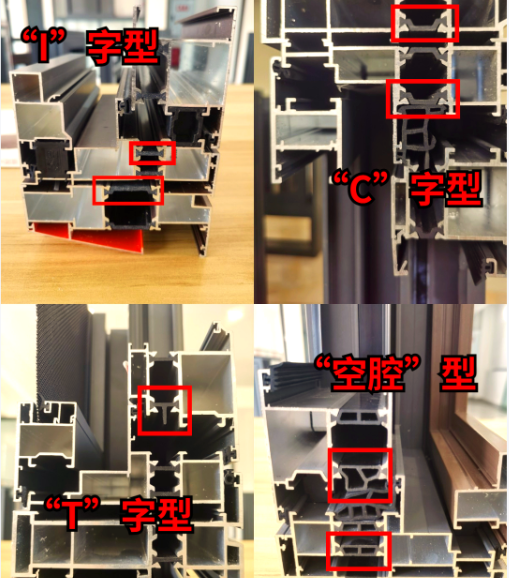
Third, the thermal insulation strip: the "heart" of broken bridge aluminum, a core accessory that many people ignore
The thermal insulation strip is the core of the broken bridge structure, directly determining the thermal insulation performance and long-term stability of the entire window. There are two types on the market: PA66 nylon thermal insulation strip and PVC plastic thermal insulation strip. The price difference between the two is huge, and the performance is very different.
The national standard requires that the broken bridge aluminum doors and windows must use PA66 plus 25% glass fiber nylon heat insulation strips, which are resistant to high temperature, not easy to deform, and have a thermal expansion coefficient close to that of aluminum alloy. Long-term sun exposure alternates high and low temperatures, and will not shrink, crack, or groove. Long-term stability. High-quality PA66 heat insulation strips have fine glass fiber texture on the surface and are marked by brand laser.
Low-cost doors and windows use a large number of PVC plastic insulation strips, which feel smooth and soft, have poor high temperature resistance, and are easy to soften and deform when exposed to the sun in summer. In winter, they become brittle and crack at low temperatures. After two or three years of use, the insulation strips shrink and fall off, the broken bridge structure fails, and the whole window insulation is directly scrapped. There will also be a large gap in the frame fan, air leakage and water seepage.
Identification tips: PVC insulation strips can be ignited, and the combustion has a pungent plastic smell; PA66 is flame retardant, self-extinguishing from the fire, and the smoke smell is light. At the same time, the width of the insulation strip also affects the heat preservation. On the premise of structure permitting, the wider the insulation strip, the better the heat insulation effect.
[Detail picture of sealing rubber strip | Section of EPDM rubber strip, showing the styles of co-extruded rubber strip and composite rubber strip]
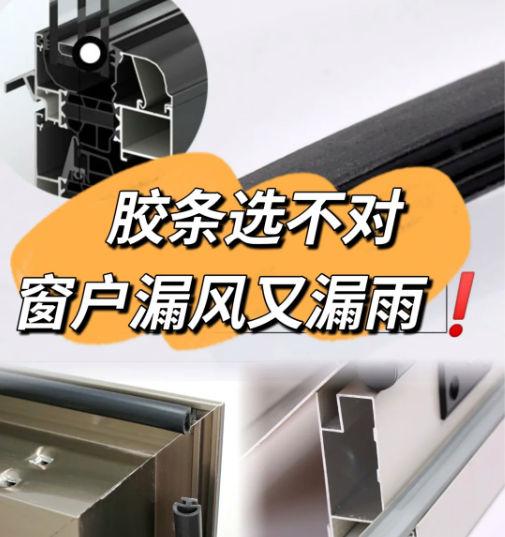
Fourth, the sealing system: the key to airtight and watertight performance, understand the difference between several seals
Doors and windows leak air, ash, water seepage, most of the problems lie in the sealing system. Broken bridge aluminum seals rely on rubber strips to achieve, the mainstream material is EPDM rubber strips, aging resistance, high and low temperature resistance, ozone resistance, normal service life of more than 15 years; inferior rubber strips use recycled rubber, hard, cracking, slag, two or three years to lose elasticity, sealing failure.
The industry often says that three seals and four seals refer to the sealing level between the frame fans: one seal blocks large particles of dust and rainwater, the second seal forms a buffer cavity, and the three seals achieve the main airtight isolation of hot and cold air. Multiple seals cooperate with the isobaric drainage structure to form three-dimensional protection. Pay attention to a misunderstanding: it is not that the more sealing channels, the better. Some manufacturers simply add rubber strips, but the cavity does not have an isobaric design, and the drainage is not smooth, and there will still be water leakage. High-quality sealing design pays attention to the combination of "resistance, drainage and conduction". It is necessary to block rainwater and drain the water that penetrates into the cavity smoothly.
The rubber strip structure is divided into extrusion rubber strip and co-extrusion rubber strip. The co-extrusion rubber strip and the profile card slot are integrated and matched, and it is not easy to fall off; the splicing rubber strip focuses on the interface position, and many door and window water leakage points are in the butt gap of the rubber strip.
[Schematic diagram of insulating glass structure | Disassembly of insulating glass and laminated insulating glass structure, marked with aluminum strip, desiccant, butyl glue, structural glue]
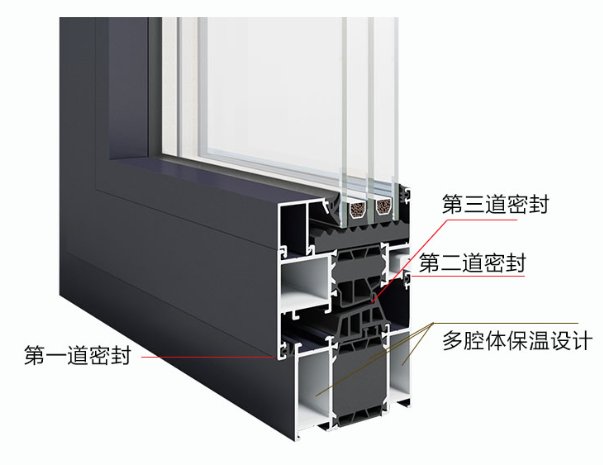
Glass configuration: determine the effect of sound insulation, thermal insulation, and anti-condensation
The area of aluminum alloy door and window glass accounts for more than 70%, and the glass configuration has a great impact on the performance of the whole window. The mainstream of home improvement broken bridge aluminum is insulating glass, which is composed of two or more pieces of tempered glass, with a hollow layer in the middle. The aluminum spacer is filled with desiccant to absorb internal water vapor and prevent fogging.
Basic model: 5 + 12A + 5 double glass hollow, suitable for low-rise, low-noise communities;
Upgraded model: 5 + 20A + 5 large hollow, the hollow layer is larger, and the sound insulation and insulation are better than 12A;
High-performance models: Low-E insulating glass, Low-E film layer can reflect infrared heat, block outdoor heat radiation in summer, retain indoor heat in winter, and have obvious energy-saving effects. It is divided into high-transparency Low-E, medium-transparency Low-E, and high-transparency models are preferred for home improvement. Daylighting is not affected.
Scenes with high street and elevated noise: choose laminated insulating glass, such as 5 + 0.76PVB + 5 laminated + 12A + 5, the laminated layer can effectively block low-frequency noise, which is not achievable by ordinary insulating glass.
The glass must be 3C certified tempered glass, high-rise floor-to-ceiling windows, large fixed fans are forced to be tempered; pay attention to distinguish the gluing process of the glass, double seal: the inner layer of butyl glue blocks water vapor, the outer layer of structural glue ensures the bonding strength, and the small workshop only plays a glue, the water vapor slowly enters the hollow layer, the inside of the glass is foggy and moldy, which cannot be repaired, and can only be replaced in one piece. The hollow layer can be filled with argon gas to further reduce the heat transfer coefficient, which belongs to the high-end system window configuration.
[Real pictures of hardware accessories | Haobo, Gewu and other brand hardware, close-up of inner opening and inner inverted lock point, actuator, hinge]
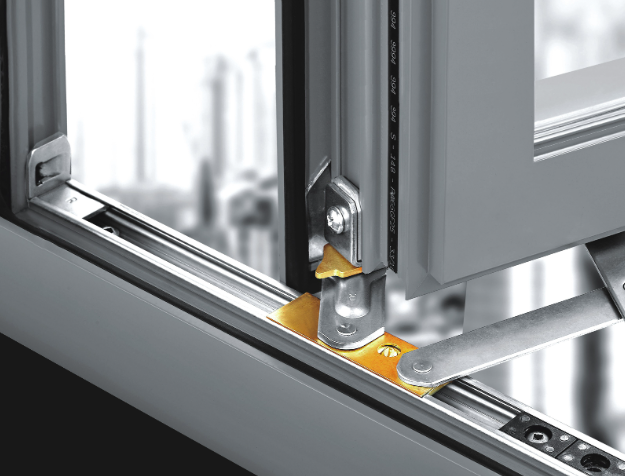
Hardware accessories: the joints of doors and windows determine the feel and service life of the switch
Many owners put all their budgets on profiles and glass, ignoring hardware. The hardware bears the load-bearing and locking functions of the entire window opening fan. The inferior hardware switch card and lock point cannot be locked. It will loosen and sink after a year or two, and the fan body will sag and rub against the profile, causing the seal to fail.
Aluminum alloy door and window hardware is divided into domestic high-quality brands and imported brands. The hardware corresponding to common opening methods: casement window hinge, lock point lock box, actuator; inner opening and inner inverted hardware; sliding window pulley, hook lock; lifting sliding door heavy-duty hardware. Among them, the inner opening and inner inverted hardware has a complex structure and is a premium point. A set of qualified inner opening and inner inverted includes a multi-point locking system. The more locking points, the more uniform the pressing of the frame fan, and the better the sealing effect.
Focus on the material: high-quality hardware substrate is zinc alloy, stainless steel, surface anti-corrosion treatment; low-cost hardware thin iron die-casting, easy to rust and fracture. High-rise opening fan, must be matched with load-bearing matching hinge, the larger the opening fan size, the heavier the glass, the higher the hardware load-bearing grade requirements. It is recommended not to make the opening fan too large, and the width of a single fan is recommended to be controlled within 700mm to avoid long-term load sagging.
[Profile surface treatment sample diagram | Fluorocarbon spraying, electrostatic powder spraying, wood grain transfer, anodizing sample comparison]
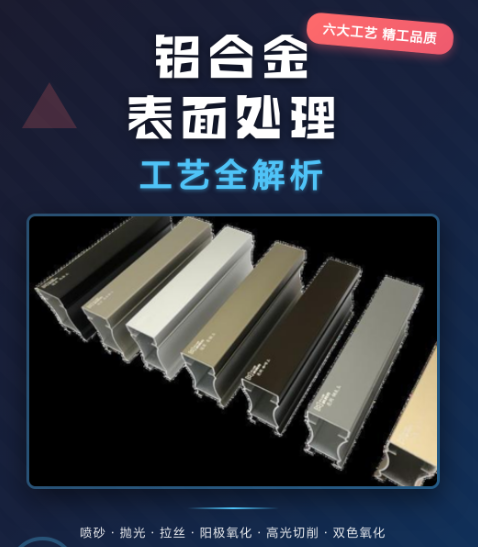
The surface treatment process of aluminum alloy profiles determines the appearance and weather resistance
On the one hand, aluminum alloy surface treatment is decorative, and on the other hand, it protects aluminum from oxidation and corrosion. There are four mainstream processes:
Electrostatic powder spraying: the most commonly used in the market, with rich colors, high cost performance, good coating adhesion, and versatility indoors and outdoors; high-quality powder spraying can withstand more than 10 years of weather, and poor recycled powder is prone to fading and pulverization.
Fluorocarbon spraying: PVDF fluorocarbon paint, UV resistance, acid rain corrosion resistance is the strongest, the first choice for seaside, outdoor, engineering projects, higher cost, long-term sun exposure is not easy to change color.
Wood grain transfer printing: simulates the texture of logs to satisfy users who like wood feeling, and is mostly used in indoor and sun rooms; fluorocarbon base wood grain is preferred for outdoor wood grain models, and ordinary wood grain is easy to fade outdoors.
Anodizing: an oxide film is formed on the surface, with a matte metallic texture, high hardness, wear resistance, and few style choices.
When purchasing, avoid the low-cost painting process. Ordinary paints have poor adhesion and peel off quickly in the wind and sun.
[Schematic diagram of drainage structure | Comparison of hidden drainage and exposed drainage holes, diagram of the principle of isobaric drainage]
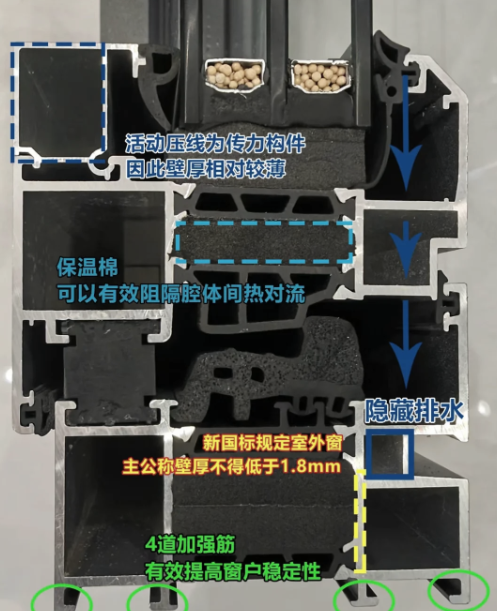
Eight, drainage structure design: comparison of the advantages and disadvantages of open drainage and hidden drainage
Broken bridge aluminum drainage is divided into exposed drainage holes and hidden drainage. The exposed drainage hole structure is simple and the cost is low, but the appearance can see the drainage cover, strong wind and rainstorm weather, rainwater is easy to pour back; hidden drainage is a common solution for system windows, and a circuitous drainage channel is designed inside the profile cavity. The appearance is simple and beautiful. With the isobaric cavity, the rainstorm backflow resistance is stronger.
There is a key point in the drainage design: the drainage hole cannot be blocked. After the installation is completed, the protective film and styrofoam should not block the drainage channel. Many doors and windows leak, not because the sealing strip is broken, but because the drainage cavity is blocked by debris, the water cannot be discharged and overflow into the room. The hidden drainage processing is more difficult, and the design requirements of the profile cavity are strict. It is also a detail that distinguishes ordinary broken bridges from system windows.
[Standardized installation construction site map | Foaming agent, weathering glue on external walls, auxiliary frame installation, vertical adjustment construction]
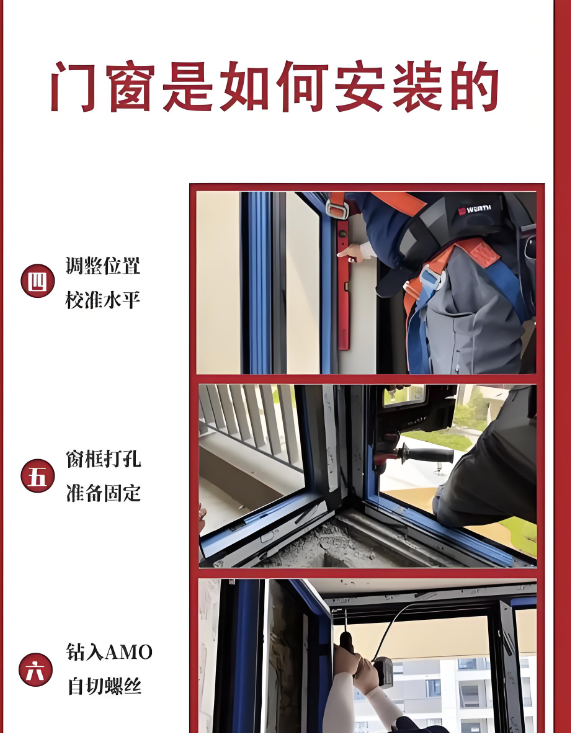
Nine, aluminum alloy doors and windows standardized installation process and acceptance points
Industry consensus: doors and windows are three-point products and seven-point installation. No matter how good the profile glass is, if it is not installed in place, it will still leak and ventilate. The national standard recommends frame installation, also known as the sub-frame process. Install the sub-frame first, plaster and close the mouth before installing the main frame. Reduce wall settlement and pull doors and windows, better waterproof stability. Many home improvement stores omit the sub-frame to save costs.
Standard installation steps:
The first step is to review and clean the hole, check the size of the hole, and remove the loose mortar;
The second step, the door and window frames are in place, the level is adjusted horizontally and vertically, and the gaps are uniform;
The third step is to fix the fixing piece, the fixed point spacing conforms to the specification, and it is forbidden to nail directly at the position of the heat insulation strip;
The fourth step is to fill the gaps between the frame and the wall.