

Door and window pulley
Professional in-depth analysis of door and window pulleys | A complete guide to material, load-bearing, structure, selection, failure and replacement
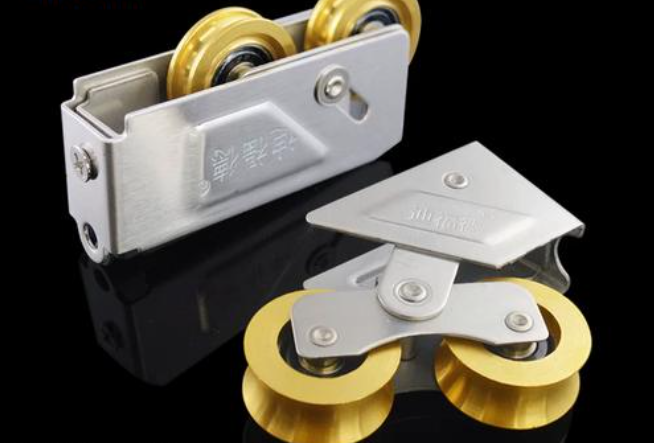
[Door and window pulley product collection, sliding window pulley, lifting sliding door pulley, broken bridge sliding door pulley real shot, distinguish single wheel, double wheel, adjustable pulley]
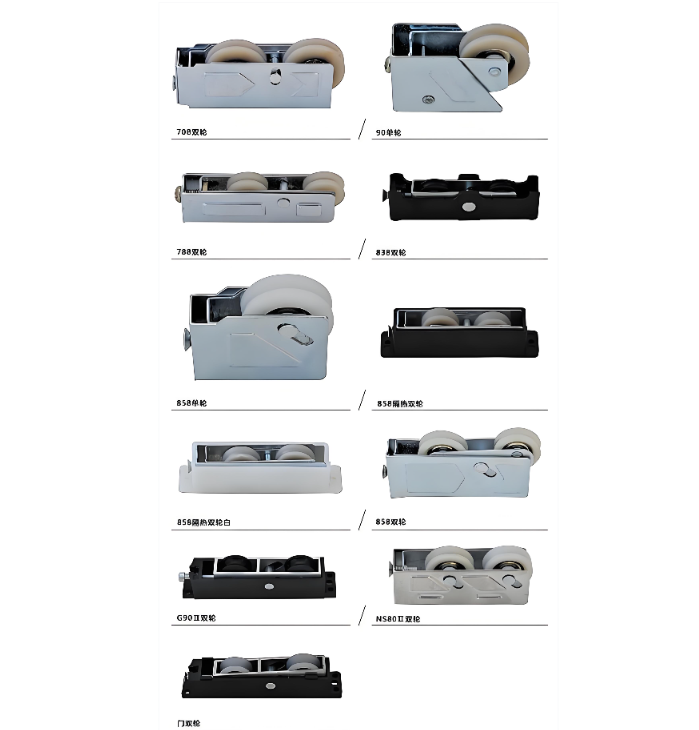
Door and window pulleys are the core motion hardware of sliding doors and windows. They seem to be small in size, but they directly determine the opening and closing feel, mute effect, service life and sealing performance of sliding doors and windows. Common in broken bridge sliding windows, sliding balcony doors, heavy-duty lifting sliding doors, sun room sliding fans and other products. Many owners, door and window practitioners focus on profiles, glass, and sealing strips when selecting doors and windows, and it is easy to ignore the small accessory of pulleys. After a period of use, there are problems such as push-pull cards, abnormal noises, sinking, derailment, and the fan body cannot be pushed. Most of the root causes are the wrong selection of pulleys or substandard quality.
Door and window pulleys are vulnerable hardware that continuously bear the weight of door fans and repeated friction losses. They have strict load-bearing classification, material standards, and track adaptation requirements. This paper expands from the dimensions of door and window pulleys classification, internal structure, core materials, load-bearing parameters, track matching, installation and debugging, common faults, replacement methods, purchase and avoidance of pits, daily maintenance, etc., taking into account professional technical knowledge and ordinary users
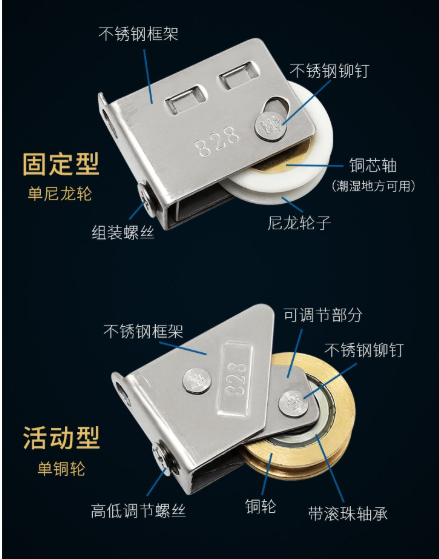
[Schematic diagram of structural disassembly | Disassembly section of door and window pulleys, brackets, wheel cores, bearings, wheel surfaces, adjusting screws, and anti-drop buckles are marked]
First, the door and window pulley foundation structure and working principle
A complete set of door and window pulleys is generally composed of six major components: bracket, bearing, wheel core, wear-resistant wheel surface, adjustment mechanism, and anti-drop limit buckle. The entire weight of the fan body of the sliding door and window is pressed on the pulley, and the pulley rolls along the profile track to transform sliding friction into rolling friction and reduce the thrust required for pushing and pulling.
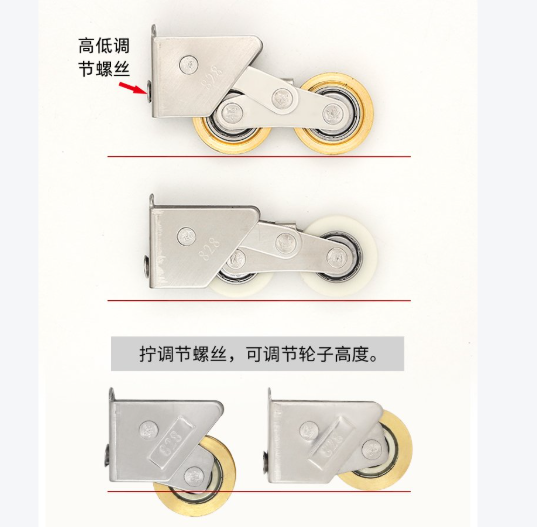
The bracket is the bearing base, responsible for fixing the pulley under the fan material; the bearing is the core rotating component, which determines the smoothness and durability; the wheel surface is directly in contact with the track, which is the fastest wear position; the adjustment screw is used to fine-tune the height up and down to solve the problems of sinking, uneven height, and stuck rails of the door leaf; the anti-detachment buckle is a safety structure to prevent the fan body from jumping out of the track when the pushing and pulling force is too strong, especially for high-rise doors and windows.
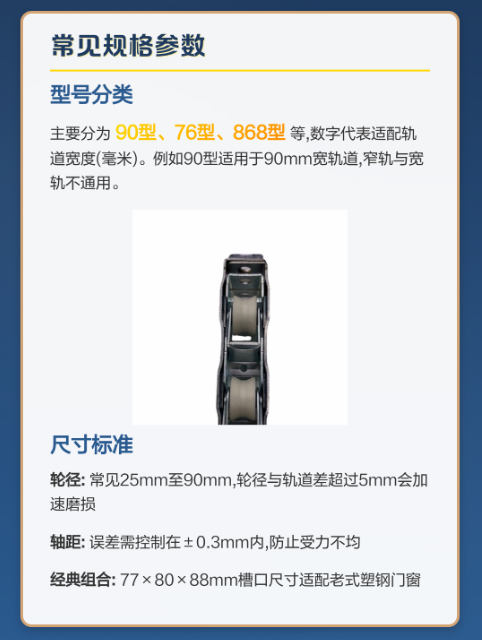
Many low-cost simplified pulleys will omit anti-drop buckles and cancel precision bearings, and only use simple plastic bushings, which will wear and deform in a short time. Not only is the push-pull laborious, but there is also a safety hazard of window sash falling off. Pulleys are not universal parts. Different series of broken bridge push-pull profiles have different notch widths, track heights, and bottom frame structures. The size of the pulley base must match the profile notch and cannot be mixed at will.
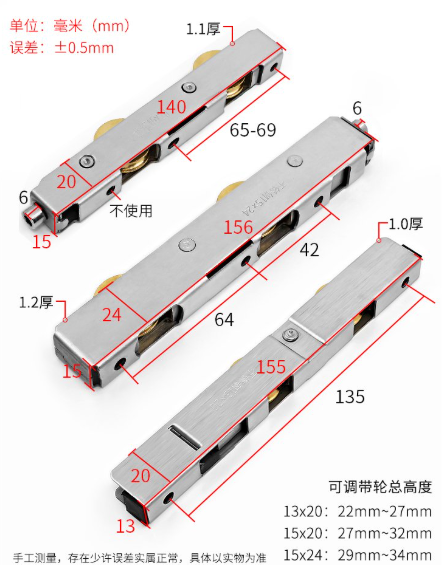
[Classification comparison chart | Single wheel pulley, double wheel pulley, adjustable pulley, heavy lifting pulley, invisible pulley physical comparison]
Mainstream classification of door and window pulleys, divided by structure and load-bearing
According to the structure and load-bearing capacity, door and window pulleys on the market are mainly divided into light single wheels, standard double wheels, adjustable double wheels, heavy lifting push-pull pulleys, and invisible embedded pulleys, with obvious differences in application scenarios.
Light single-wheel pulley: compact in size, single-wheel bearing, mostly used for old-fashioned plastic-steel sliding windows and small narrow fan sliding windows, with a load-bearing capacity generally within 30kg. Advantages: cheap; disadvantages: limited load-bearing, poor stability, and easy to tilt the fan body. Now home-improvement broken bridge sliding windows are rarely used alone.
Standard two-wheel pulley: the most commonly used style of home improvement broken bridge sliding window, the two wheels are under simultaneous force, the force is more uniform, and it is not easy to wear unilaterally. The load-bearing range is 40-80kg, suitable for conventional width sliding windows and small sliding screen windows. The two-wheel model has a higher fault tolerance rate, and can still roll smoothly when the track is slightly uneven.
Adjustable double-wheel pulley: Add independent adjustment screws on the basis of the double-wheel, and the left and right wheels can be adjusted separately. When there is a slight error in the processing or installation of doors and windows, and the fan body sinks in the later stage, there is no need to remove the fan, but directly rotate the screws to fine-tune, so that the fan body remains level and the sealing strip fits evenly. It is the preferred style for the sliding window of the system.
Heavy lifting sliding door pulley: specially equipped with 120, 128, 135 series heavy lifting sliding doors, multi-wheel group side-by-side structure, using thickened stainless steel bracket, large size bearing, single group of pulley bearing up to 120kg, 160kg or even more than 200kg. Heavy-duty sliding door has large glass and high self-weight, and ordinary window pulleys cannot bear it at all. Forced use will quickly crush the bearing.
Invisible embedded pulley: The base is embedded inside the fan material cavity, the outside is not prominent, the appearance is simple, and it is mostly used for narrow-sided minimalist sliding doors and narrow-frame sliding windows. It requires extremely high processing accuracy and track flatness, and the cost is high.
[Material sample comparison chart | Close-up of nylon wheel, stainless steel wheel, copper wheel, POM wear-resistant wheel, bearing sample]
Third, the pulley core material analysis, understand the wear resistance, mute, load-bearing differences
The service life of door and window pulleys depends to a large extent on the three core materials of wheel face, bearing and bracket, which are also the main areas for merchants to reduce their distribution.
Wheel surface material: The mainstream is divided into POM steel wheels, reinforced nylon wheels, stainless steel metal wheels, and copper wheels. POM Saigang is the first choice for high-end doors and windows, with its own self-lubricating properties, low friction coefficient, silent and wear-resistant, not easy to crack, and not easy to become hard and brittle in low temperature environments; reinforced nylon wheels are cost-effective, meet conventional household use, and the long-term sun aging speed is faster than POM; stainless steel wheels and copper wheels have high hardness and wear resistance, but the rolling noise is large, and the friction between metal and metal tracks is prone to harsh sounds. Generally, it is used in factories and simple fences for engineering. Home improvement windows are not recommended.
Bearing material: divided into steel bearings, stainless steel bearings, plastic bushings. Precision ball stainless steel bearings are waterproof and rust-proof, rotate smoothly, and have high durability; ordinary carbon steel bearings are prone to rust and get stuck in contact with water vapor; plastic bushings have no balls, which are cheap substitutes and wear out in a few months. Outdoor doors and windows, balcony sliding doors, stainless steel bearings are preferred.
Bracket material: 304 stainless steel bracket is the best, with strong anti-rust ability, the first choice for humid balconies, rainy areas in the south, and coastal environments; 201 stainless steel bracket is low in price, slowly rusts in humid environments, and the bracket deforms and breaks; galvanized iron bracket is the worst, easy to rust, not recommended for home improvement.
[Schematic diagram of track adaptation | Arc track, flat track, broken bridge bottom frame track, wheel surface shape and track matching relationship]
Fourth, the matching logic of pulley and track, many faults come from unmatched
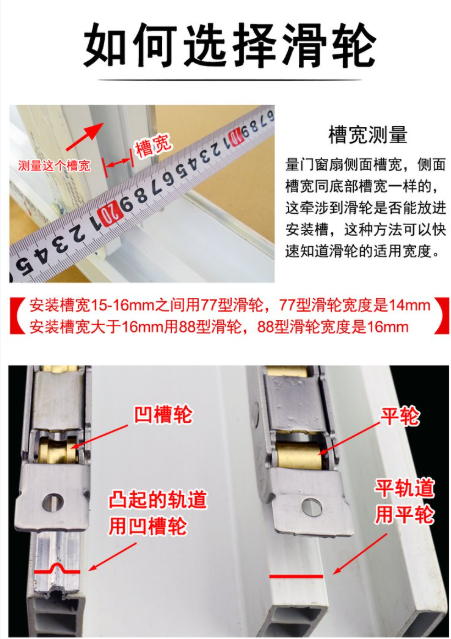
When many masters repair, they only change the pulley, ignoring the track state, and the new pulley is damaged not long after it is installed. The profile of the pulley surface must match the track section of the bottom frame. Common tracks are divided into arc tracks and plane tracks. The arc groove track is matched with the arc wheel surface, and the contact area is moderate, which is not easy to deviate; the flat track is adapted to the flat bottom pulley.
If the arc wheel is placed on a flat track, the contact point is very small, the pressure increases, and the wear speed is doubled; if the flat-bottomed wheel is placed on the arc track, it is easy to shake left and right, deviate and derail. At the same time, the track surface must be smooth and free of burrs. If the profile track is sprayed with rough particles and bumped and deformed, it is equivalent to sandpaper continuously grinding the pulley.
In addition, the width of the inner groove of the track should be adapted to the total width of the pulley. If the gap is too large, the fan body will shake left and right; if the gap is too small, the pulley will be squeezed and rubbed, and the push and pull will be heavy. When designing the broken bridge push-pull system, the profile manufacturer designs the pulley, track, and fan materials as complete sets. Try to choose the same system matching pulleys, and do not mix and match across series. The track is prone to accumulation of dust and sediment every day, and sediment is mixed between the wheel surface and the track, which is the number one culprit for the rapid wear of the
[Performance parameter table | Different types of pulleys are rated for load-bearing, suitable fan type, and bearing type reference marks]
Fifth, the principle of load-bearing selection: rather choose large load-bearing, do not just card the upper limit
Pulleys are marked with rated load-bearing capacity, which is a safe continuous load, not a maximum destructive load. Safety allowances must be reserved for type selection.
Conventional reference standards: single sliding window weight < 40kg, choose 40-60kg double-wheel pulley; single sliding window 40-70kg, choose 80kg adjustable double wheel; balcony conventional sliding door, single 70-120kg, choose 120kg pulley; heavy lifting sliding door, large glass wide fan, 120kg or more, choose multi-wheel heavy pulley.
Key reminder: door and window weight = aluminum profile weight + hollow glass weight, large area thick glass weight is very high, many businesses only judge by the naked eye, with small load-bearing pulleys, short-term use, long-term bearing continuous overload, accelerated wear and tear, sinking and pushing. When purchasing, be sure to calculate the weight of the door leaf according to the glass thickness, fan width and fan height, and then match the pulley load-bearing grade. The safety factor is recommended to be ≥1.5 times.
[Installation and debugging construction map | Pulley loading fan chute mouth, fixing screws, high and low adjustment, anti-drop clearance debugging real shot]
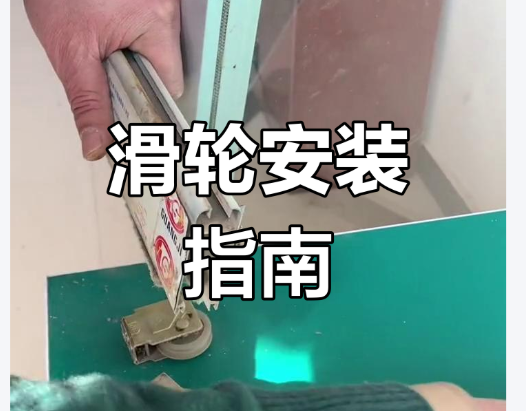
Six, standardized installation and commissioning points
Pulley installation belongs to the process of door and window processing and on-site installation with high precision. If the debugging is not in place, no matter how good the pulley is, it will not perform well.
Factory preloading stage: the pulley is stuck into the fan bottom to reserve a slot, the fixing screw is locked, the screw cannot be pushed to the wheel body to avoid the wheel being stuck; after installation, the wheel rotates flexibly without sticking.
On-site installation and debugging steps: first, the fan body is hung into the track, and the left and right gaps are checked first; second, use a one-word screwdriver to adjust the bottom adjustment screws, slowly lift and lower, so that the fan body is horizontal, and the rubber strips around it are evenly fitted to the frame, and the seal is tight after closing; third, check the anti-detachment buckle, the buckle is reserved for a reasonable gap from the track, and it cannot withstand the track, and at the same time ensure that it will not jump out; fourth, repeatedly push and pull the test, the whole process is smooth without card points, and there is no ear friction noise; fifth, check the left and right limits to prevent push and pull over the
Common debugging errors: adjust too high, the fan body lifts too much, the upper track is dead, and the push and pull are heavy; adjust too low, the fan body sinks, and the bottom rubs against the bottom frame, causing loud noise and rapid wear.
[Fault comparison diagram | Pulley rust, wheel surface wear, bearing stuck, bracket deformation, track sediment fault real shot]
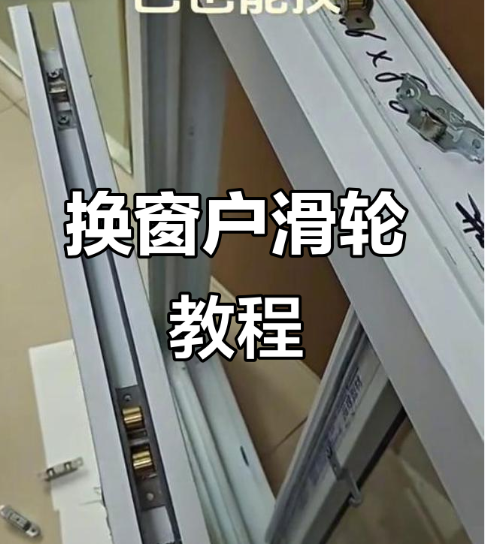
Seven, door and window pulley high-frequency failure, cause judgment
Fault 1: push-pull card, great resistance. Most of them are track sediment accumulation, wheel surface wear, bearing rust, fan adjustment is too low friction bottom frame.
Fault 2: There is harsh friction and abnormal sound in push-pull. The wheel surface material is metal, the track burr is deformed, the wheel is eccentric, and the bearing lacks lubrication.
Fault 3: One fan sinks, and one side is not tightly sealed after closing. Pulley wear, bracket deformation, and load-bearing selection are too small.
Fault 4: When pushing and pulling, the window sash swings left and right, which is easy to deviate. Lack of anti-drop buckle, or the pulley and track clearance is too large.
Fault 5: Sometimes good or bad, occasionally stuck. The screw is loose, the pulley is displaced, or the foreign object is stuck in the track.
Many owners directly lubricate the pulley with oil and butter, which is smooth in the short term, but the grease easily absorbs dust and sediment, forms sludge, and wears faster, which is a wrong maintenance method.
[Replacement and maintenance schematic diagram | Remove the fan, take out the old pulley, clean the track, install the new pulley, and re-level the steps]
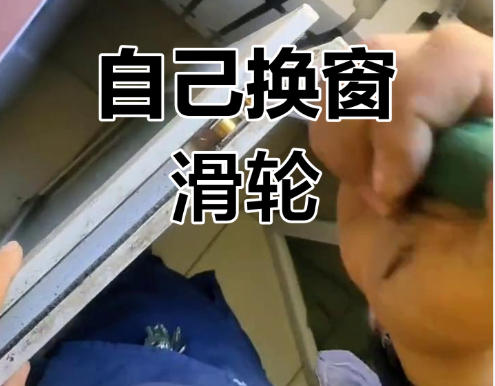
Eight, the actual operation points of pulley replacement
After the sliding door and window pulley is damaged, it should be replaced with the same type first, and the original track should be retained first. If the track deformation is serious, the track profile should be replaced synchronously.
Steps: First pull the push-pull fan to the middle, find the upper limit block, and remove the limit; two people cooperate, gently lift the fan body upward, and take it out from the bottom track; clean up the sediment and debris inside the track, and polish the track burr; remove the old pulley fixing screw at the bottom of the fan, and remove the damaged pulley; put in a new pulley of the same specification, and lock the fixing screw; re-hook the fan weight into the track and install it back into the limit block; repeatedly adjust the height to test the effect of push-pull, sealing, and anti-falling.
Note that the risk of disassembling the fan body of high-rise external windows and sliding windows is high. It is not recommended that the owner operate it by himself. Contact a professional door and window maintenance master to avoid the window sash falling from high altitude.
[Purchase comparison chart | Qualified 304 bracket POM pulley vs cheap plastic bushing, 201 thin bracket inferior pulley comparison]
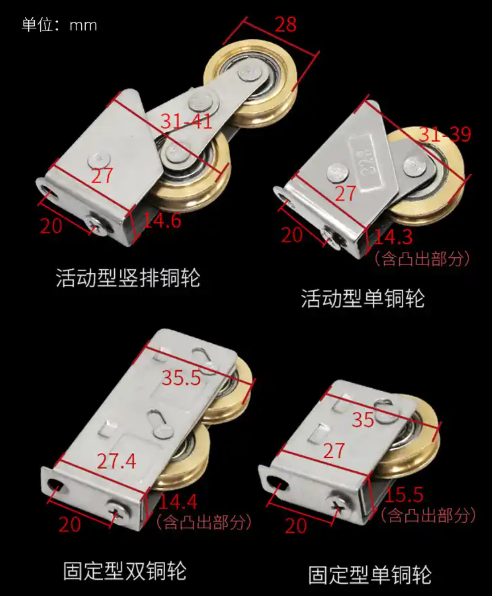
Nine, buy pit avoidance guide, avoid industry reduction routine
False standard load-bearing, the shell is marked with 80kg, the actual bracket is thin, the bearing is simple, and the rated load cannot be reached;
201 stainless steel, galvanized iron bracket as 304 stainless steel, wet environment rust deformation;
Plastic bushings replace ball bearings, which rotate dry and have a very short lifespan.
Ordinary nylon wheels pretend to be POM racing steel wheels, which age quickly and are prone to cracking and falling off;
Omit the anti-drop buckle, reduce costs, and pose potential safety hazards;
Regardless of windows and doors, light window pulleys are installed on heavy sliding doors;
Only look at the price, do not check the base size and wheel type, buy it back and the profile slot does not match, and it cannot be installed.
Purchase contract, parts list, try to mark clearly: bracket material, wheel surface material, bearing type, rated load-bearing, whether with anti-drop device.
[Maintenance diagram | Track cleaning, dust wiping, special dry lubricant maintenance]
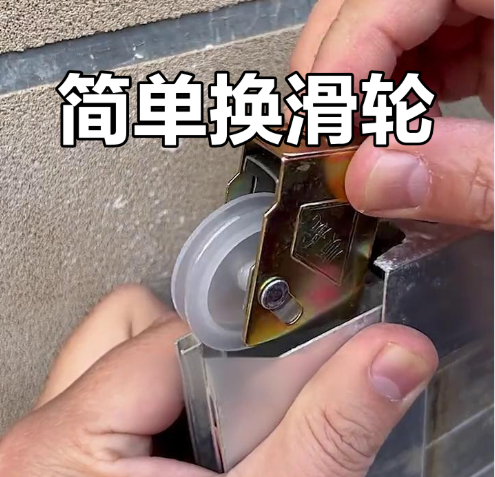
Daily maintenance to extend the service life of the pulley
Door and window pulleys are low-maintenance hardware, and proper maintenance can significantly increase their lifespan.
Regular cleaning: clean up the dust, sediment, and leaf debris in the bottom track every six months. Sediment is the largest source of wear for the pulley.
Lubrication selection: priority dry Teflon spray, silicon-based dry lubricant, do not use oil, butter;
Check settlement: observe whether the sliding fan sinks and whether the closing gap is uneven every year, and fine-tune the pulley height in time when sinking occurs;
In the long-term humid environment along the coast and balcony, 304 stainless steel bracket POM pulley is preferred to wipe the track regularly to reduce salt spray corrosion;
Avoid violent push-pull, do not push hard, do not hang heavy objects on the push-pull fan, and increase the pulley load to accelerate damage.
[Application diagram of the finished product | The installation of the supporting pulley for the broken bridge sliding window and the heavy lifting sliding door is completed]
conclusion
The door and window pulley is an inconspicuous but crucial door and window hardware. Whether a sliding door and window is easy to use, quiet and durable, the quality and matching of the pulley play a decisive role. Many door and window projects, home improvement cases, profiles and glass are selected with high-end configuration. Finally, because the pulley is equipped with cheap and low-matching models, it malfunctions in advance, affecting the entire door and window experience.
The adjustable double-wheel structure of POM steel wheel + 304 stainless steel bracket + stainless steel ball bearing is the best choice for the sliding window of the broken bridge at home; the large heavy-duty sliding door must be matched with the heavy-duty pulley of the multi-wheel group, and sufficient load-bearing allowance must be reserved. At the same time, the pulley is not an isolated accessory, but should be matched with the profile track, installed and debugged in a standardized manner, and regularly cleaned and maintained.
Understanding the material classification, load-bearing standards, and adaptation logic of the pulley, and not blindly pursuing low-cost accessories, can keep the sliding doors and windows smooth and silent for a long time, reduce the trouble of later maintenance and replacement, and ensure the safety and comfort of home use