

wrought iron fence
Wrought iron guardrail | Full analysis of material craftsmanship, style selection, installation standards and maintenance
First, the basic cognition of wrought iron guardrail: what is wrought iron guardrail
Comparison diagram of traditional wrought iron and modern wrought iron guardrails
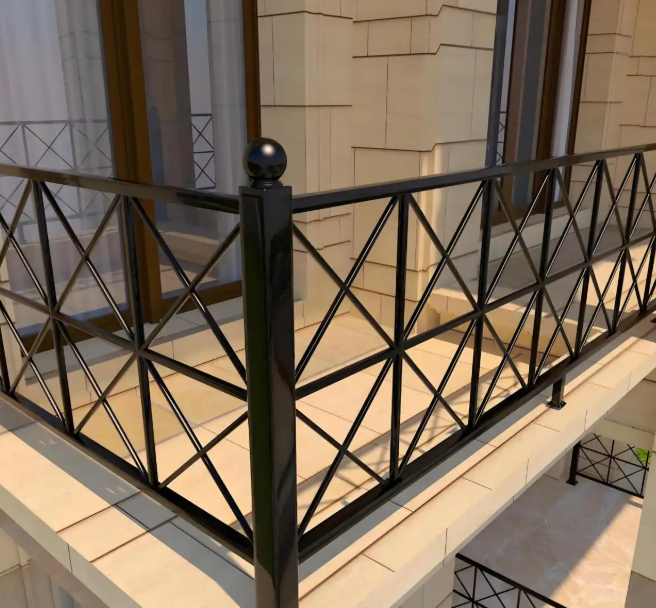
Iron fence, also known as iron fence, iron fence, is a low-carbon steel, wrought iron as the base material, after forging, bending, welding, grinding, anti-rust spraying and a series of processing metal fence products, is a long-standing category of guardrail. Unlike zinc steel guardrail, aluminum alloy guardrail, cement guardrail, iron fence is mainly hand-forged shape, retro art texture, taking into account the protection and isolation and decorative aesthetics, widely used in villa courtyard, community walls, balconies, gardens, scenic spots, gatehouses, factory isolation and other scenes.
Many people mistakenly think that wrought iron guardrail is simple iron pipe welding. In fact, modern iron art is divided into two branches: forging iron art and pipe iron art. Forging iron art belongs to traditional crafts, and complex patterns are formed through high temperature forging, twisting, curling grass, and carving, which has high artistic value. Pipe iron art adopts square pipe and round pipe splicing and welding, and the shape is simple and cost-effective. The core advantage of wrought iron guardrail is that it is extremely malleable, and the pattern style is not limited. European, new Chinese, American, and retro styles can be customized. It is a popular choice for owners who pursue a sense of courtyard atmosphere.
At the same time, wrought iron guardrail is a load-bearing protective component, not just an ornament, but must meet the safety specifications of protection height, impact resistance and stable structure. If you want wrought iron guardrail to not rust or deform for a long time, the selection of substrate, anti-rust treatment, welding process, and post-maintenance are all crucial, which is also the most important professional point to pay attention to when purchasing wrought iron guardrail.
Second, the classification and performance comparison of mainstream substrates for wrought iron guardrails
Close-up drawing of pipe section of wrought iron guardrail base material
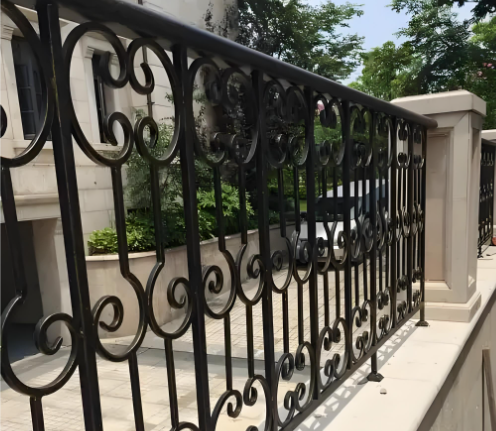
The substrate is the foundation for the durability of wrought iron guardrails. The commonly used raw materials for wrought iron guardrails on the market are divided into ordinary low-carbon black iron, Q235 wrought iron, and thickened seamless steel pipes. The cost, toughness, and rust resistance of different substrates vary widely.
First, Q235 low-carbon wrought iron. It is the preferred material for high-end wrought iron, with good ductility. It can twist, press, and forge various complex patterns at high temperatures. It has good toughness and is not easy to break directly due to external impact. It is suitable for European-style carved and curved garden guardrails and is also the most commonly used substrate for villa wrought iron. The disadvantage is that iron itself is easy to oxidize, and a full set of anti-rust treatment must be done.
Second, ordinary black iron pipes. Square tube and round tube welded wrought iron guardrails are the mainstream materials, with fast processing speed and affordable price. They are suitable for simple straight-line wrought iron fences. They are mostly used for factory and community walls. The style is simple and the mass production efficiency is high. Most of the low-priced wrought iron on the market uses thin-walled black iron pipes, which have insufficient wall thickness and weak impact resistance.
Third, thickened seamless steel pipe. Engineering-grade wrought iron guardrail material, pipe wall thickness, high impact strength, suitable for road isolation, factory walls, high protection requirements of the scene, not easy to deform, excellent load-bearing performance.
When purchasing, be sure to confirm the wall thickness of the pipe: the main frame of the domestic courtyard guardrail is generally recommended to have a wall thickness of ≥1.5mm, and the main frame of the high-protection fence is recommended to be ≥2.0mm. Balcony wrought iron guardrail has higher stress requirements, and the wall thickness of the column is not less than 2.0mm. Thin tube wrought iron looks similar in the short term. It is easy to bend and shake after two or three years of use, and the safety hazard is large.
Third, the core processing process of wrought iron guardrail
Production flow chart of forging, welding and grinding in wrought iron workshop
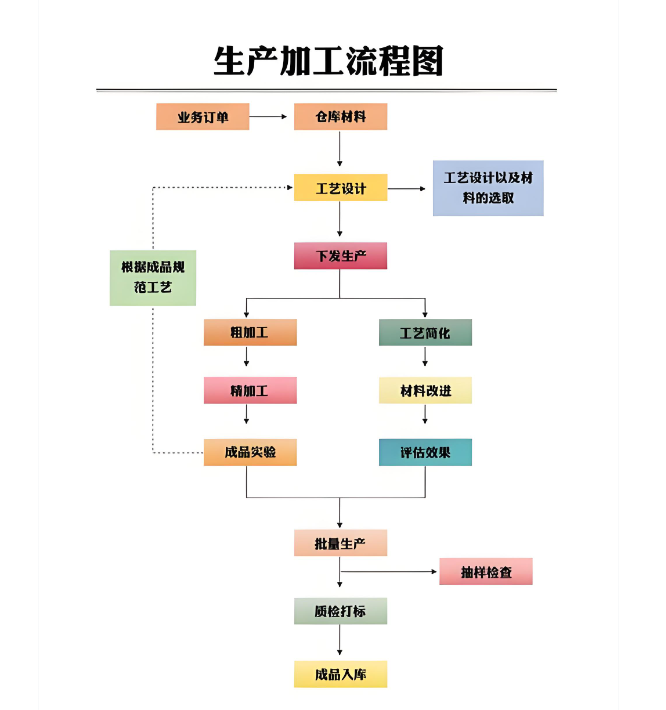
Wrought iron guardrail is a customized processing product. A set of qualified wrought iron needs to go through multiple processes. Process reduction is the hardest hit area for low-cost wrought iron to cut corners. Complete standardized processes are: drawing lofting, cutting, bending, forming, welding, assembling, welding, grinding, rust removal, acid cleaning, phosphating anti-rust primer, intermediate paint, spraying, topcoat, coloring, and protecting the finished quality inspection of the topcoat.
The first is lofting and blanking. According to the customer's size and style drawings, the pipe and iron are accurately cut to ensure that the size error is controlled within 3mm and avoid too large the on-site installation gap. The forging process is aimed at the engraved model, heating forging twist, leaf roll, spear tip and other shapes. Welding preferentially adopts the full welding process instead of spot welding. Spot welding is only surface connection, and the weld joint is very easy to crack and fall off after force.
After the welding is completed, the grinding process is very critical. The welding scars, burrs, and sharp edges and corners are all polished smoothly to prevent scratches. At the same time, the polishing is flat to ensure the adhesion of the paint. Pickling phosphating is the core pre-process of anti-rust, which removes rust and oil stains on the surface of steel. Many small manufacturers directly skip phosphating and spray paint after simply sanding. The paint has poor adhesion and will peel and rust in half a year to a year.
Primer, medium paint, topcoat, and topcoat are sprayed with four layers of protection. After each layer dries, the next layer is sprayed to form a complete protective film, which isolates air and water vapor from contacting the iron substrate and delays rust.
Fourth, detailed explanation of the anti-corrosion coating process on the surface of wrought iron guardrail
Comparison chart of wrought iron rust samples and complete spraying samples
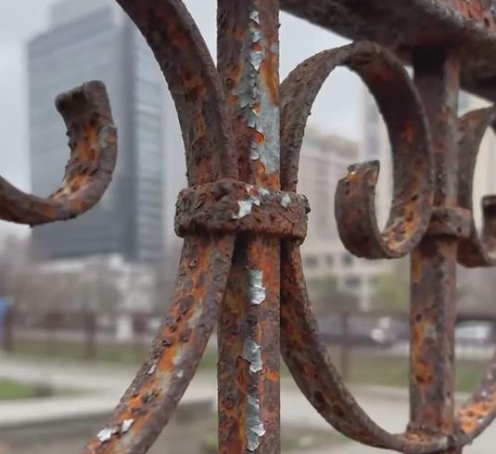
The biggest shortcoming of wrought iron is that it is easy to rust. Whether wrought iron is good or not, anti-rust coating is the decisive factor. At present, the mainstream of the industry is divided into three processes: electrostatic spraying, high-temperature baking paint, and traditional paint brushing.
The first is electrostatic powder spraying, which is also the mainstream preferred process. The powder is electrostatically adsorbed on the surface of the wrought iron and sent to a high-temperature oven for curing and forming. The coating thickness is uniform, the adhesion is strong, the rain resistance is initialized, the ultraviolet resistance is resistant, and it is not easy to fade and peel. It can be used outdoors for 8-12 years. The color selection is rich, and the sand pattern, smooth surface and matte can be done. The home courtyard is preferred to spray iron.
The second type is high-temperature fluorocarbon baking paint. High-end wrought iron is used, with stronger weather resistance, acid rain resistance and salt spray resistance. It is preferred in humid and rainy coastal areas, and the cost is high. It is suitable for high-end villas and seaside courtyards.
The third type is ordinary hand-painted paint. It belongs to the old process. The thickness of manual brushing is uneven, and it is easy to hang and fall off. Generally, it fades and rusts in two or three years. At present, only low-priced simple iron is used, and long-term outdoor use is not recommended.
In addition, many customers will ask: hot-dip galvanized iron. Hot-dip galvanizing is first dipped in zinc as a whole, and then polished and sprayed. The anti-rust level is the highest, and the salt spray test effect is the best. It is suitable for humid, rainy and seaside areas. If the budget is sufficient, the hot-dip galvanizing + spraying double-layer anti-rust solution is preferred.
Fifth, the mainstream style classification and applicable scenarios of wrought iron guardrails
European style, new Chinese style, simple wrought iron guardrail style renderings
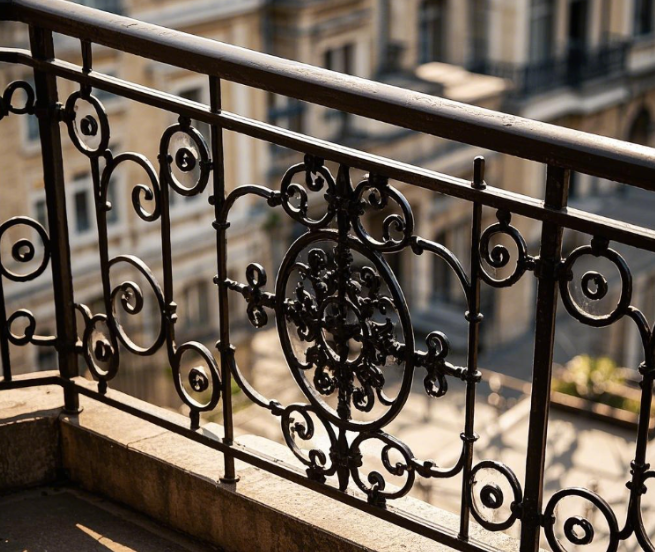
Wrought iron has strong plasticity and a wide range of styles. It can be divided into four main categories according to style, and different styles are suitable for different architectural styles.
1. European-style carved wrought iron guardrail: grass pattern, twist twist iron, spearhead, wreath carving, rich curves, gorgeous retro, suitable for European villas, French gardens, strong artistic atmosphere, high cost, mostly forging process.
2. New Chinese wrought iron guardrail: The lines are simple and neat, with national style elements such as paper patterns, auspicious clouds, landscapes, plum blossoms, etc., to weaken the complex carvings, taking into account modern simplicity and Chinese charm. New Chinese self-built houses and Chinese gardens are very suitable.
3. Simple straight-line wrought iron guardrail: square tube round tube splicing, vertical rod and crossbar, almost no complex carving, clean and generous shape, high cost performance, community walls, factory isolation, farm yards are the most used, strong and durable, and the price is close to the people.
4. Artistic custom wrought iron guardrail: special-shaped shape, landscape wrought iron, used in scenic spots, homestays, and gardens. It can be forged separately according to the designer's drawings, with a high degree of personalization.
At the same time, according to the installation location, it is divided into: wrought iron guardrail for walls, wrought iron guardrail for balconies, wrought iron handrails for stairs, fence for low flower pools in gardens, and wrought iron for gates. Balcony wrought iron guardrail has mandatory safety regulations, and the net spacing of vertical rods cannot be greater than 11cm to prevent children from getting stuck in their heads. The height of the low-rise balcony guardrail is not less than 1.05 meters, and the height of the high-rise balcony guardrail is not less than
Six, iron fence installation specifications, safety standards
Iron fence column embedded, concrete fixed construction map
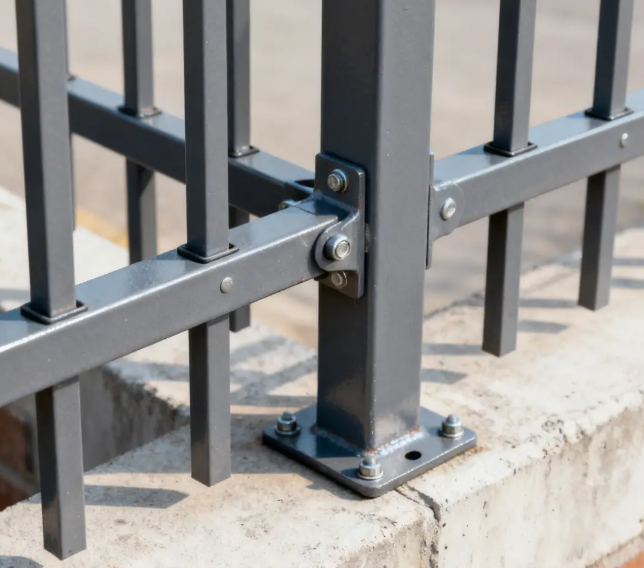
The three-point product is installed in seven points. The wrought iron guardrail is not installed in place, and the column is loose and inclined. No matter how high-quality wrought iron is, it cannot play a protective role.
There are two conventional fixing methods for wrought iron columns of walls: civil pre-embedding and flange baseplate expansion screw fixing. Pre-embedding is the priority plan. The column is buried 30-50cm underground, and the poured concrete is solidified. It has strong impact resistance and is suitable for courtyard walls. Flange expansion screws are suitable for hardened cement floors, and the construction speed is fast, but they are suitable for hardened floors with sufficient ground thickness.
The installation focuses on several standards: the vertical deviation of the column is controlled within 3 feet, and the crossbar is horizontally aligned; all splicing gaps are uniform; the ground drop position is treated in a step-by-step manner to avoid forced pulling and deformation; the welding port and the cutting damage position must be repainted after the installation is completed, and the protective layer must be repaired. Many construction teams will omit this step, and the incision position will rust first.
The balcony wrought iron guardrail is strictly prohibited from being directly fixed on the thermal insulation layer. It must penetrate the thermal insulation layer and be fixed to the solid wall, otherwise it will easily fall off if shaken vigorously, and there is a serious safety risk. After completion, a shaking test is required, and the overall stability is not shaken to be qualified.
Horizontal comparison of wrought iron guardrail and zinc steel and aluminum alloy guardrail
Comparison chart of wrought iron, zinc steel and aluminum alloy guardrails
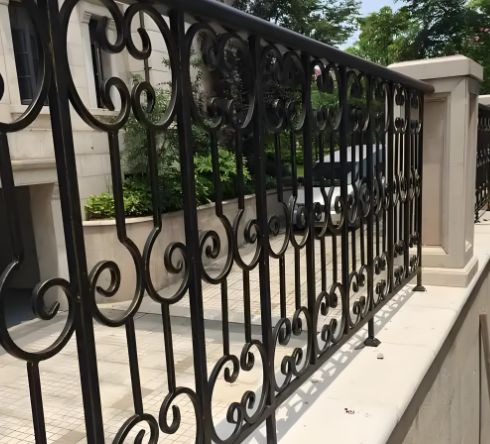
Many customers torn garden guardrail choose wrought iron or zinc steel, aluminum alloy, the three have their own advantages and disadvantages, convenient for everyone to choose.
Wrought iron guardrail: the advantage is that the shape is rich, the artistic sense of carving is strong, and the retro effect is irreplaceable; the short board is that the weight is too large, the anti-rust requirements are high, and regular maintenance is required. The price of the same specification is higher than that of ordinary zinc steel.
Zinc steel guardrail: pipe assembly type, welding-free, rust-proof and stable, moderate price, most of the styles are standardized, few carving shapes, relatively simple styles, not easy to make complex artistic shapes.
Aluminum alloy guardrail: non-rusting, light weight, maintenance-free, long service life; the disadvantage is poor ductility, difficult to forge complex twisted flowers, curly grass shapes, weak artistic expression, high-end customized styles are very expensive.
Simple summary: value the shape, retro carving, garden appearance, and choose wrought iron with a sufficient budget; pursue worry-free maintenance, simple wall isolation, and give priority to zinc steel or aluminum alloy.
Eight, wrought iron fence daily maintenance, rust removal maintenance skills
Schematic diagram of cleaning and rust removal maintenance of wrought iron guardrail
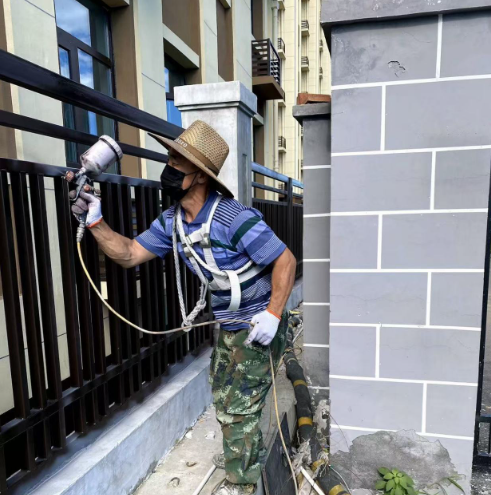
Even if it is a double-layer anti-rust process wrought iron guardrail, outdoor wind blows all year round, sun and rain, regular maintenance can greatly extend the service life.
First, clean regularly. Wipe the surface dust and moss with a soft cloth and water, do not use a steel wire ball to brush hard, it is easy to scratch the spray protective layer; oil stains can be wiped with neutral detergent.
Second, regular inspection. Comprehensive inspection every spring and autumn to check whether the paint surface is damaged by bumps, paint peeling, or iron exposure. Once the substrate is exposed, the water vapor will quickly rust inward. Small damage can be repaired in time to prevent rust spots from expanding.
Third, rust spot treatment. Slight rust, polished clean, spray anti-rust primer first, and then spray the same color topcoat after drying; a large area of serious rust needs to be polished, rust removed and re-sprayed.
Fourth, avoid corrosion sources. Garden wrought iron should not be close to sprinklers, septic tanks, and saline soils for a long time. It is recommended to do protective maintenance every two years for the seaside environment.
Reminder: Do not wait for a large area of rust to rot before dealing with it. Iron rust continues to spread. A small rust spot will spread to a large area in half a year.
Nine, wrought iron fence purchase pit avoidance guide
Inferior thin-walled wrought iron, cutting corners for details
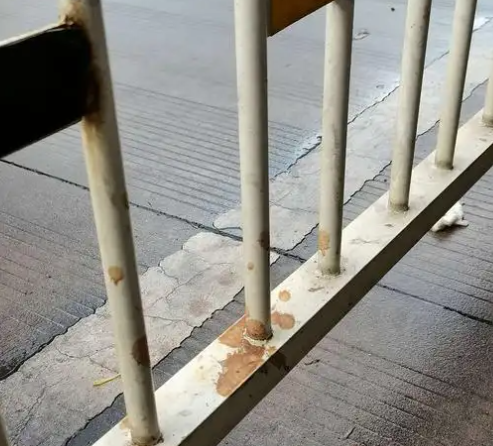
The wrought iron industry has many routines, and many merchants attract customers at low prices, mainly by stealing these places.
1. Pipe wall thickness virtual label: marked 2.0mm, actually only 1.0mm thin-walled tube, weighing comparison is easy to distinguish, the same style, the more wrought iron weight, the more solid the material.
2. Skip pickling and phosphating, just simply polish and spray paint, it looks good in the short term, and soon peels and rusts.
3. Spot welding replaces full welding, the weld joint is virtually welded, and it breaks under force.
4. Only the bare price is quoted, excluding transportation, installation, pre-embedded concrete, and paint replenishment costs. Later, the price will continue to increase.
5. Processed with recycled miscellaneous iron, there are many impurities, the material is brittle, and it is easy to break when hit.
Before placing an order, it is recommended to state in the contract the substrate material, pipe wall thickness, anti-rust process (whether hot-dip galvanizing, spraying/painting), welding method, quality assurance period, keep samples for comparison, and check the materials received.
Full text summary
Panoramic renderings of the completion of the courtyard wrought iron guardrail
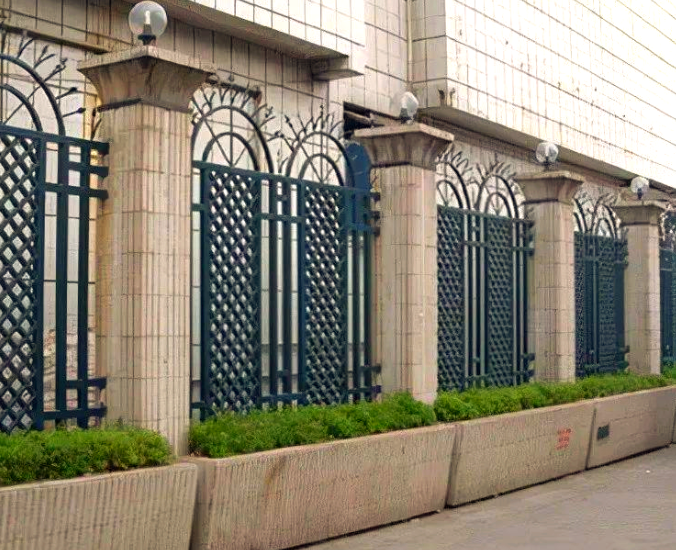
As a classic metal guardrail category, wrought iron guardrail has always been a popular choice for villa courtyards and retro gardens with its unique artistic expression of forging. From Q235 wrought iron substrate, blanking forging and welding, to pickling phosphating, multi-layer anti-corrosion spraying, to standardized pre-embedded installation, the whole process has strict process standards.
Its core shortcoming is that the iron substrate is prone to oxidation and rust, so the anti-rust scheme, pipe thickness, and welding quality are the three cores for selecting wrought iron guardrails. Compared with zinc steel and aluminum alloy guardrails, wrought iron is better in shape plasticity and retro aesthetic effect, suitable for owners who pursue garden characteristics and artistic atmosphere; but need to accept the cost of regular maintenance.
Select a regular wrought iron manufacturer, reject low-priced products with thin-wall spot welding and omit anti-rust processes, and cooperate with standardized installation and regular maintenance. A set of wrought iron guardrails can be used stably for more than ten years, taking into account protection safety and garden decoration effects.