

Railway fence
Railway Fence Professional Detailed Explanation | Specifications, Standards, Materials, Construction, Selection and Acceptance Guidelines
First, what is a railway fence, its core function and scope of application?
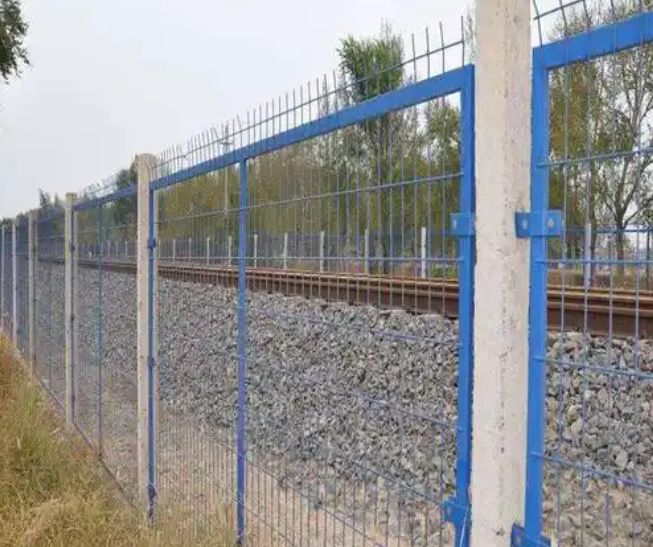
Railway fence, also known as railway isolation fence, railway protection net, and railway protection fence, is a very important security isolation product in the railway security system. It belongs to traffic security infrastructure and is mainly installed on both sides of high-speed railway lines and regular-speed railway lines. It plays the role of isolation protection, anti-intrusion, and anti-overturning.
Railway lines belong to closed control areas. Once pedestrians, livestock, and vehicles break into the tracks, it is easy to cause major safety accidents such as emergency braking and derailment of trains. The primary goal of railway guardrails is to establish physical isolation barriers to prevent people and animals from entering the railway boundaries, ensure the safety of train operation, and protect the personal safety of people along the line.
According to the usage scenarios, it is mainly divided into two categories: regular-speed railway guardrail network and high-speed railway guardrail network. The technical standards, mesh specifications, and column strength requirements of the two are completely different. In addition to the main isolation on both sides of the line, different styles of railway guardrail network will also be used around some crossings, bridge sections, subgrade slopes, and station yards.
Many customers are prone to confuse highway guardrails with railway guardrails, and the two cannot be used in common. Railway guardrails have higher requirements for impact resistance, climbing resistance, and damage prevention, and are subject to special railway industry regulations. They are not simply replaced by ordinary guardrails.
Second, the current national standards and industry norms for railway fence networks
Schematic diagram of railway fence test sample and standard document
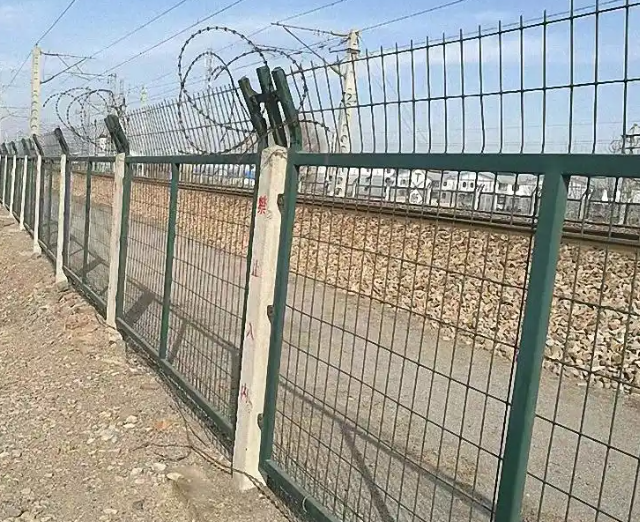
Railway fence production and acceptance cannot be customized at will, and must follow the relevant technical specifications of the railway industry. The core reference is TB/T 3129 "Railway Line Protective Fence" and other industry standards. High-speed railway protective fences also have special matching requirements for high-speed railway design.
The standard clearly stipulates the material, wire diameter, mesh, external size, anti-corrosion age, anti-climbing performance, column burial depth, connector strength and other hard indicators of the product. For example, the guardrail net of the high-speed rail section has strict requirements for anti-climbing performance, and some sections need to be equipped with anti-climbing thorns; roadbed sections, bridge sections, tunnel openings, and standard parameters are also distinguished.
The specification also makes mandatory requirements for the anti-corrosion layer of the product. Most of the railways are in an open-air environment in the wild, with wind and rain, large temperature difference between day and night, and some areas are close to saline-alkali land and humid areas. If the anti-corrosion process is not up to standard, it will rust and break in just two or three years and lose its protective ability. Regular railway guardrail net anti-corrosion layer needs to meet the specified salt spray test time to ensure long-term use.
For bidding projects and railway renovation projects, Party A will clearly mark the execution standards. When purchasing, we must check whether the parameters meet the railway specifications. Non-standard products cannot pass the supervision and acceptance, resulting in rework losses.
III. Mainstream classification and style characteristics of railway fence
Comparison chart of several mainstream railway fence styles
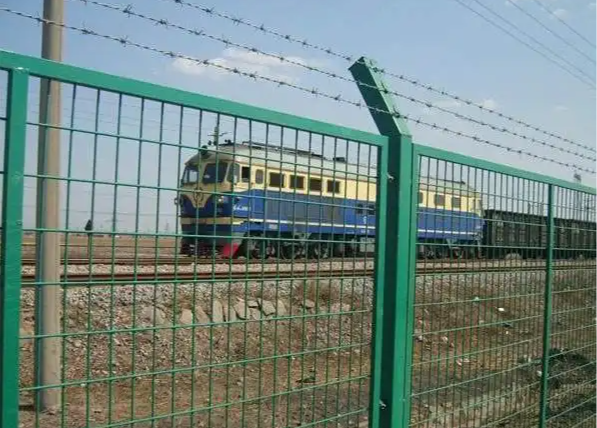
According to the structural style of railway fence, the mainstream is divided into frame railway fence, bilateral wire railway fence, blade barbed wire fence, steel plate railway protective fence, reinforced concrete protective fence with metal mesh, etc.
Frame railway guardrail is currently the most used style in railway projects. The mesh is welded inside the rectangular frame, which has strong overall rigidity, is not easy to deform, has good impact resistance, is easy to disassemble and maintain, and is widely used in the subgrade section along the high-speed rail. Bilateral wire guardrail net has low cost and is mostly used for isolation of branch railways and secondary stations, and the protection level is lower than that of the frame net.
The blade barbed wire guardrail net is generally matched in key sections and complex public security sections. The blade barbed rope is installed on the top of the guardrail net, which has a strong deterrent effect and the highest anti-overturning level. The steel plate guardrail net is made of steel plate stamping and stretching, which has good integrity and is not easy to be cut by humans. It is suitable for sections with strict public security control.
There are also reinforced concrete fences. The columns and frames are precast concrete parts, with metal mesh, which has the advantages of low cost and anti-theft. The disadvantage is that the weight is large, and the transportation and installation are inconvenient. Now more new high-speed rail projects use all-metal frame guardrails. The selection of different road sections needs to be comprehensively determined according to the security level, geological conditions and budget.
IV. Material selection and anticorrosion process of railway fence
Detailed drawing of section of hot-dip galvanized and immersed layer of guardrail mesh
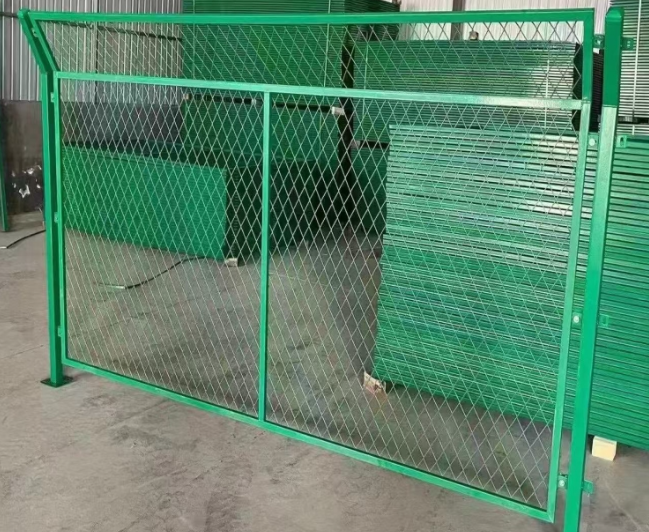
The main raw material of railway guardrail is generally Q235 low-carbon steel wire, which has good toughness and stable welding performance. It is the mainstream substrate of railway guardrail. Inferior products will use recycled miscellaneous steel, which is brittle and easy to break after impact, and has high safety hazards.
Anti-corrosion is the core of railway guardrail network. At present, the mainstream mature process is hot-dip galvanizing first, and then soaking (PE soaking), that is, double anti-corrosion treatment. The first step is hot-dip galvanizing, the steel wire or frame is immersed in zinc liquid as a whole, and the zinc layer and steel form a metallurgical combination to isolate the steel from air and water vapor contact; the second step is surface soaking, wrapping a layer of polyethylene plastic layer to further resist ultraviolet rays and acid rain corrosion, while making the surface smooth and increasing the anti-climbing effect.
There are also some low-priced products that only do simple spraying and cold galvanizing, and the anti-corrosion life is very short. Cold galvanizing generally starts to rust in 1-3 years, while qualified hot-dip galvanizing + immersion products can reach 8-15 years of service life in normal field environments. Coastal saline and alkali areas, rainy and humid road sections, you can also add thicker zinc layers and thicker plastic layers to customize high-corrosion versions.
When selecting, it is important to distinguish between hot-dip galvanizing, cold galvanizing, spraying, and dipping. The cost and service life of the four processes vary widely, and it is also a place where many suppliers steal materials at low prices.
V. Interpretation of key technical parameters of railway fence
Railway fence size marking drawings
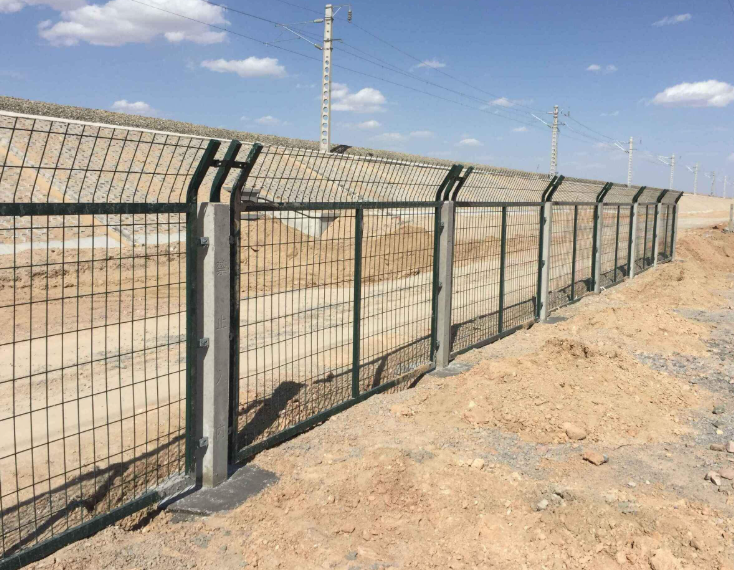
Many novice purchasers do not understand the parameters. Here are the core indicators of the railway fence: wire diameter, mesh, external height, frame square tube specifications, column specifications, and mesh size.
The height of the conventional subgrade high-speed rail fence is mostly 1.8m and 2.0m; the wire diameter is commonly used 4.0mm, 4.5mm, 5.0mm; the mesh is commonly used in 75150mm and 80160mm, and the mesh should not be too large to prevent children and small animals from passing through; the frame pipe is commonly used in 2030mm and 3050mm rectangular pipes, and the column is made of 48 round pipes or 5050 square pipes.
The size of the mesh is mostly 1.8m3m and 2m3m, which is convenient for standardized mass production and transportation. Connectors include anti-theft bolts and clamps. Railway guardrail nets must be equipped with anti-theft bolts to prevent human disassembly and theft. Ordinary open bolts are not allowed to be used on main railway.
All parameters are not fixed. Bridges, tunnel entrances, stations, branch railways, and drawings will adjust the height and silk diameter separately. The formal project is subject to the technical requirements of construction drawings and invite tenders documents. If the parameters are not up to standard, the supervisor has the right to reject the goods.
Six, railway fence installation construction points and construction process
On-site column embedding, mesh installation construction map
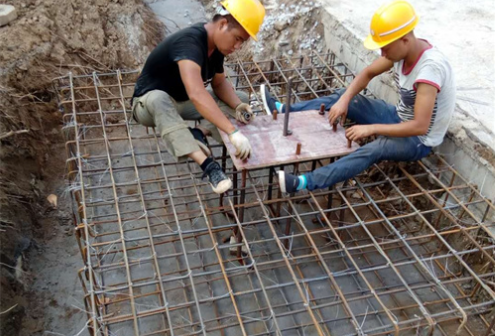
Railway fence construction, must first be familiar with the railway boundary red line, in strict accordance with the boundary of the lofting, can not invade the railway boundary, can not reserve too large gap. Standard construction process: measurement lofting pit excavation column pre-embedded/flange fixed pouring concrete maintenance mesh assembly fixed straightening correction finishing cleaning.
The installation of the column is divided into two ways: pre-embedded and flange fixed. The soil roadbed is preferentially pre-embedded, the depth of the column buried in the ground should be up to standard, and the concrete foundation should be poured to ensure the anti-pull and anti-dump capabilities; the position of the hardened bridge deck and concrete platform should be fixed with flange expansion screws.
When installing, it is necessary to ensure that the guardrail net of the whole line is straight, the height is consistent, the mesh is tight, there is no obvious skew, and the adjacent mesh gaps are controlled within the standard range. Tighten all the bolts, and the anti-theft nuts should be anti-loosening; for the section with thorns installed on the top, the thorns should be tightened and fixed firmly, leaving no stepping fulcrum.
The construction time needs to be coordinated with the railway skylight point operation, and the business line railway cannot be built at will. It is necessary to declare the skylight plan, work under the supervision of protective personnel, and abide by the safety management regulations of railway business line construction. This is the biggest difference between railway guardrail construction and ordinary highway guardrail construction.
Seven, railway fence network common diseases, post-maintenance plan
Repair site diagram of rusted, deformed and damaged guardrail net
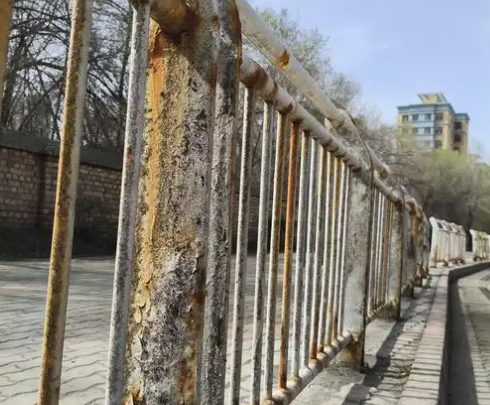
Long-term use in the field, railway fence will have several common problems: man-made damage to cut the mesh, vehicle impact deformation, cracking of the plastic layer, corrosion of the galvanized layer, settlement and tilt of the column foundation, and loss of anti-theft bolts.
The daily inspection is the normal work of the railway work section. Regularly check along the line and find that the damage and opening should be repaired and closed in time. Once there is a gap, it is a potential safety hazard. If the plastic skin is slightly cracked, special refinish paint can be applied; if the mesh is deformed in a large area and the steel is seriously rusted, the entire mesh can be replaced directly.
Key sections: near villages and towns, grazing areas, and around crossings, the probability of man-made damage is higher, and the frequency of inspections needs to be improved. In winter frozen soil areas, the foundation is prone to frost heaving and tilting. After spring, focus on re-measuring the verticality of the columns to strengthen the foundation in time.
Maintenance accessories are recommended to stock up in advance, anti-theft bolts, clamps, and small pieces to replenish the net, which is convenient for quick repair and shortens the vacancy time of line security.
Eight, railway fence procurement pit avoidance guide and selection suggestions
Sample comparison: comparison chart of qualified samples and cut corners samples
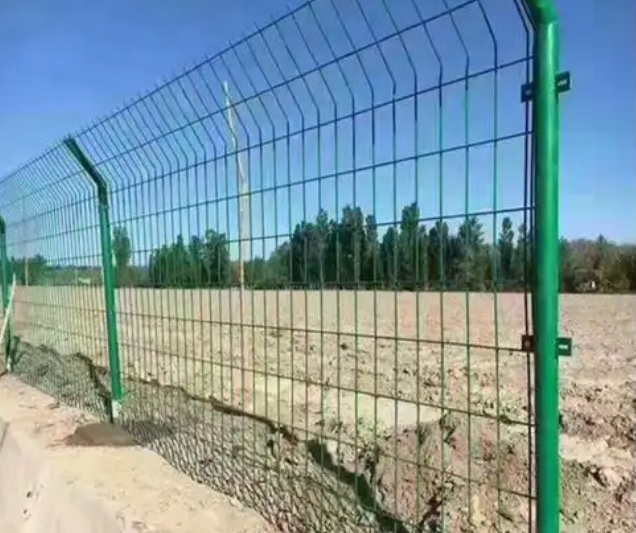
Purchasing railway guardrails is easy to step on the low-price trap. Many businesses use cold galvanizing instead of hot galvanizing, with filament diameters posing as thick wire and thin plastic layers posing as thicker dipping. They will rust in a short period of time after arrival, and the project acceptance will fail.
First, give priority to confirming the execution standards, and require the manufacturer to provide test reports and salt spray test reports; second, the contract states the wire diameter, pipe wall thickness, zinc layer thickness, plastic layer thickness, and agrees on the sampling method to support on-site weighing and caliper measurement; third, the business line high-speed rail project should try to choose a factory with railway supply performance and be familiar with the supervision and acceptance requirements.
If it is a branch line, factory railway, freight yard internal isolation, the budget is limited, you can choose a lower specification; high-speed rail main line, passenger dedicated line, priority high with hot-dip galvanized impregnated frame fence, safety level first.
At the same time, it is necessary to consider transportation. Most railway lines are remote, and mesh is a large cargo. Loading needs to be firmly packed to prevent bumping and scratching the plastic layer during transportation, resulting in appearance defects.
Nine, summary: the value of railway fence in railway safety system
Clean finished railway fence finished panorama
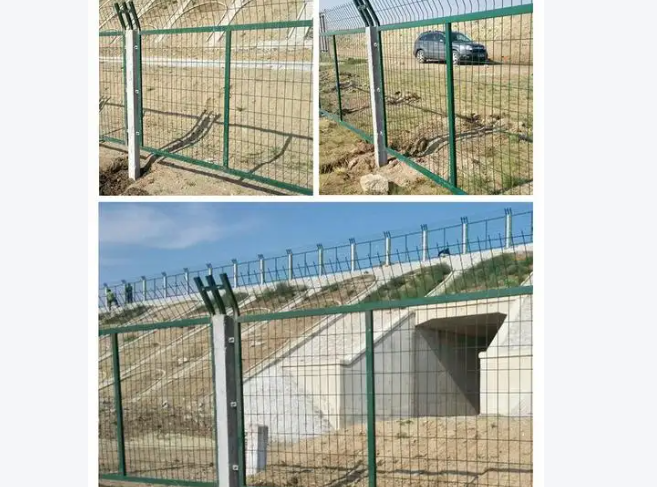
The railway fence looks like a simple wire mesh, but it is actually an indispensable part of the railway safety protection system. It relies on standardized structure, reliable anti-corrosion, and standardized construction to isolate the line for a long time, blocking the risk of foreign intrusion, and reducing the probability of train accidents.
From standards, materials, styles, parameters, construction to operation and maintenance, every step has strict industry requirements, and cannot be procured and constructed according to the general civilian guardrail concept.
As the source manufacturer of guardrail nets, we can produce various types of railway protective fences, guardrail nets, and blade barbed wire supporting products according to the TB/T 3129 standard. We support drawing customization, inspection cooperation, and project batch supply. We provide products, technology docking, and program suggestions in one stop, and serve various projects such as general-speed railways, high-speed rail reconstruction and expansion, and station isolation.